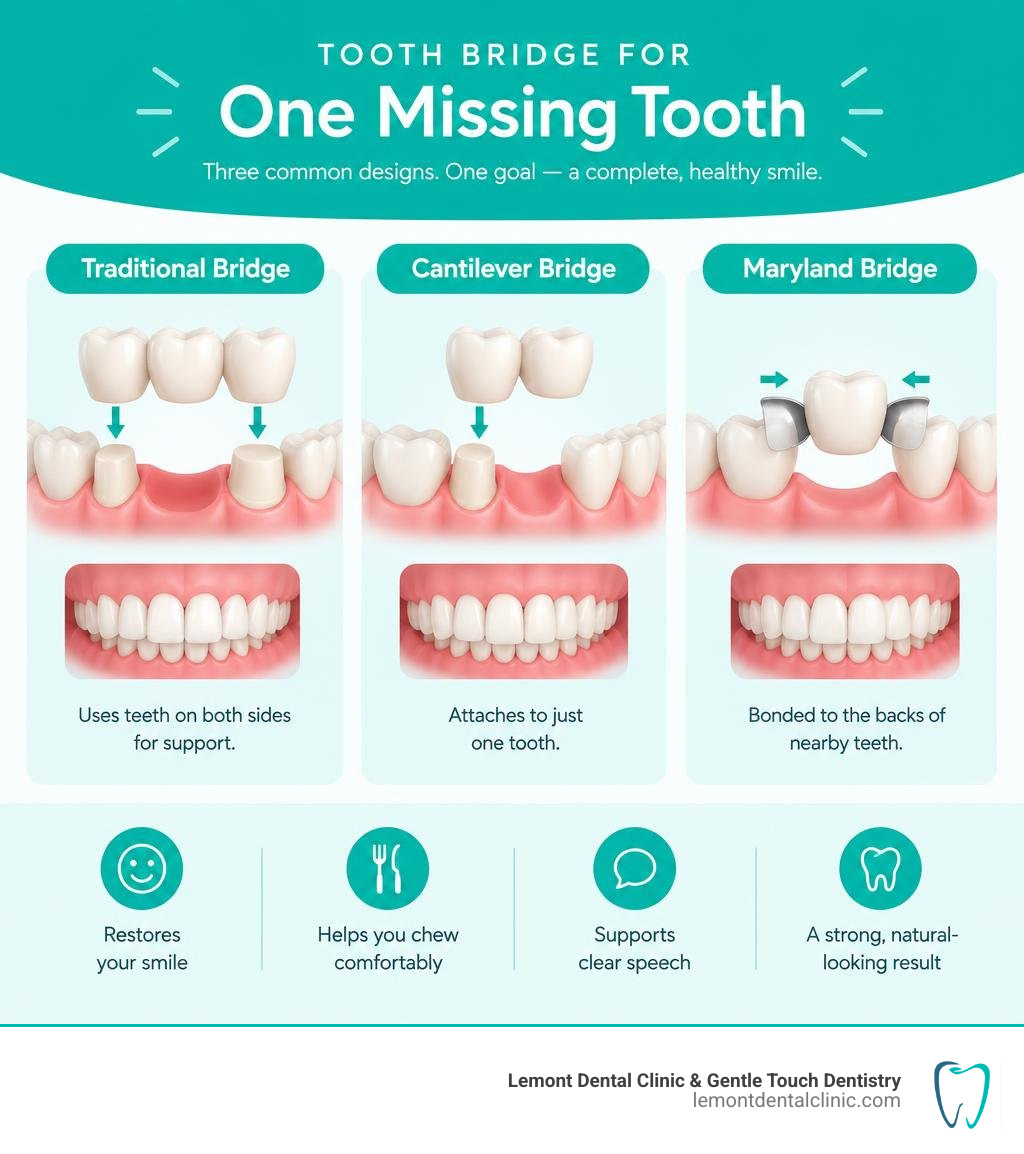
Yes. A tooth bridge for one tooth fills the gap with an artificial tooth held in place by nearby teeth. A traditional bridge uses teeth on both sides for support. Other designs may attach to just one tooth or bond to the backs of nearby teeth. The right choice depends on where the gap is, the health of the supporting teeth, and how much force the bridge must handle.
A bridge can restore your smile and help you chew and speak comfortably. This guide explains the options, costs, treatment steps, and care needed to help a bridge last.
Understanding Options for a Tooth Bridge for One Tooth
When a single tooth is lost to decay, injury, or wear, the surrounding dental architecture begins to change almost immediately. The teeth adjacent to the space drift inward, opposing teeth super-erupt into the void, and your overall bite balance destabilizes. Choosing a tooth bridge for one tooth prevents these structural shifts while returning natural chewing efficiency and aesthetic balance to your smile.
Before recommending a fixed prosthetic, we evaluate several clinical markers:
Periodontal Health: Supporting gums and alveolar bone must be free of active infection.
Masticatory Bite Forces: The bite pressures delivered in that specific region of your jaw dictate what materials we use.
Neighboring Tooth Structure: The condition of adjacent enamel and pulp health determines whether crowning them makes clinical sense.
Arch Alignment: Proper spacing ensures the replacement pontic mimics a natural tooth without crowding adjacent roots.
What Is a Tooth Bridge for One Tooth and How Does It Work?
A dental bridge replaces a missing tooth by anchoring an artificial tooth (known as a pontic) to natural teeth or dental implants on either side (known as abutments). In restorative dentistry, we often construct these units using custom crowns and bridges to permanently seal and protect the foundation teeth.
The structural engineering of a fixed bridge relies on classic prosthodontic guidelines, specifically Ante’s Law. This principle states that the total root surface area of the abutment teeth embedded in healthy bone must equal or exceed the root surface area of the tooth being replaced. For instance, a missing molar carries a root surface area of roughly 470 square millimeters, while a premolar averages about 155 square millimeters. By honoring these biological limits, we ensure that regular chewing loads are distributed safely across your jaw without overstressing any single tooth.
Who Is an Ideal Candidate for Single-Tooth Replacement?
Not every missing tooth case is identical. An ideal candidate for a single-tooth bridge generally presents with:
Strong Abutment Teeth: Natural teeth next to the gap that have adequate enamel, healthy pulp chambers, and stable roots.
Pre-existing Restorations: If neighboring teeth already have large fillings or existing damage, placing bridge crowns on them actually strengthens their overall integrity.
Non-Surgical Preference: Patients who prefer to avoid surgical procedures, bone grafting, or the 3- to 6-month healing window required for dental implants.
Stable Systemic Health: Those looking for a reliable, fixed alternative that can be placed quickly and safely without medical contraindications.
Types and Clinical Designs for Single-Tooth Bridges
Modern prosthodontics gives us multiple approaches to restore a single gap. Selecting the ideal framework depends entirely on where the missing tooth was located and the functional stress placed on that area.
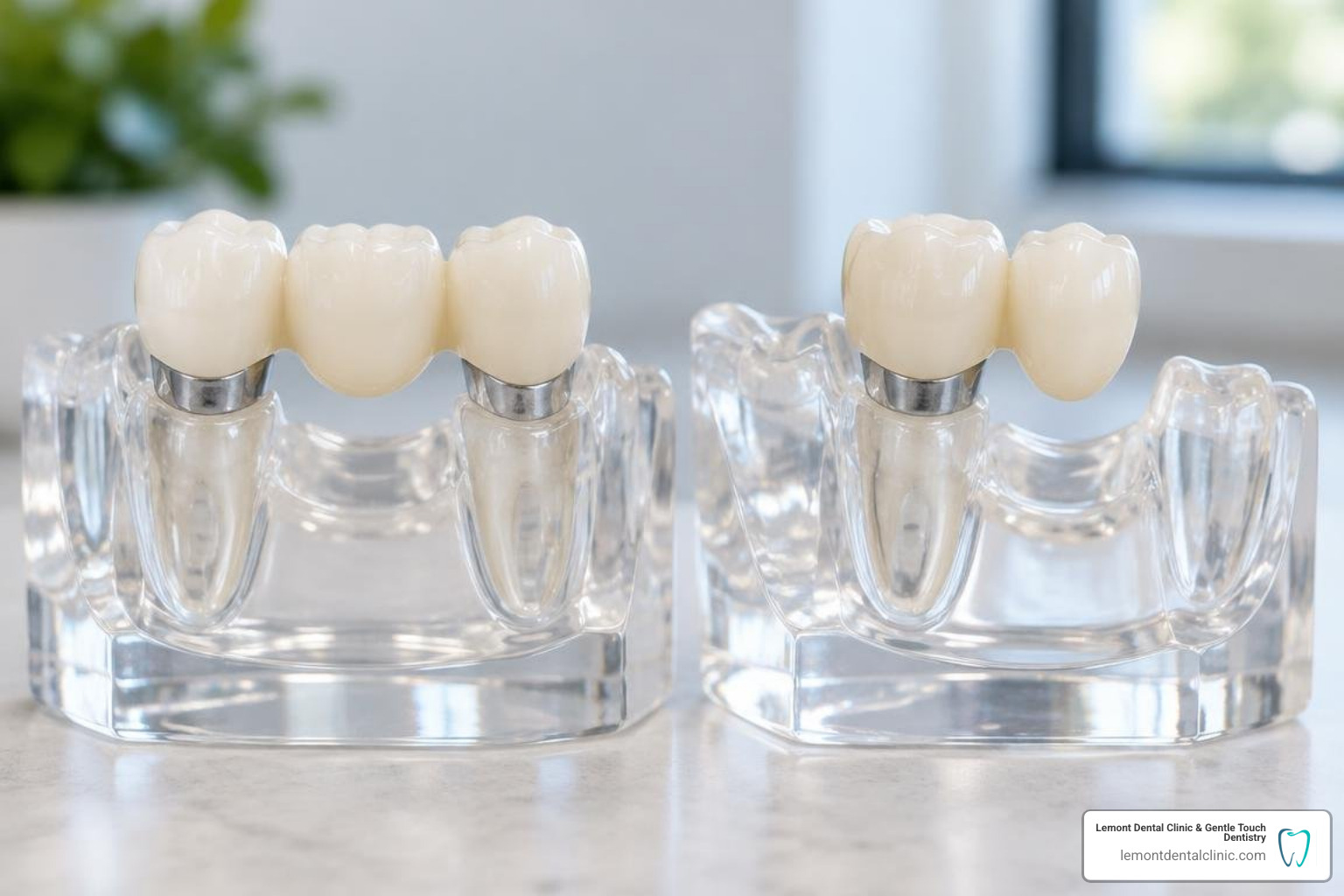
A traditional bridge is the gold standard for replacing a single missing back tooth (such as a premolar or molar). This restoration consists of three fused units: two full crowns placed over the reshaped abutment teeth, with the artificial pontic suspended securely between them.
To handle strong chewing forces, these restorations require precise connector dimensions. Metal frameworks require minimum cross-sectional connector areas of 16 square millimeters for posterior spans and 12 square millimeters for anterior spans, while all-ceramic designs require even more robust connectors.
Modern material options include:
High-Strength Zirconia: Boasting flexural strengths between 900 and 1,200 MPa, solid zirconia provides exceptional fracture resistance for posterior teeth.
Lithium Disilicate (E-Max): Offering flexural strengths around 350 to 400 MPa, this all-ceramic material delivers unmatched lifelike translucency, making it an exceptional choice for front teeth.
Porcelain-Fused-to-Metal (PFM): A reliable, time-tested framework that combines a cast metal sub-structure with an aesthetic porcelain overlay.
Cantilever and Maryland Resin-Bonded Bridges
When a standard three-unit bridge is overly aggressive or anatomical limitations exist, alternative designs provide conservative options:
Cantilever Bridges: A cantilever bridge anchors the pontic to an abutment tooth on only one side of the gap. While rarely used on heavy-load back molars due to leverage forces, single-retainer zirconia cantilever bridges are remarkably effective for replacing missing front incisors. In fact, long-term clinical research demonstrates a 15-year survival rate of 97.3% for single-retainer zirconia cantilever bridges in anterior applications.
Maryland Resin-Bonded Bridges: Designed primarily for missing front teeth, a Maryland bridge uses small composite or metal “wings” bonded to the back surfaces of neighboring teeth. Because this method requires minimal enamel alteration, it preserves natural tooth structure, though it is not designed to withstand heavy chewing loads.
The Treatment Process, Recovery, and Long-Term Maintenance
Receiving a custom single-tooth bridge is a precise, straightforward process completed across two main appointments.
Step 1: Examination, Preparation, and Impressions
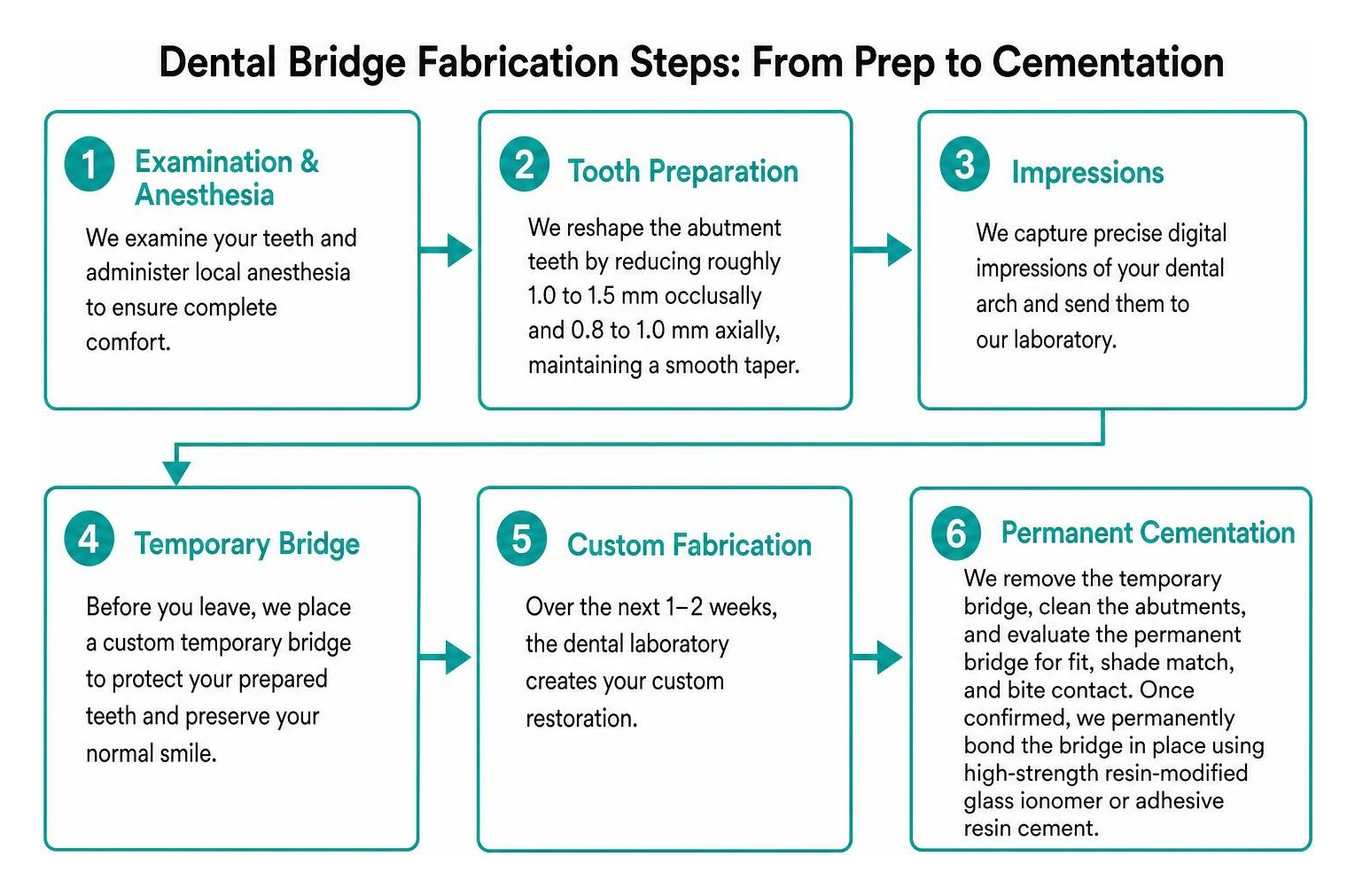
During your first visit, we administer local anesthesia to ensure complete comfort. We carefully reshape the abutment teeth by reducing roughly 1.0 to 1.5 millimeters of occlusal surface and 0.8 to 1.0 millimeter axially, maintaining a smooth taper to receive the custom crowns. We capture precise digital impressions of your dental arch and send them to our laboratory. Before you leave, we place a custom temporary bridge to protect your prepared teeth and preserve your normal smile.
Step 2: Custom Fabrication and Permanent Cementation
Over the next one to two weeks, the dental laboratory creates your custom restoration. At your second appointment, we remove the temporary bridge, clean the abutments, and evaluate the permanent bridge for fit, shade match, and bite contact. Once confirmed, we permanently bond the bridge in place using high-strength resin-modified glass ionomer or adhesive resin cement.
Daily Maintenance and Care Plan
A fixed bridge cannot get cavities itself, but the natural teeth supporting it can still develop decay at the margins. Follow these essential habits to ensure long-term success:
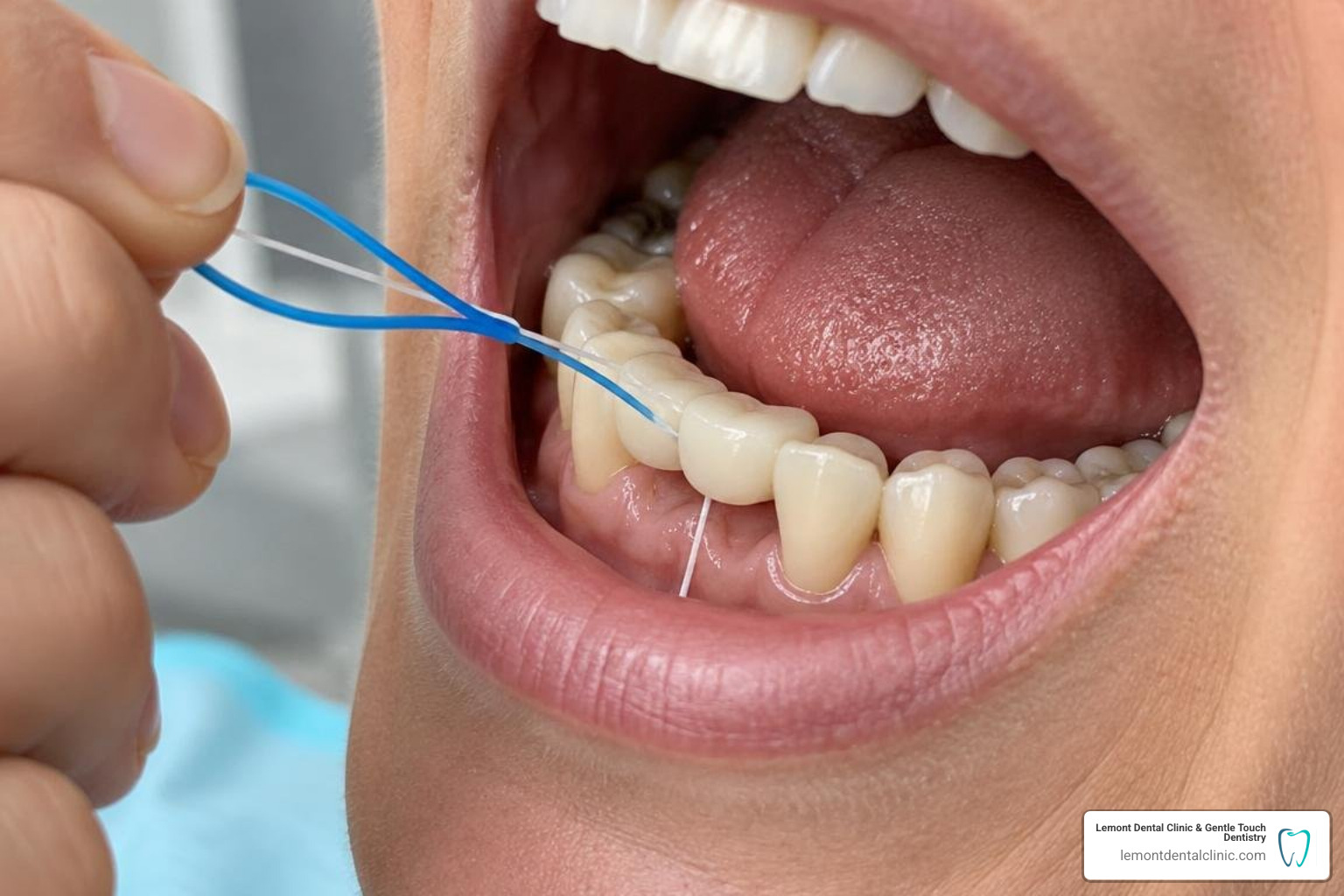
Clean Under the Pontic Daily: Use bridge threaders, superfloss, or dedicated interdental brushes to clear plaque and food debris from beneath the artificial tooth.
Brush Twice Daily: Clean all tooth surfaces with a soft-bristled brush and non-abrasive fluoride toothpaste.
Rinse with Antibacterial Mouthwash: Help reduce microbial buildup around the gumline and connector margins.
Avoid Chewing Extremely Hard Objects: Protect your porcelain margins from chipping by avoiding ice, hard candies, or non-food items.
Keep Regular Check-Ups: Schedule professional cleanings and examinations every six months so we can evaluate your bridge’s stability and gum health.
Single Tooth Bridge Cost Breakdown in 2026
The cost of a single tooth bridge is determined per unit. Because replacing one missing tooth requires a three-unit bridge (two abutment crowns plus one artificial pontic), the overall investment reflects the fabrication and placement of all three components.
Material Selection: Solid monolithic zirconia and layered lithium disilicate carry different laboratory fabrication fees compared to standard base-metal PFM restorations.
Preparatory Treatments: If an abutment tooth requires root canal therapy, crown lengthening, or core buildup, these steps are factored into the comprehensive treatment plan.
Insurance Coverage: Many dental insurance plans categorize traditional bridges as major restorative care, frequently covering between 40% and 50% of allowable fees up to your annual policy maximum. Reviewing dental bridge cost considerations can help clarify how insurance policies generally process these restorative claims.
Single-Tooth Bridge Longevity, Health, and Value
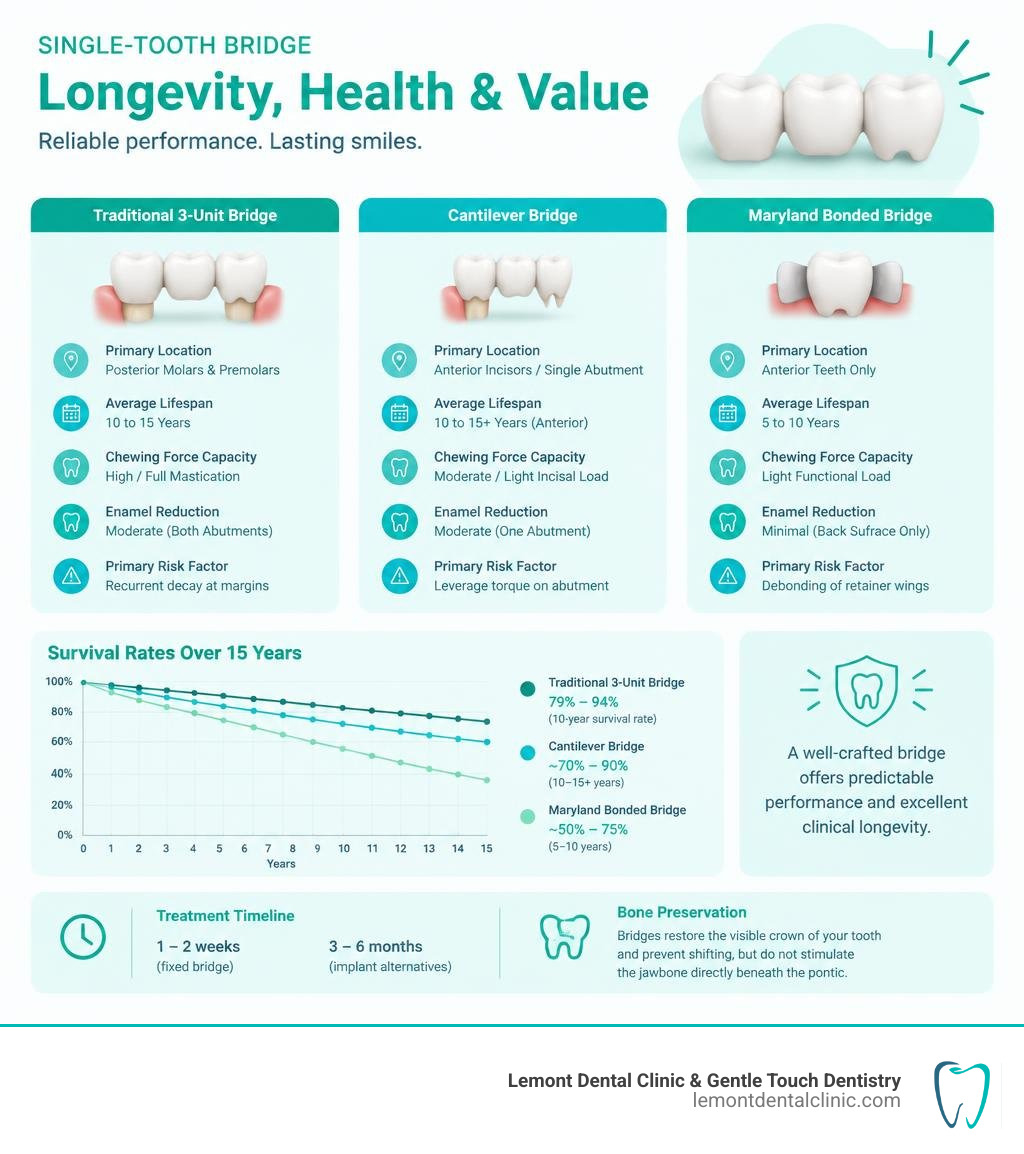
A well-crafted dental bridge offers predictable performance and excellent clinical longevity. Long-term studies show that traditional three-unit bridges maintain an annual failure rate of only 1% to 2%, resulting in a 10-year clinical survival rate of 79% to 94%.
Feature / Metric
Traditional 3-Unit Bridge
Cantilever Bridge
Maryland Bonded Bridge
Primary Location
Posterior Molars & Premolars
Anterior Incisors / Single Abutment
Anterior Teeth Only
Average Lifespan
10 to 15 Years
10 to 15+ Years (Anterior)
5 to 10 Years
Chewing Force Capacity
High / Full Mastication
Moderate / Light Incisal Load
Light Functional Load
Enamel Reduction
Moderate (Both Abutments)
Moderate (One Abutment)
Minimal (Back Surface Only)
Primary Risk Factor
Recurrent decay at margins
Leverage torque on abutment
Debonding of retainer wings
How Do Single-Tooth Bridge Designs Compare?
When evaluating your options, consider these key clinical points:
Treatment Timeline: A fixed bridge is completed in just 1 to 2 weeks, whereas alternatives requiring osseointegration can take 3 to 6 months.
Bone Preservation: Bridges restore the visible crown of your tooth and prevent shifting, though they do not stimulate the jawbone directly beneath the pontic.
Abutment Impact: Traditional designs require preparing adjacent teeth. If those teeth already have fillings or wear, crowning them offers a restorative benefit. If they are completely untouched, conservative cantilever or resin-bonded options may help preserve healthy enamel.
Frequently Asked Questions About Single Tooth Bridges
How long does a single tooth bridge typically last?
Most single tooth bridges last between 7 and 15 years, with many exceeding 15 years when supported by excellent oral hygiene. Porcelain bridges average 10 to 15 years, while proper daily flossing underneath the pontic prevents decay along the abutment margins—the leading cause of premature bridge failure.
Can a single tooth bridge be used for any missing tooth in the mouth?
While traditional three-unit bridges can replace almost any missing tooth if healthy abutments are available, conservative cantilever bridges are generally reserved for front teeth or premolars. Back molars endure high bite forces that can exert excessive leverage on a single supporting tooth.
Can you eat normally with a single tooth bridge?
Yes. Once your permanent bridge is adjusted and bonded, you can eat a full, balanced diet. We recommend chewing softer foods during the first few days while your bite adapts. To protect your restoration long term, avoid biting directly into hard items like unpopped popcorn kernels, hard candies, or ice.
Conclusion
A missing tooth impacts more than just aesthetics—it influences your bite dynamics, speech clarity, and long-term dental alignment. A custom tooth bridge for one tooth offers a dependable, non-surgical solution that restores natural oral function in just a few visits.
At Lemont Dental Clinic & Gentle Touch Dentistry, we provide comprehensive restorative care for patients across Lemont, Palos Hills, and surrounding communities including Palos Park, Lockport Heights, Romeoville, Bolingbrook, and Oak Lawn. Our experienced team combines advanced digital technology with competitive pricing to help you achieve a stable, natural smile.