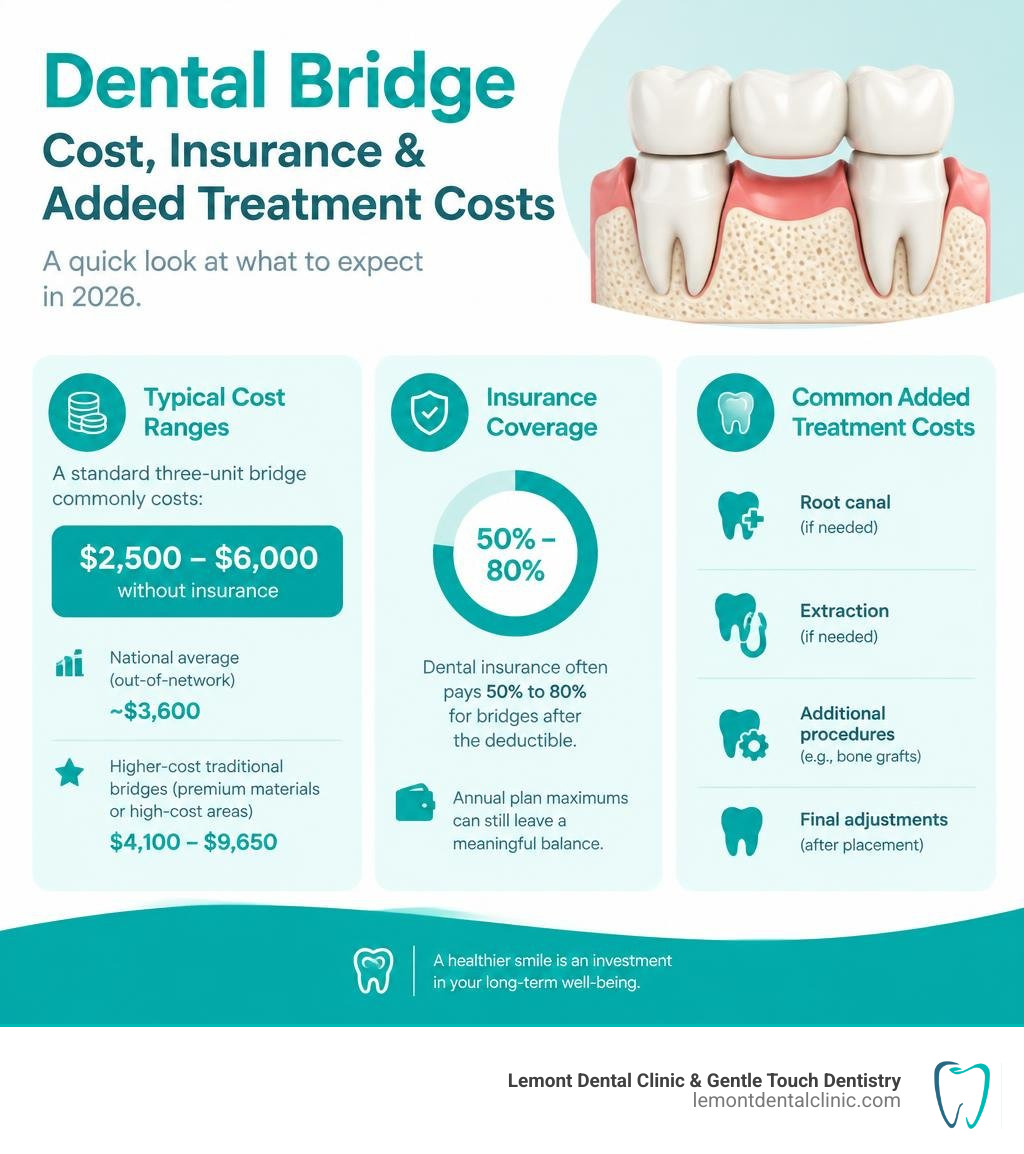
How much does a bridge for teeth cost? In 2026, a standard three-unit dental bridge commonly costs about $2,500 to $6,000 without insurance. National estimates vary because they may measure different bridge types and locations, but an out-of-network three-unit bridge often averages around $3,600. Higher-cost traditional bridges, especially those made with premium materials or completed in high-cost areas, can reach $4,100 to $9,650.
Your actual price depends on the bridge design, the material, the condition of the supporting teeth, and whether treatment such as a root canal or extraction is needed first. Dental insurance often pays 50% to 80% for bridges after the deductible, but annual plan maximums can still leave a meaningful balance.
A written, itemized estimate is the best way to compare options. It should show what is included in the bridge itself and what may be billed separately.
Dental Bridge Pricing: How Much Does a Bridge for Teeth Cost in 2026?
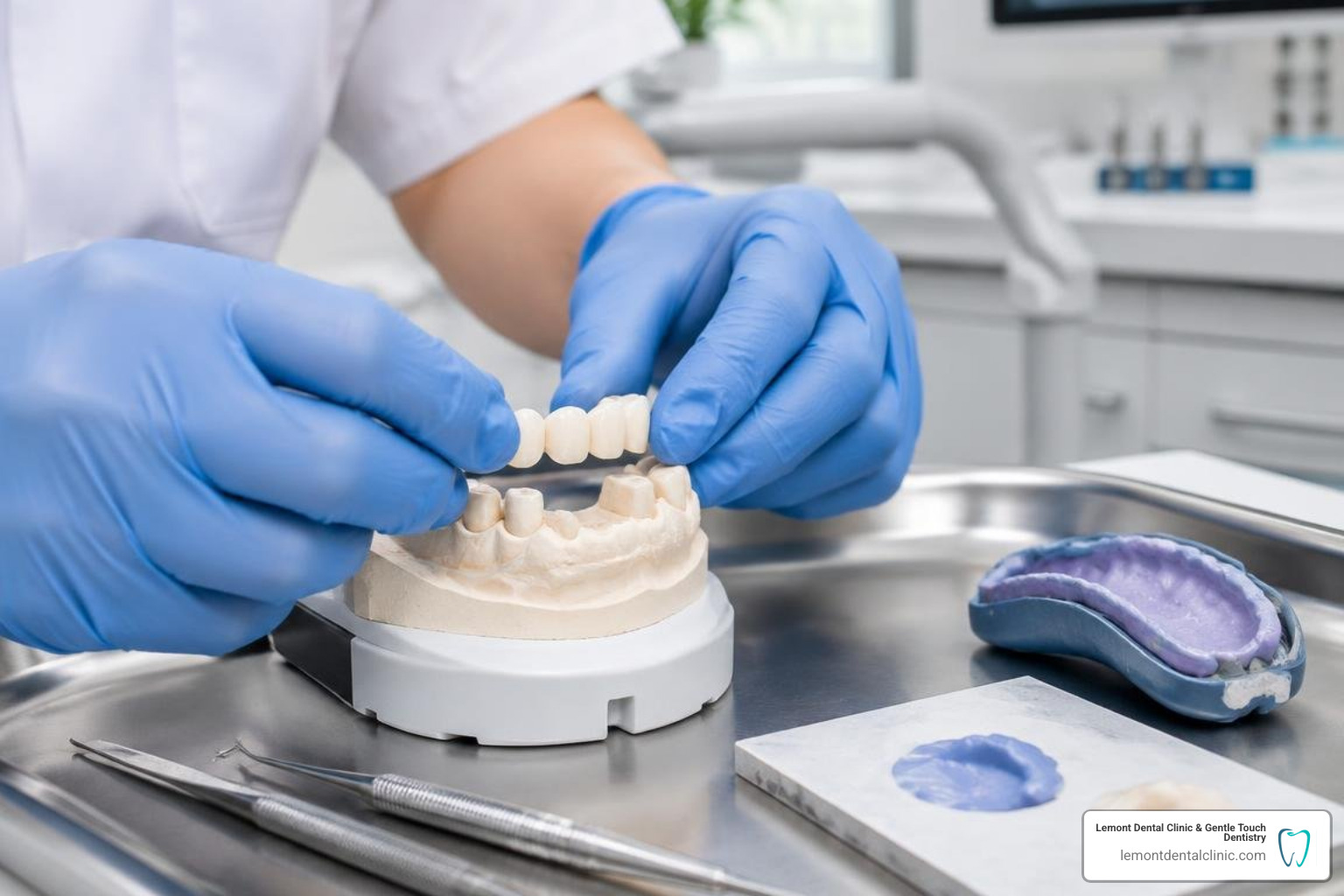
When reviewing restorative treatment options, understanding how dental restorations are billed helps demystify the bottom-line numbers on your estimate. Dental bridges are priced by the “unit.” Each crown placed over a supporting anchor tooth counts as one unit, and each artificial replacement tooth (known as a pontic) counts as an additional unit.
For a single missing tooth, a standard fixed bridge consists of three units: two abutment crowns anchored onto the neighboring natural teeth, connected to one floating pontic in the middle.
Across the United States, overall restorative dental bridge prices have climbed roughly 17.7% over the past four years—rising from an average of $2,548 in 2022 to approximately $3,000 to $5,197 in 2026 depending on the structural type, material quality, and complexity of the case. By understanding national dental bridge cost variations, patients can better understand where regional pricing trends fit into their overall financial planning.
Bridge Type
Material / Design
Average Cost (Without Insurance)
Typical Range (Without Insurance)
Est. Cost With 50% Insurance Coverage*
Traditional (3-Unit)
Porcelain-Fused-to-Metal (PFM)
$3,500
$2,500 – $4,500
$1,250 – $2,250
Traditional (3-Unit)
All-Ceramic / High-Translucency Zirconia
$4,500
$3,000 – $6,000
$1,500 – $3,000
Cantilever (2 to 3-Unit)
Metal-Ceramic or All-Ceramic
$2,200
$1,041 – $3,500
$520 – $1,750
Maryland (Resin-Bonded)
Metal or Ceramic Wings + Pontic
$1,800
$1,500 – $2,500
$750 – $1,250
Implant-Supported Bridge
2 Implant Fixtures + 3-4 Unit Zirconia Span
$8,500
$5,000 – $15,000+
$3,500 – $10,000+
*Note: Actual insurance savings depend heavily on your policy’s annual maximum limit (usually $1,000 to $2,000 per calendar year).
Traditional and Cantilever: How Much Does a Bridge for Teeth Cost per Unit?
Traditional dental bridges remain the most common fixed restorative treatment. In a traditional 3-unit design, each unit typically costs between $800 and $2,000. If you opt for time-tested porcelain-fused-to-metal (PFM), the total fee lands on the lower to mid-tier of the price spectrum ($2,500 to $4,500). If you select monolithic zirconia or layered lithium disilicate (E-max) for superior aesthetics and strength, the total often ranges from $3,000 to $6,000. For patients evaluating the total cost of a 3-unit tooth bridge, material selection represents one of the largest variables in final lab and clinical fees.
A cantilever bridge is used when healthy anchor teeth are present on only one side of the missing tooth gap. While it requires fewer total units (often two units: one anchor crown and one pontic), it places substantial leverage forces on that single anchor tooth. Cantilever bridges average between $1,041 and $3,500, but they are clinically restricted to areas of the mouth that endure minimal biting stress, such as the front teeth.
Maryland Resin-Bonded and Implant-Supported Bridges
For single missing front teeth where the adjacent teeth are entirely healthy and free of fillings, a Maryland resin-bonded bridge offers a conservative, lower-cost alternative. Instead of grinding down natural teeth for full-coverage crowns, a Maryland bridge utilizes discreet metal or ceramic “wings” bonded directly to the back surfaces of neighboring teeth. Maryland bridges generally range from $1,500 to $2,500. While less durable under heavy chewing loads, they provide an aesthetic, tissue-preserving option.
At the other end of the spectrum, patients replacing multiple consecutive missing teeth often look into permanent bridge teeth solutions supported by dental implants rather than natural teeth. An implant-supported bridge does not compromise natural tooth structure. Instead, oral surgeons or restorative dentists place two or more titanium implant posts directly into the jawbone to suspend a multi-tooth ceramic span. While highly durable, the surgical fixtures, custom abutments, and bridge framework bring the total fee between $5,000 and $15,000+.
Key Factors and Hidden Expenses That Drive Total Restoration Fees
The total cost on your treatment plan rarely reflects a one-size-fits-all sticker price. Several clinical and logistical factors influence the final invoice:
Materials Used: Basic porcelain-fused-to-metal bridges carry lower lab fabrication costs, while full monolithic zirconia or specialized ceramic materials carry a $500 to $1,500 material premium due to CAD/CAM digital milling and aesthetic characterization.
Span and Number of Replaced Teeth: A 4-unit bridge replacing two adjacent teeth naturally incurs higher material, fabrication, and chair-time fees than a standard 3-unit span.
Geographic Location and Overhead: Restorative care in Illinois reflects local laboratory costs, high standards of clinical technology, and regional overhead. For example, average traditional bridges across Illinois typically range from $1,575 on the low end to $5,250–$5,406 for comprehensive multi-unit cases.
Dentist’s Clinical Expertise: Complex restorative cases requiring precise smile design or bite realignment require advanced clinical planning and digital workflows, such as those used when delivering custom crowns and bridges.
Pre-Procedure Work: Extractions, Core Buildups, and Root Canals
The most common reason a final dental bill exceeds the baseline bridge quote is necessary preparatory treatment. A bridge can only succeed if its supporting foundation—the anchor teeth and bone—is structurally sound and disease-free.
When budgeting for care, consider whether any of these preparatory steps apply to your smile:
Diagnostic Digital X-Rays / 3D CBCT Scans: $100 – $400
Tooth Extraction (if replacing an un-restorable tooth): $150 – $500+ per tooth
Root Canal Therapy (if an anchor tooth has nerve decay or infection): $700 – $1,800 per tooth
Bone Grafting (for implant-supported bridges or site preservation): $300 – $1,200 per site
If you are replacing a tooth that must first be removed, reviewing a full fake tooth cost breakdown can help you plan for both the surgical extraction and the prosthetic phase of treatment.
What Is Included in Your Initial Dental Estimate vs. Billed Separately
To prevent unexpected billing surprises, review your itemized treatment estimate before starting care.
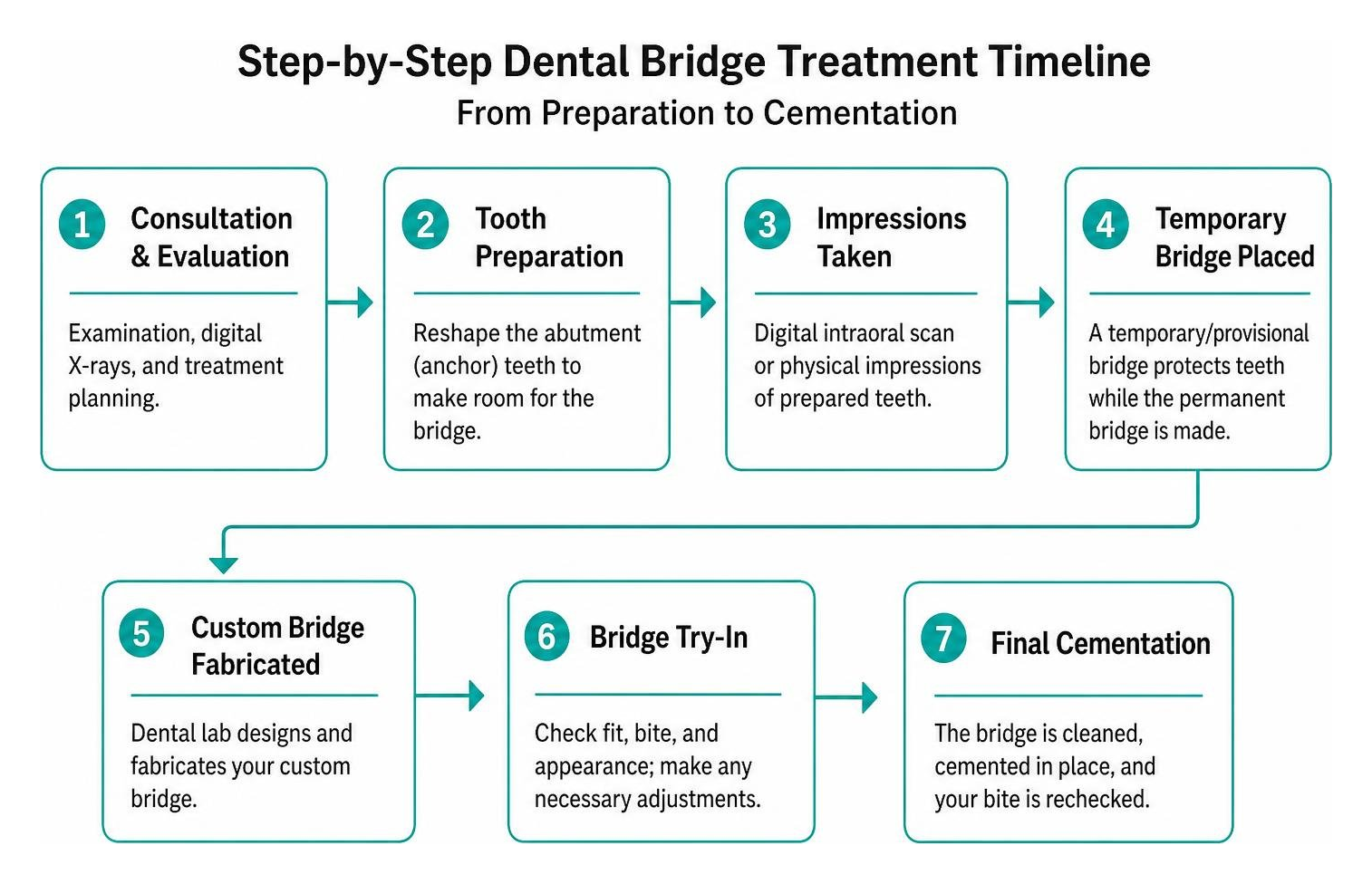
A comprehensive bridge estimate typically includes:
Local anesthesia during preparation and seat appointments
Reshaping and preparation of the abutment anchor teeth
Digital intraoral scanning or physical master impressions
Fabrication and placement of a temporary/provisional bridge
Dental laboratory fabrication fees
Final try-in, bite balance adjustments, and permanent cementation
Items frequently billed separately include initial diagnostic exams, periodic cleanings, preparatory extractions, periodontal therapy, root canals, and specialized nightguards designed to protect your new porcelain restoration from nighttime grinding (bruxism).
Insurance Coverage, Out-of-Pocket Limits, and Payment Strategies
Dental insurance plans classify fixed bridges under Major Restorative Services (Class III). While preventative cleanings are often covered at 80% to 100%, major procedures generally receive 50% coverage (or up to 80% in select premium PPO plans) after your annual deductible is satisfied.
For extensive details on policy tiers and benefit structures, checking resources like the official Delta Dental bridge coverage guide will clarify how major carriers categorize unit codes (D6240 for pontics, D6750 for abutment crowns).
However, the primary hurdle with dental insurance is not the coverage percentage—it is the annual maximum limit. Most standard dental insurance policies cap their payout at $1,000 to $2,000 per benefit year.
Example Scenario:
Total 3-Unit Bridge Cost: $4,000
Plan Coverage: 50% ($2,000 theoretical benefit)
Plan Annual Maximum: $1,500
Actual Insurance Payment: $1,500
Your Out-of-Pocket Responsibility: $2,500
Out-of-Pocket Estimates: How Much Does a Bridge for Teeth Cost Without Insurance?
If you are self-paying or do not have dental insurance, your total out-of-pocket expense will generally run between $2,500 and $6,000 for a conventional three-unit bridge. To make restorative care manageable, several proven payment strategies can minimize financial strain:
Strategic Calendar-Year Phasing: If your treatment is planned near the end of the year, we can often schedule tooth preparation and impressions in November or December (using this year’s remaining insurance maximum) and seat the permanent bridge in January (tapping into your refreshed benefit maximum for the new year).
FSA and HSA Funds: Utilizing pre-tax dollars through a Flexible Spending Account (FSA) or Health Savings Account (HSA) effectively lowers your total treatment cost by your marginal income tax rate (saving 20% to 35%).
Structured Financing Plans: Many patients leverage monthly third-party healthcare financing (such as CareCredit or Sunbit) or structured in-office arrangements. Reviewing available flexible dental payment plans allows you to distribute out-of-pocket balances across interest-free promotional terms.
Dental Bridge vs. Implant: Comparing Lifespan, Maintenance, and 20-Year Value
When faced with replacing a single missing tooth, the central decision usually comes down to a fixed dental bridge versus a single dental implant.
A traditional bridge is typically $500 to $1,500 less expensive upfront than an implant restoration (which averages $3,000 to $6,000 per tooth when combining the surgical post, custom abutment, and crown). Additionally, a bridge requires no oral surgery and is completed in just 2 to 3 weeks across two appointments, compared to the 3 to 6 months required for an implant to integrate into the jawbone.
However, the long-term cost equation changes significantly over a 15- to 20-year horizon:
Lifespan & Replacement: Traditional bridges have a 3-year success rate of 94%–97%, a 5-year success rate of 90%–95%, and an average lifespan of 10 to 15 years. Over time, recurrent decay can develop at the margins of the crowned anchor teeth, eventually requiring bridge replacement. Implants boast a 10-year success rate above 95% and routinely last 20+ years or a lifetime.
Impact on Neighboring Teeth: Placing a bridge permanently alters two healthy adjacent teeth by shaving down their enamel for crowns. An implant stands entirely independently, leaving adjacent teeth untouched.
Bone Preservation: When a natural tooth root is lost, the underlying jawbone gradually resorbs over time. A bridge pontic rests above the gum line and does not stimulate the bone; a dental implant mimics a natural tooth root, halting bone loss.
When comparing dental bridges vs implants, many patients find that a slightly higher upfront investment in an implant avoids replacement costs a decade later. Conversely, for patients whose adjacent teeth already have large fillings or require full crowns anyway, a bridge solves two dental problems in a single, cost-effective treatment. For individuals exploring all non-removable and removable alternatives, carefully evaluating bridges implants and flippers provides a clear picture of short-term affordability versus long-term stability.
Frequently Asked Questions About Dental Bridges
How long does a traditional dental bridge last before needing replacement?
A traditional dental bridge typically lasts between 10 and 15 years, with some lasting 20 years or longer under optimal oral hygiene conditions. The lifespan depends heavily on keeping the margins of the supporting crowned anchor teeth clean. Because the pontic is fused to the crowns, you cannot pass ordinary floss between the teeth; using floss threaders, superfloss, or interdental water flossers daily is essential to prevent bacterial decay along the gumline.
Is getting a dental bridge painful during or after the procedure?
The procedure itself is virtually painless. We thoroughly numb the treatment area with local anesthesia before preparing the anchor teeth and taking impressions. After the numbness wears off, you may experience mild gum tenderness or minor temperature sensitivity for a few days, which is easily managed with over-the-counter pain relievers (such as ibuprofen or acetaminophen). Once the permanent restoration is cemented and the bite is balanced, your bridge should feel as comfortable and natural as your original teeth.
Can you replace a failing dental bridge with a dental implant later?
Yes, transitioning from a failed bridge to an implant is a common procedure. If an anchor tooth develops severe decay or fractures beneath the crown, the bridge must be removed. At that point, you can explore transitioning from dental implants vs bridge systems. If bone loss has occurred under the pontic area over the years, a minor bone graft may be performed prior to or during implant placement to ensure long-term structural stability.
Conclusion
Choosing the right tooth replacement is an important decision for both your oral health and your budget. While national averages for a three-unit bridge fall between $2,500 and $6,000, your personal treatment plan will depend on your unique bite, the condition of your supporting teeth, and your aesthetic goals.
At Lemont Dental Clinic & Gentle Touch Dentistry, we serve patients across Lemont, Palos Hills, and surrounding communities including Chicago Ridge, Oak Lawn, Palos Park, Worth, Hickory Hills, Orland Park, Palos Heights, Bolingbrook, and Romeoville. Our team delivers comprehensive, all-in-one general and restorative dental care using modern digital workflows, clear communication, and transparent pricing.
Ready to restore your bite and smile with confidence? Contact our friendly team today to schedule your comprehensive consultation, receive an itemized treatment estimate, and explore our 3-unit tooth bridge restorative options.