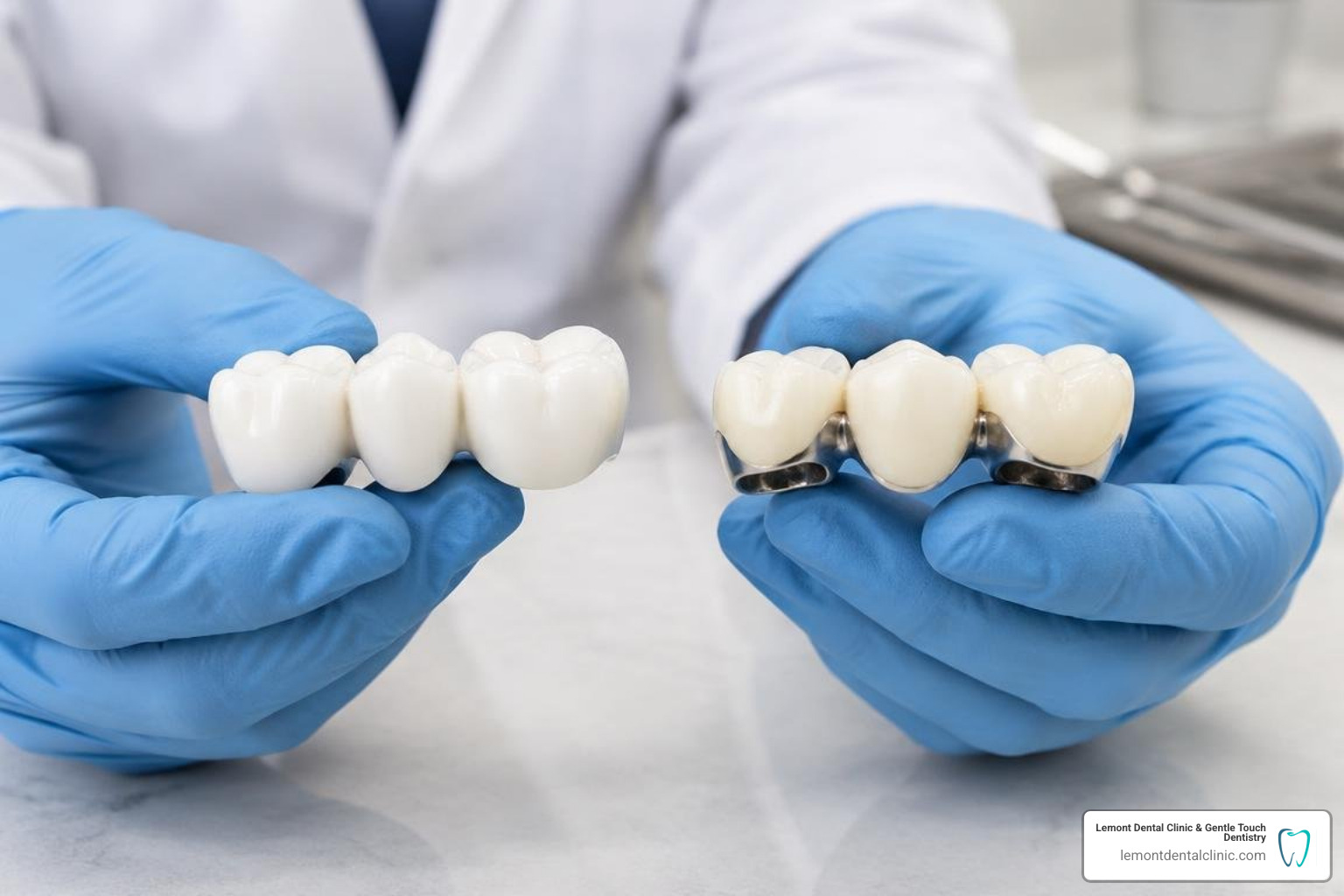
A fixed dental bridge is an oral prosthetic device designed to replace one or more missing teeth by anchoring an artificial tooth (known as a pontic) securely to neighboring teeth or implants. When you experience tooth loss, nearby teeth naturally tend to drift toward the open space, altering your bite, straining your jaw joints, and making oral hygiene more difficult. Quality restorative dental services help prevent these long-term alignment problems while returning your mouth to full masticatory function.
For patients researching fixed bridge cost, a standard 3-unit traditional bridge typically ranges from about $2,000 to $5,000 without insurance, while national averages fall between roughly $3,600 and $5,197 depending on materials and clinical needs. At its core, a fixed bridge consists of two main elements: the abutment teeth (the supporting teeth or implants on either side of the space) and the pontic (the floating artificial tooth that spans the gap). Depending on the health of your surrounding teeth and the location of the missing space, several structural styles of crowns and bridges are available.
Traditional and Cantilever Bridges
A traditional fixed bridge is the most widely used restoration. In this design, the teeth directly adjacent to the gap are reshaped and fitted with retainer crowns. The pontic is fused between these two crowns, creating a solid, single-piece unit. Traditional bridges provide outstanding stability because the chewing force is distributed evenly across both anchor teeth. They are especially effective in posterior areas (the premolars and molars) where high bite force occurs during daily eating.
A cantilever bridge works on a similar principle but connects the pontic to only one abutment tooth on a single side of the gap. Dentists recommend cantilever bridges when there is an intact natural tooth on only one side of the missing space. Because the bridge is supported on just one side, chewing creates a lever effect that places additional rotational stress on the supporting tooth. As a result, cantilever bridges are generally reserved for areas that experience lighter chewing loads, such as front teeth, and are rarely placed on heavy-load molars.
Maryland Resin-Bonded Bridges
A Maryland bridge (often called a resin-bonded bridge) offers a conservative alternative for replacing missing anterior (front) teeth. Rather than cutting down adjacent healthy teeth to place full-coverage crowns, a Maryland bridge utilizes a metal or ceramic framework with small “wings.”
These wings are bonded directly to the hidden, lingual (back) surfaces of the natural anchor teeth using high-strength dental resin. Because this method requires minimal tooth preparation, your natural enamel remains largely intact. While Maryland bridges represent an aesthetic and conservative option for low-stress front zones, the resin bond can detach under heavy bite forces, making them less suited for back teeth.
Complete Breakdown of Fixed Bridge Cost in 2026
When evaluating bridge prices, national figures show significant ranges depending on the complexity of the case. The national average cost for a traditional bridge is approximately $5,197, though typical ranges fall between $4,100 and $9,650 when accounting for various clinical requirements. According to published dental data, the average out-of-network cost for a standard three-unit bridge sits around $3,600.
To help you compare options, here is a breakdown of estimated fees based on structure, unit count, and fabrication materials:
Dental bridge pricing is calculated per “unit.” A unit refers to each individual crown or artificial tooth within the bridge structure.
3-Unit Bridge: Designed to replace one missing tooth. It includes two abutment crowns (one on each adjacent tooth) plus one pontic in the middle. If a practice charges $1,200 per unit, a 3-unit bridge totals $3,600.
4-Unit Bridge: Designed to replace two missing teeth side-by-side. It consists of two abutment crowns on the perimeter and two pontics spanning the space. Adding that fourth unit typically increases total costs by $1,000 to $2,500, bringing a 4-unit bridge into the $3,000 to $7,500 range.
Every additional pontic or support crown adds laboratory fabrication fees and clinical chair time.
Fixed Bridge Pricing by Bridge Type and Material
The material chosen for your restoration affects both its aesthetic quality and overall cost.
Porcelain-Fused-to-Metal (PFM): PFM bridges feature a strong metal alloy substructure coated with tooth-colored porcelain. They offer excellent durability for molars and typically range between $975 and $2,370 per unit. Over time, a faint gray metal line can become visible near the gumline if tissue recedes.
All-Ceramic / Lithium Disilicate: Ceramic options deliver exceptional translucency and mimic natural tooth enamel seamlessly. These are ideal for front teeth and visible smile zones, averaging $965 to $2,265 per unit.
Monolithic Zirconia: Known for extreme fracture resistance, zirconia handles heavy bite pressures and teeth grinding (bruxism) without chipping. Zirconia restorations are commonly priced at the higher end of the ceramic scale ($1,100 to $2,400 per unit) due to advanced digital milling requirements.
All-Metal / Full Gold Alloys: Highly biocompatible with exceptional longevity and minimal wear on opposing teeth, non-precious and precious metal bridges run from $665 to $1,470+ per unit (plus precious metal market surcharges). Because of their metallic color, they are generally used exclusively on hidden second molars.
Factors That Influence Fixed Bridge Cost
Several clinical and operational variables dictate final out-of-pocket costs:
Geographic Overhead: Operating expenses vary by market. In Illinois communities across Lemont, Palos Hills, Bolingbrook, Orland Park, and Oak Lawn, local lab rates, facility costs, and regional standards shape pricing structures. For instance, statewide data in Illinois places the average traditional bridge cost around $5,406.
Laboratory Craftsmanship and Materials: Custom artistic shading, high-translucency zirconia blocks, and master dental technician hand-layering add $500 to $3,500 in direct lab production expenses.
Digital Technology: Clinics utilizing intraoral 3D digital scanners and CAD/CAM precision workflows streamline fitting times and reduce remake rates, ensuring superior margins and bridge longevity. For an in-depth breakdown of professional pricing mechanics, explore this clinical guide on dental bridge pricing.
Insurance Coverage, Additional Expenses, and Financing Options
Navigating payments for major restorative dental procedures involves reviewing plan guidelines, clinical prerequisites, and payment options.
Navigating Dental Insurance and Out-of-Pocket Limits
Most comprehensive dental insurance plans classify a fixed dental bridge as a Major Restorative Service. Under standard PPO policies:
Coverage generally reimburses 40% to 50% of the allowable fee once you have met your annual deductible.
Annual policy maximums typically range between $1,000 and $2,000 per calendar year. Because a traditional bridge often costs upwards of $3,500, a single restoration can quickly reach your yearly benefit maximum, leaving the remaining balance to be paid out-of-pocket.
Be mindful of policy limitations such as missing tooth clauses (which deny coverage if the tooth was lost before your policy started) and waiting periods for major services.
If your bridge procedure spans the end of one calendar year and the beginning of the next, you may be able to divide your prep and seat appointments across benefit cycles to utilize two annual maximums.
Pre-Requisite Treatments and Additional Clinical Fees
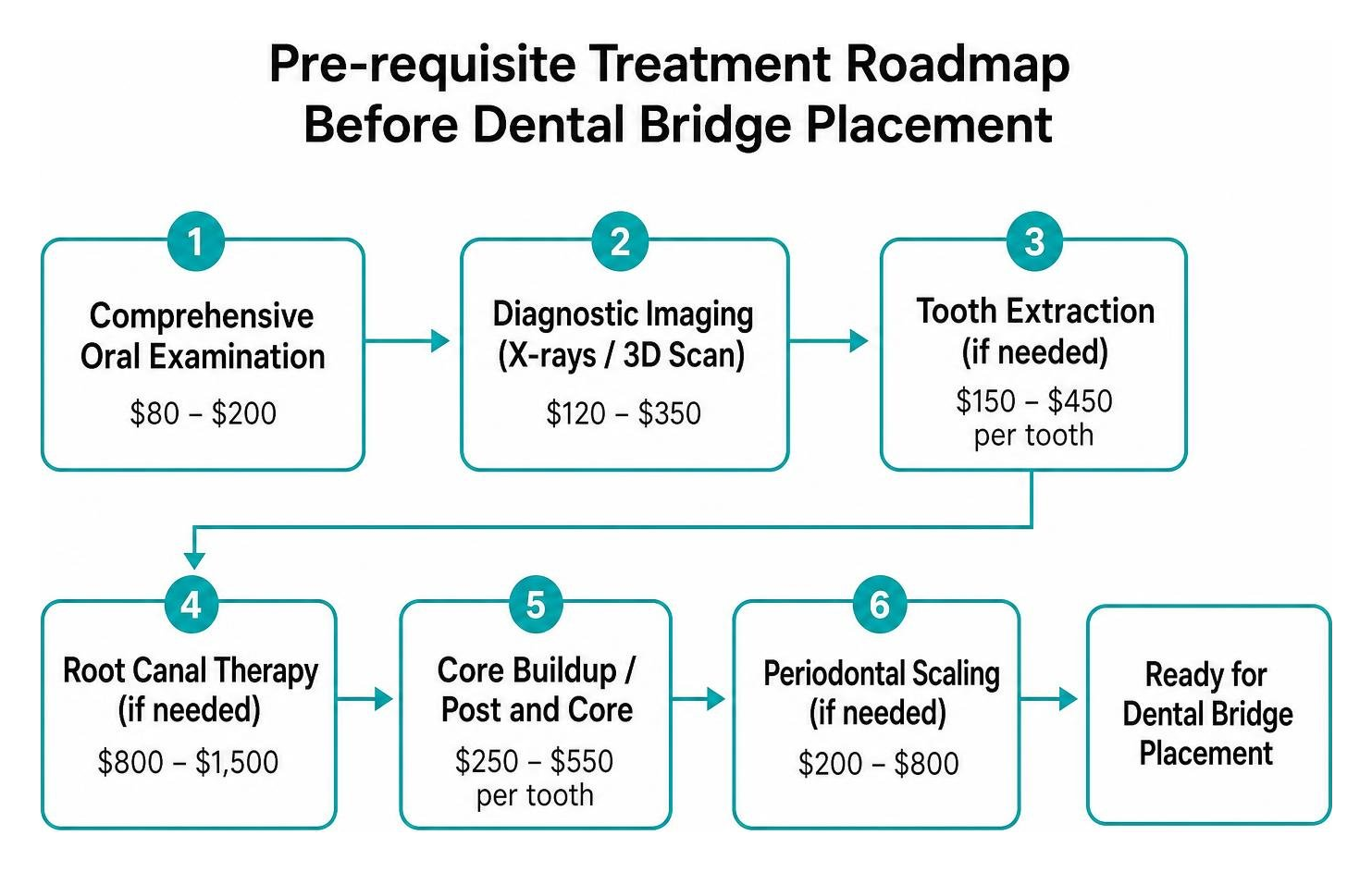
A dental bridge requires a healthy periodontal and endodontic foundation. If supporting teeth require treatment before bridge placement, additional fees may apply:
Comprehensive Oral Examination: $80 – $200
Diagnostic Digital X-Rays / 3D Cone Beam Scan: $120 – $350
Tooth Extraction (if damaged tooth is still present): $150 – $450 per tooth
Root Canal Therapy (if an abutment tooth has nerve inflammation): $800 – $1,500
Core Buildup / Post and Core (to rebuild broken anchor teeth): $250 – $550 per tooth
Periodontal Scaling (to resolve active gum inflammation): $200 – $800
Payment Plans and Budget Management
To manage out-of-pocket costs comfortably without delaying necessary care:
HSA & FSA Accounts: Health Savings Accounts (HSA) and Flexible Spending Accounts (FSA) allow you to use pre-tax earnings toward dental bridges and diagnostic fees, reducing your net costs.
Structured Monthly Financing: Many patients utilize healthcare credit cards like CareCredit or structured clinic installment programs to break expenses down into manageable monthly payments. Our team provides flexible dental payment plans to help you finance restorative treatments smoothly.
Frequently Asked Questions About Fixed Bridge Cost
How long does a fixed dental bridge typically last?
A well-maintained fixed bridge typically lasts between 5 and 15 years, and can last over 20 years with meticulous oral care. The longevity of your bridge depends directly on the health of the underlying abutment teeth. Because the artificial pontic sits on top of the gums, food debris and bacterial plaque can collect underneath.
Using specialized floss threaders, superfloss, or water flossers daily around the margins prevents recurrent decay at the crown borders. Regular dental checkups and professional cleanings every six months are essential to ensure the cement seal remains intact and the supporting bone stays strong.
Is getting a fixed bridge painful?
Getting a fixed bridge is a comfortable, routine procedure. During the preparation appointment, local anesthesia is administered to numb the anchor teeth and surrounding gum tissues, keeping you pain-free throughout the reshaping and impression process.
After the numbness wears off, you may experience mild gum tenderness or temperature sensitivity around the prepared teeth for a few days. This temporary discomfort responds well to over-the-counter pain relievers and desensitizing toothpaste. Once the final permanent bridge is cemented and your bite is calibrated, the restoration functions just like natural teeth.
How much does it cost to replace an existing dental bridge?
Replacing an existing dental bridge generally costs the same as placing a new one—between $2,000 and $5,200+ for a standard 3-unit bridge—with occasional additional fees for removing the old restoration.
When an older bridge fails, it is usually due to cement wash-out, fractures, or recurrent decay beneath one of the anchor crowns. The dentist must section and remove the existing bridge, clean away any localized decay, perform structural core buildups if needed, and take fresh impressions for the new laboratory fabrication.
Conclusion
Restoring missing teeth is an important investment in your overall oral function, facial symmetry, and daily comfort. While comparing fixed bridge costs involves evaluating materials, unit counts, and insurance benefits, choosing the right treatment ensures your restoration serves you reliably for years to come.
At Lemont Dental Clinic & Gentle Touch Dentistry, we take pride in delivering comprehensive restorative dentistry to our patients throughout Lemont, Palos Hills, and surrounding communities including Bolingbrook, Orland Park, and Oak Lawn. Our experienced clinical team combines cutting-edge digital diagnostics, high-grade biocompatible materials, and clear pricing to help you achieve a stable, complete smile.
Schedule your consultation today and discover the expected cost of a 3-tooth bridge to restore your oral health and smile with complete confidence.