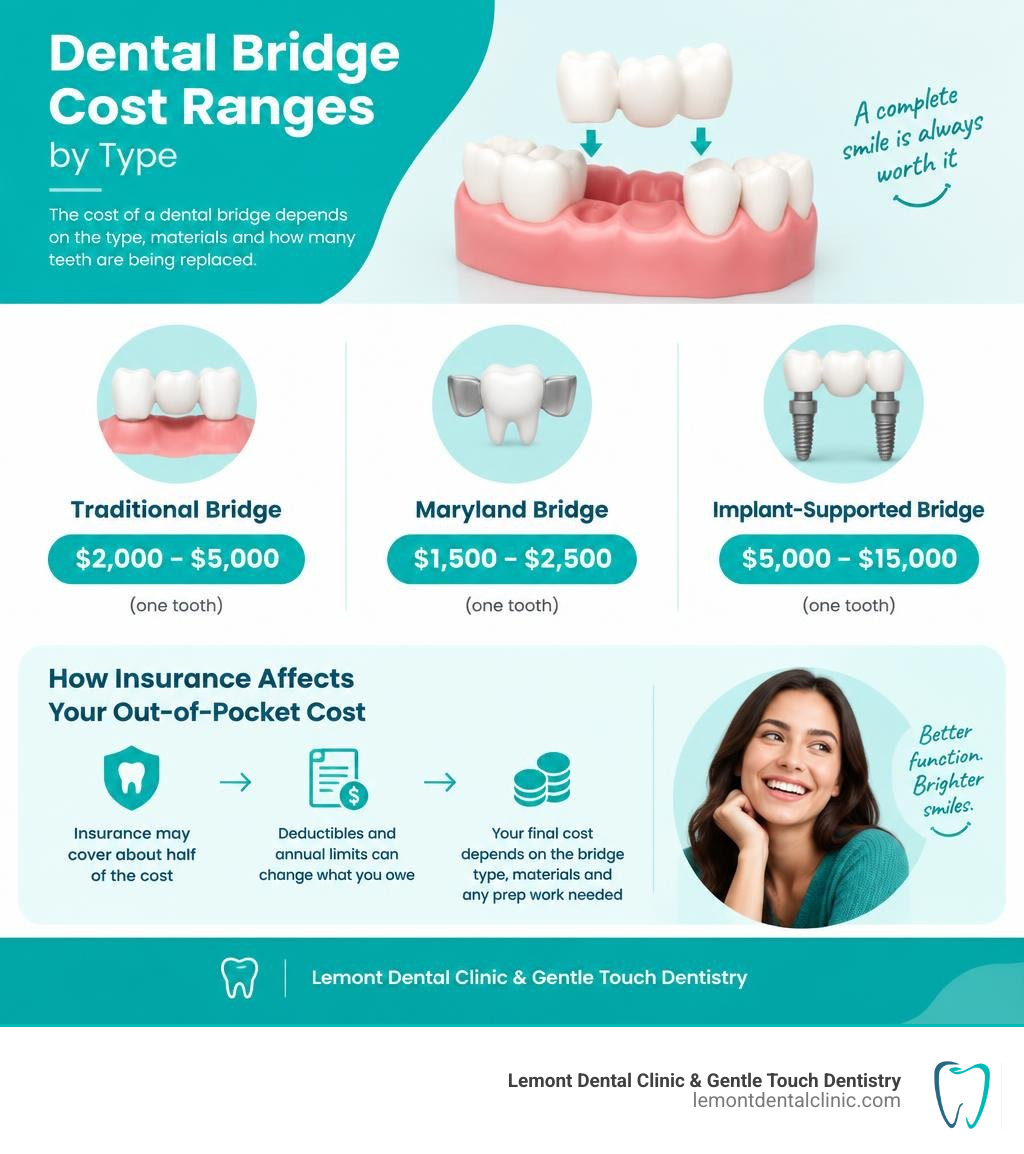
A dental bridge typically costs $2,000 to $5,000 without insurance for a traditional bridge replacing one tooth. A Maryland bridge often costs $1,500 to $2,500, while an implant-supported bridge can cost $5,000 to $15,000. Insurance may pay about half of the covered cost, but deductibles and annual limits can change what you owe.
A bridge fills a gap left by a missing tooth and can help you chew and smile with more confidence. Your final price depends on the bridge type, materials, and any dental work needed before placement. Ask for a written estimate that shows both the treatment cost and your expected insurance benefit.
Dental Bridge: How Much Does It Cost?
Patients often ask, “How much does a dental bridge cost?” The answer depends significantly on the structure of the restoration and the number of artificial teeth, known as pontics, needed to complete the smile. Across the United States, the national average cost for a traditional dental bridge sits around $5,197, typically ranging between $4,100 and $9,650 when accounting for multiple units and complex restorative needs. For a standard three-unit bridge—consisting of two crowns placed over neighboring natural anchor teeth (abutments) and one false tooth suspended between them—the out-of-network cost averages around $3,600.
Because a bridge is priced by the “unit,” each individual crown and pontic contributes to the total fee. Understanding this unit structure is essential when planning your restorative care. To get a granular look at unit pricing, check our dental bridge pricing guide unit types materials and hidden fees.
Bridge Type
Average Cost (Without Insurance)
Typical Range (Without Insurance)
Estimated Cost (With 50% Insurance)
Traditional Bridge (3-Unit)
$3,600 – $5,197
$2,000 – $5,000
$1,000 – $2,598
Cantilever Bridge
$1,041 – $3,000
$2,000 – $5,000
$1,000 – $2,500
Maryland Resin-Bonded Bridge
$1,569
$1,500 – $2,500
$750 – $1,250
Implant-Supported Bridge (3–4 Teeth)
$5,195 – $12,000
$5,000 – $15,000
$2,500 – $7,500+ (Subject to caps)
Dental Bridge How Much Does It Cost Without Insurance?
If you are paying entirely out of pocket, out-of-pocket expenses for a bridge generally span from $1,500 on the lower end for conservative bonded designs up to $15,000 or more for comprehensive implant restorations.
Without dental benefits, every step of the laboratory fabrication and clinical preparation contributes to the final balance. The dental laboratory must custom-mill each crown and pontic to match the exact shade, contours, and occlusion of your natural teeth. As detailed in the WebMD guide to dental health bridges, these restorations serve an essential functional role by preventing surrounding teeth from drifting into open spaces, preserving jaw alignment, and restoring full chewing efficiency.
Dental Bridge How Much Does It Cost With Dental Insurance?
Dental insurance plans often categorize fixed bridges under “major restorative care.” Most standard dental policies cover roughly 50% to 80% of the allowable cost for a bridge once you have met your annual deductible.
However, your actual savings are bounded by specific policy conditions:
Annual Maximums: Many plans maintain an annual maximum payout between $1,000 and $2,000. If a bridge costs $4,000 and your insurance covers 50%, a $1,500 annual maximum means your insurer pays $1,500, leaving you responsible for the remaining $2,500.
Waiting Periods: New policies frequently enforce a 6- to 12-month waiting period before major restorative benefits activate.
Missing Tooth Clauses: Some policies will not cover the replacement of a tooth that was extracted before your coverage effective date.
According to the Delta Dental cost overview for dental bridges, staying in-network helps ensure you receive pre-negotiated fee schedules, substantially lowering your out-of-pocket share.
Cost Breakdown by Dental Bridge Type and Material
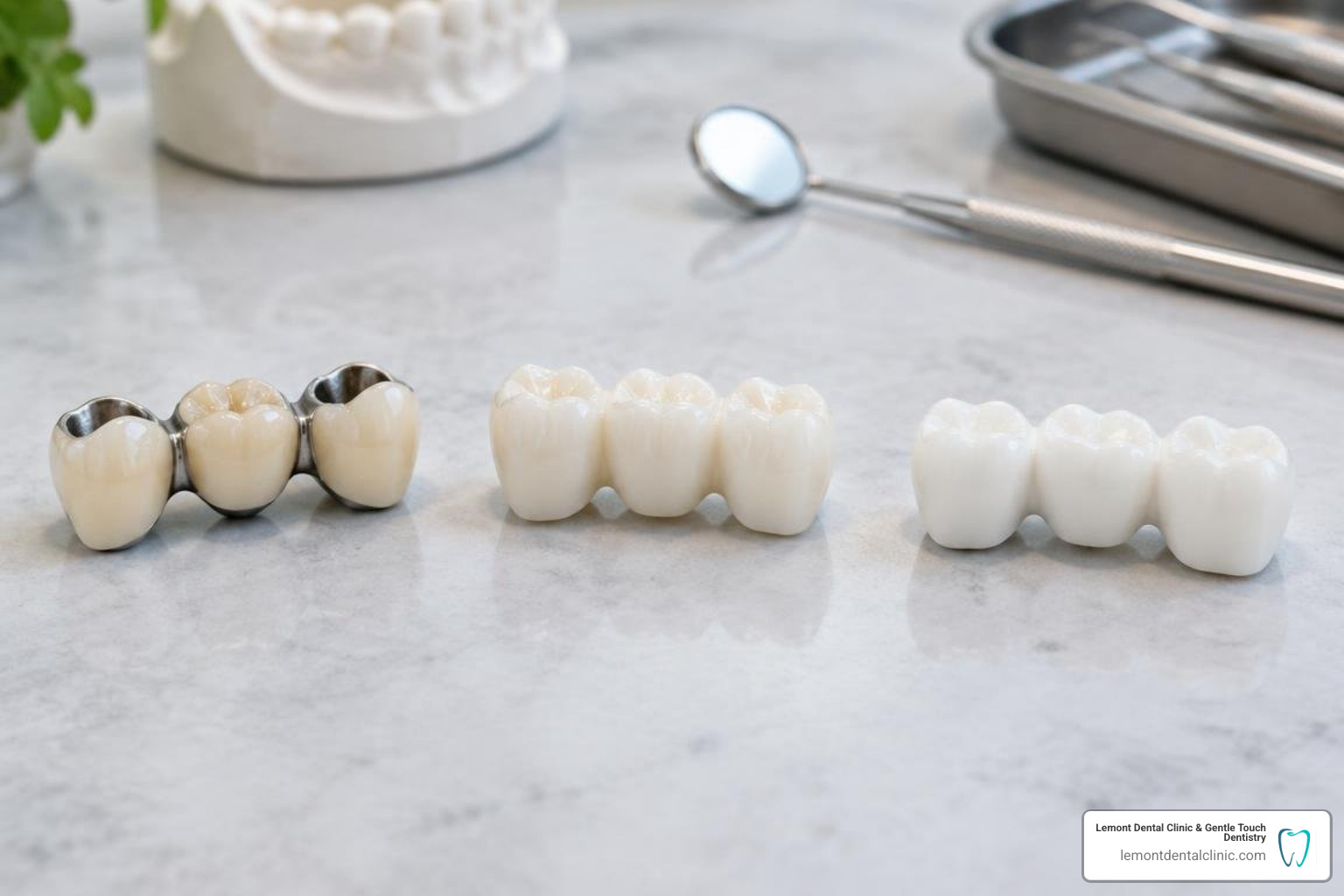
The design of your prosthetic and the material selected directly dictate both clinical longevity and overall pricing. Modern dentistry relies on several high-performance materials, each offering a distinct balance of cosmetic translucency and mechanical strength. For a thorough review of modern restorative options, browse our guide on what you will actually pay for a dental bridge this year.
Porcelain-Fused-to-Metal (PFM): Ranging from $1,500 to $3,000 per bridge, PFM combines the structural rigidity of a metal sub-framework with an outer porcelain layer. It provides solid durability for premolars and molars, though a slight dark line may become visible at the gumline over time.
Full Porcelain / Ceramic: Averaging $2,000 to $4,000, all-ceramic bridges provide outstanding aesthetics that mimic the natural translucency of enamel, making them a preferred choice for front teeth.
Zirconia: Priced between $2,500 and $5,000, zirconia is an exceptionally tough, fracture-resistant ceramic that withstands heavy bite forces while offering a natural tooth shade.
Traditional and Cantilever Bridges
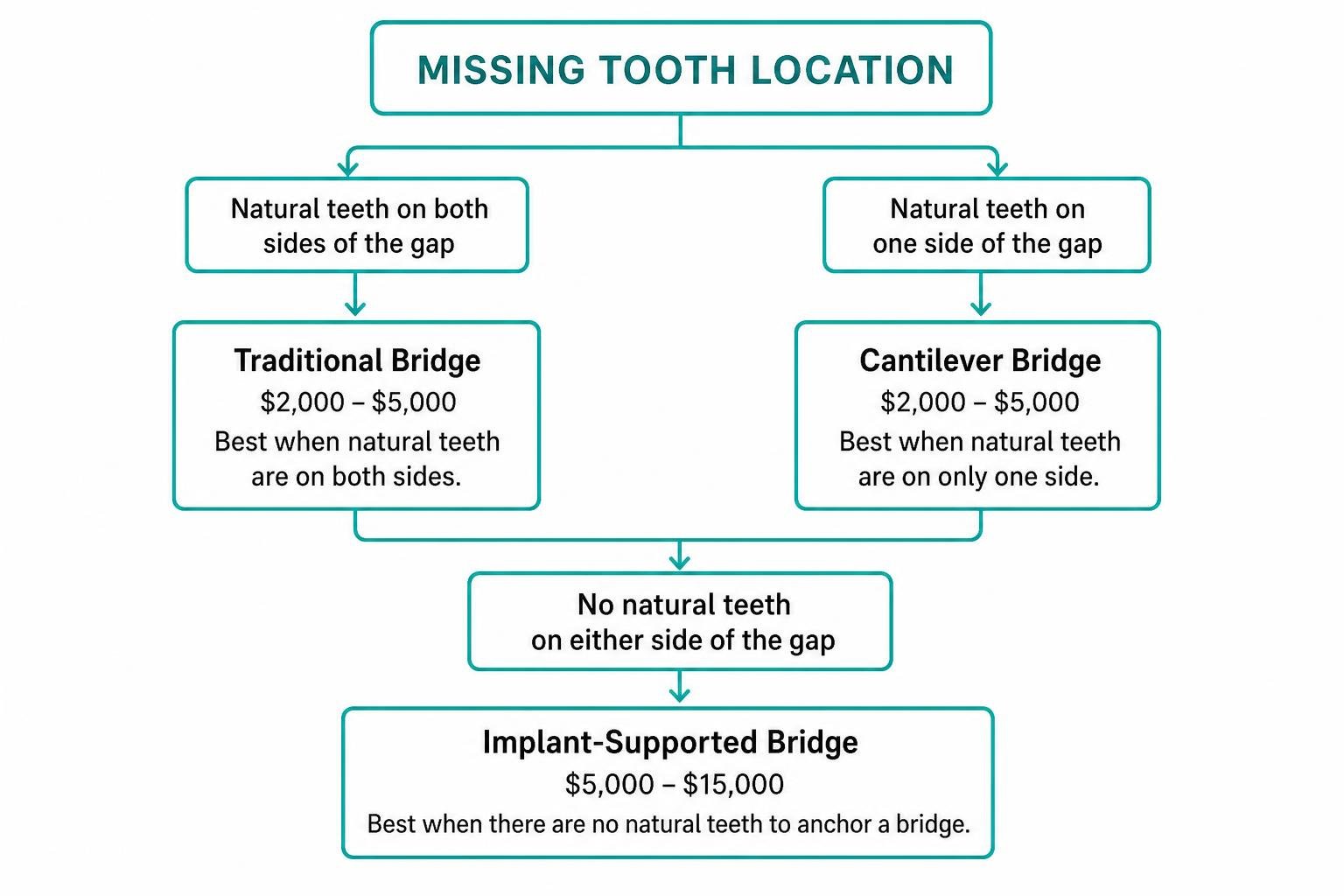
A traditional dental bridge remains the most widely placed restorative option. It requires shaping the two teeth on either side of the gap to receive supportive crowns. A three-unit traditional bridge typically costs between $2,000 and $5,000. For detailed unit-by-unit considerations, see our fixed bridge cost guide 2026 as well as our pricing guide on the cost of 3 tooth bridge restorations.
A cantilever bridge is utilized when healthy anchor teeth exist on only one side of the missing space. While cantilever designs also cost between $2,000 and $5,000, they act as a physical lever. For this reason, dentists primarily reserve them for low-stress zones to avoid placing excessive torque on the single supporting root.
Maryland Resin-Bonded Bridges
A Maryland bridge offers a conservative, tooth-preserving alternative, commonly used to replace missing incisors. Instead of requiring extensive enamel removal on adjacent teeth, a Maryland bridge uses metal or ceramic “wings” bonded directly to the back surfaces of the neighboring teeth.
Maryland bridges generally cost between $1,500 and $2,500. Because they rely entirely on resin bonding rather than full-coverage crowns, they are best suited for areas with minimal bite pressure. To learn more about single-gap options, read our guide on single tooth replacement types costs and what to expect.
Implant-Supported Dental Bridges
When several consecutive teeth are missing, an implant-supported bridge provides exceptional stability without altering any natural teeth. Titanium implant posts are surgically positioned within the jawbone, acting as artificial roots to support a multi-unit bridge spanning three or four teeth.
Implant-supported bridges typically cost between $5,000 and $15,000. While the upfront investment is higher due to surgical placement and specialized abutments, they stimulate underlying bone tissue and offer outstanding long-term durability. To explore wide-span restorations, see our breakdown on why a 4 unit dental bridge might save your bite.
Dental Bridge vs. Dental Implant: Cost and Long-Term Value
Choosing between a conventional tooth bridge and a standalone dental implant involves weighing upfront expenses against long-term durability and oral health benefits.
Feature
Traditional Dental Bridge
Single Dental Implant
Implant-Supported Bridge
Upfront Cost
$2,000 – $5,000
$3,500 – $6,000
$5,000 – $15,000
Average Lifespan
5 to 15 years
25+ years to lifetime
20 to 30+ years
Impact on Adjacent Teeth
Requires enamel reduction
Preserves adjacent teeth
Preserves adjacent teeth
Bone Preservation
Does not stimulate bone
Stimulates jawbone
Stimulates jawbone
Hygiene Routine
Floss threader under pontic
Standard brushing/flossing
Floss threader/water flosser
Treatment Timeline
2 to 3 weeks
3 to 6 months
4 to 8 months
While traditional bridges provide a faster and less expensive initial fix, dental implants boast a 95% to 98% long-term success rate over a decade. Over a lifetime, an implant often proves highly cost-effective because it avoids the need to replace supporting crowns down the road. For an in-depth financial comparison, review our guide to tooth bridge cost vs implant breakdown for real financial clarity and check the CareCredit breakdown on dental implants vs bridges.
Key Factors and Additional Expenses That Impact the Final Price
Your final treatment estimate is influenced by several clinical and diagnostic factors:
Diagnostic Records: Comprehensive examinations ($50 to $200) and digital X-rays ($25 to $50) are essential to evaluate root health and bone levels.
Preparatory Procedures: If an anchor tooth has severe decay or structural damage, preliminary root canal therapy or periodontal treatment may be necessary before bridge placement.
Tooth Extractions: Removing a non-restorable tooth prior to bridge placement adds roughly $50 to $500 per tooth.
Bone Grafting: For implant-supported bridges, bone grafts may be required if bone density has diminished, adding to the initial investment.
Geographic Location: Restorative dentistry fees in Illinois reflect local laboratory and operational overhead.
To understand how permanent restorations are planned, read our overview on permanent bridge teeth.
Bridge Placement Procedure and Payment Options
Receiving a traditional fixed bridge typically takes two visits over a two- to three-week period:
Tooth Preparation & Impressions: The abutment teeth are gently recontoured under local anesthesia. We capture precise digital or physical impressions, shade-match your restoration, and secure a comfortable temporary bridge over the prepared teeth.
Custom Fabrication: A dedicated dental laboratory crafts your custom bridge from durable porcelain, PFM, or zirconia.
Final Fitting & Cementation: At the second appointment, we remove the temporary prosthetic, verify the fit and bite alignment, and permanently cement the bridge in place.
To manage out-of-pocket costs, patients can take advantage of Flexible Spending Accounts (FSA) and Health Savings Accounts (HSA), which allow you to pay with pre-tax dollars for an effective 20% to 30% savings. Many dental practices also partner with healthcare financing providers such as CareCredit to offer structured monthly payment plans. Learn more about our approach to restorations by visiting our overview on crowns and bridges.
Frequently Asked Questions About Dental Bridge Costs
How long does a dental bridge typically last?
A well-maintained dental bridge typically lasts between 5 and 15 years, with many lasting even longer when supported by excellent oral hygiene. Because the natural teeth beneath the crowns remain susceptible to decay along the margins, daily cleaning beneath the pontic using a floss threader or water flosser is critical.
Are dental bridges covered by most dental insurance plans?
Yes. Most comprehensive dental plans cover bridges as a major restorative procedure at roughly 50% after your deductible. Always verify your policy’s annual maximums, waiting periods, and missing tooth clauses before beginning treatment.
Is getting a dental bridge painful?
The procedure is virtually painless. We administer local anesthesia to completely numb the treatment area during tooth preparation and final placement. You may experience mild sensitivity to temperature for a few days afterward, which quickly resolves.
Conclusion
A custom dental bridge restores your chewing function, keeps your surrounding teeth properly aligned, and brings full confidence back to your smile. At Lemont Dental Clinic & Gentle Touch Dentistry, our experienced team provides comprehensive restorative dentistry utilizing advanced technology across our convenient practice locations in Lemont and Palos Hills, IL. We work closely with you to establish clear, personalized treatment plans tailored to your clinical needs and budget.