How Much Do Full Upper Dental Implants Cost Compared With One Tooth?
How much do full upper dental implants cost? A fixed upper arch often costs $20,000 to $40,000 or more in the U.S. A single-tooth implant typically costs $3,000 to $6,000.
The difference is not just the number of implants. A full upper arch needs a custom set of teeth supported by several implants, plus more planning, surgery, and follow-up care. Some patients also need extractions or bone work. The final price depends on what the written quote includes.
Must-know how much do full upper dental implants cost terms:
How Much Do Full Upper Dental Implants Cost in 2026?
For a fixed replacement of the upper teeth, a practical U.S. planning range is about $20,000 to $40,000 or more for one arch. Published estimates vary: some place fixed full-arch restorations around $14,000 to $36,000 per arch, while others give a range closer to $24,000 to $50,000. These figures are not guaranteed quotes, and they may include different parts of treatment.
How much do full upper dental implants cost by restoration type?
The type of restoration makes a major difference. A fixed full-arch bridge is secured to implants and is removed by a dental professional. A removable implant overdenture attaches to implants but can be taken out for cleaning. These are different treatments, even when both are described as “full arch implants.”
Upper-arch option
General planning range
What it means
Fixed full-arch restoration, including All-on-4 or All-on-6 approaches
About $20,000-$40,000+
A full set of replacement teeth secured to several implants
Implant overdenture
About $8,000-$13,500
A removable denture that attaches to implants
Traditional denture
Often substantially less upfront
A removable appliance that rests on the gums
All-on-4 and All-on-6 describe approaches that use four or six implants to support a full arch. The number needed depends on the person’s anatomy, bone, bite, and treatment goals; six implants are not automatically better for every patient. The final price can also change with the materials used and any additional procedures.
How does one full arch compare with both arches?
An estimate for one upper arch does not automatically tell you what treatment for both arches will cost. Doubling a per-arch range can provide a rough budgeting reference, but it may not match a clinic’s combined treatment plan. Some fees may apply to each arch, while other planning or visit costs may be shared.
Treatment scope
Broad planning estimate
One fixed arch
About $20,000-$40,000+
Both fixed arches
Roughly $40,000-$80,000+, depending on the plan
One implant overdenture
About $8,000-$13,500
Both implant overdentures
Roughly $16,000-$27,000
These figures are broad estimates, not a promise of what a particular patient will pay. Confirm whether the quote includes both arches, all planned implants, temporary teeth, final restorations, and any preparatory care. For Illinois context, a 2026 state-by-state implant pricing guide includes state-level estimates, but local quotes can still differ.
Why Does a Full Upper Arch Cost More Than a Single Tooth?
A single-tooth implant usually replaces one missing tooth with an implant post, connector, and crown. Full-arch treatment is a larger restoration: it involves multiple implants supporting a custom set of teeth, with planning and care across several stages.
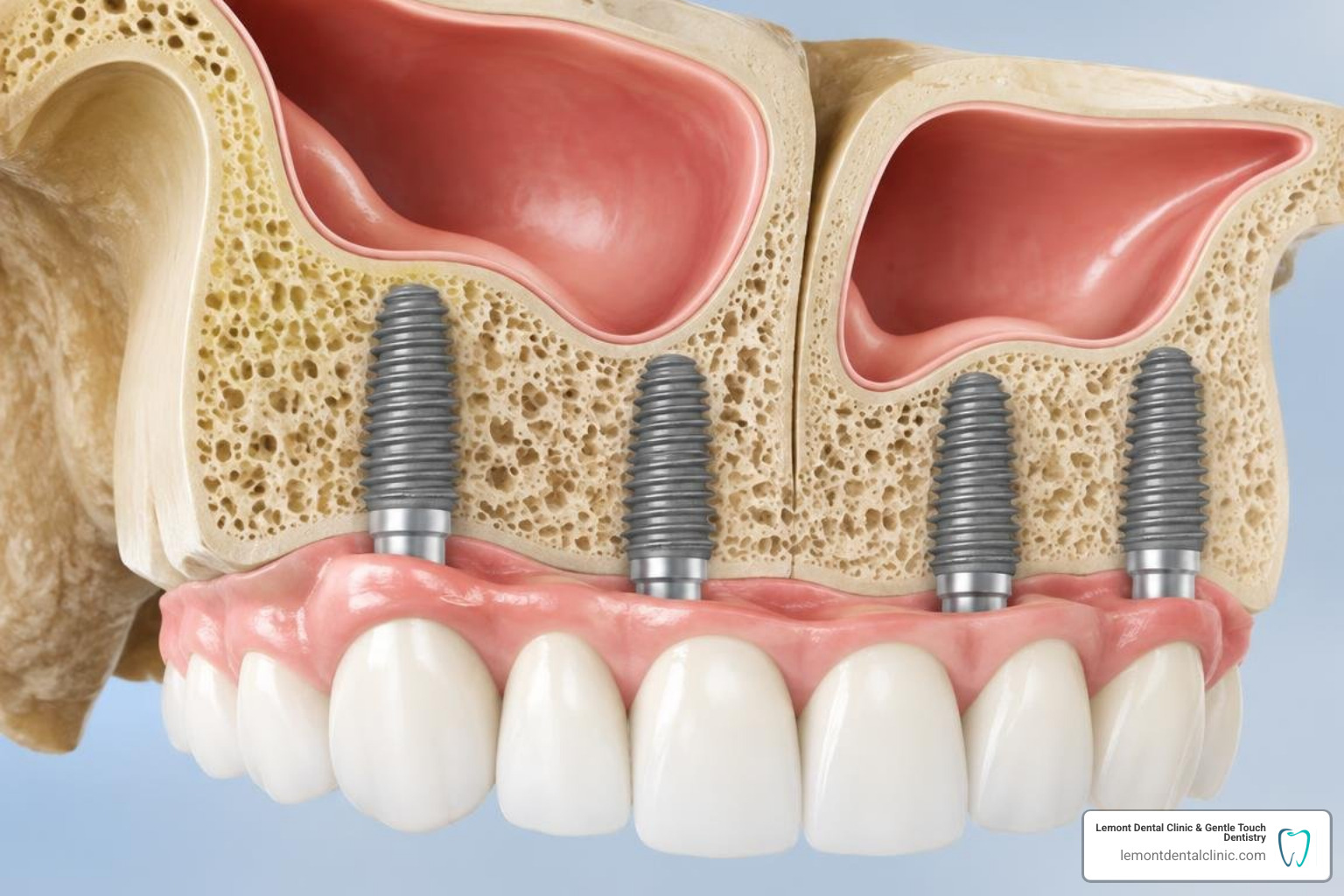
The upper jaw can add complexity. Its bone is often less dense than the lower jaw, and the sinus cavities sit above the back teeth. The dentist needs to plan implant positions around these structures and determine whether the available bone can support the restoration.
How much do full upper dental implants cost when extra procedures are needed?
The main cost drivers include:
Number and placement of implants: Some plans use four implants; others may call for five or six based on anatomy and support needs.
Existing teeth: Teeth that cannot be saved may need to be extracted before or during implant treatment. Each extraction can add to the total.
Bone volume: Bone grafting may be recommended if there is not enough bone to support implants.
Sinus position: A sinus lift may be considered when the sinus limits available bone in the upper back jaw.
Gum health: Active gum disease may need treatment before implant placement.
Sedation and anesthesia: The fee depends on the approach used and the patient’s needs.
Restoration design and material: Acrylic-based teeth and zirconia restorations have different costs and features.
As general estimates, bone grafting may add several hundred to several thousand dollars, while a sinus lift may add roughly $1,500 to $5,000. Extractions may add about $100 to $600 per tooth. These ranges vary by case and provider, and a patient may not need any of these procedures.
A 3D cone-beam CT scan can help assess bone and sinus anatomy and guide planning. It also helps the care team identify potential additional procedures before treatment begins, rather than relying on a guess based on a quick look.
What should an all-inclusive quote cover?
There is no universal definition of “all-inclusive.” One estimate may include the temporary teeth and final bridge, while another may list those separately. Before comparing totals, check whether each quote includes:
Consultation, examination, and diagnostic imaging, including a CBCT scan if needed
Treatment planning and surgical guidance
Extractions and any recommended gum treatment
Implant posts and placement surgery
Abutments or other connectors
Sedation or anesthesia
Temporary teeth during healing
The final prosthesis, including its material and lab work
Follow-up visits and adjustments
The cost of repairs, replacements, or warranty coverage, if offered
Ask whether the temporary restoration is different from the final set of teeth. A temporary bridge is intended for use during healing; it is not necessarily the same material or design as the permanent restoration. Acrylic and zirconia options can differ in appearance, durability, and price.
Our guide to the price of full mouth dental implants can help explain why full-arch treatment is priced differently from replacing individual teeth.
How Do Implants Compare With Dentures, Insurance, and Financing?
Implant treatment generally costs more upfront than a traditional denture because it includes surgery and implant-supported teeth. But the options also differ in stability, maintenance, and how they interact with the jawbone. The right choice depends on health, goals, budget, and clinical suitability.
How much do full upper dental implants cost after insurance?
Dental insurance may contribute to parts of treatment, but it rarely pays the entire cost of a full upper arch. Coverage depends on the specific plan. A policy may cover some related services, such as extractions or part of the prosthesis, while excluding implant placement or limiting the benefit.
Check your plan for:
Annual maximums and deductibles
Waiting periods for major services
Implant exclusions or replacement restrictions
Missing-tooth clauses
Coverage for the implant, abutment, and prosthesis as separate items
Whether the treatment must be considered medically necessary
Many dental plans have annual maximums in the range of about $1,000 to $2,500, which may cover only a portion of a full-arch bill. Ask the insurer for a written pre-treatment estimate based on the proposed procedure codes. It is an estimate, not a guarantee of payment.
Our overview of teeth implant pricing explains why plan benefits and out-of-pocket costs can vary.
What are the cost and function trade-offs with dentures?
Traditional dentures usually have a lower upfront cost and do not require implant surgery. They are removable and rest on the gums. Over time, they may need adjustments, relines, or replacement as the shape of the jaw changes.
An implant overdenture attaches to implants for added stability but remains removable. A fixed full-arch restoration stays in place and is generally removed only by a dental professional. Each option has different cleaning routines and treatment requirements.
Option
How it is supported
Cost and upkeep to consider
Traditional denture
Rests on the gums
Lower initial cost; may need relines, adjustments, and replacement
Implant overdenture
Attaches to implants and is removable
Higher initial cost than a traditional denture; attachments may need maintenance
Fixed full-arch implants
Secured to several implants
Higher upfront investment; requires daily cleaning and professional maintenance
Implants transfer chewing forces to the jaw through the implant posts, while traditional dentures do not stimulate the jaw in the same way. That does not mean implants are right for everyone: surgery, healing, home care, and ongoing checkups matter. Our overview of the pros and cons of full mouth dental implants can help you consider the trade-offs.
How can patients plan payments?
Depending on eligibility and the provider’s policies, patients may explore:
In-office payment arrangements
Healthcare credit cards
Personal loans
HSA or FSA funds, when the expense meets plan requirements
Staged treatment, with payments due at different phases
Compare more than the monthly payment. Ask about the interest rate, promotional period, fees, total repayment amount, and what happens if a promotional balance is not paid by the deadline. A lower monthly payment can mean paying more overall if the repayment period is longer.
Staging care may spread costs over time, but the clinical plan should guide the sequence. Ask whether delaying any phase could affect bone, gum health, or the final result.
How Can You Compare Quotes and Assess Long-Term Value?
A useful quote lets you see what is planned, what it costs, and which items are not included. If one estimate is much lower than another, compare the treatment details before assuming they are the same plan. One may include the final teeth and follow-up care, while another may price only the implant surgery.
What questions should you ask before accepting a quote?
Ask for a written, itemized estimate and use questions like these:
How many implants are included, and what type of restoration will they support?
Does the price include the exam, CBCT scan, treatment planning, and surgical guide?
Are extractions, gum treatment, bone grafting, or a sinus lift expected?
Are sedation and anesthesia included?
Will temporary teeth be provided? Are they included in the quoted amount?
What material will be used for the final prosthesis, and is lab work included?
Which provider plans, places, and restores the implants?
What follow-up visits and adjustments are included?
What maintenance, repair, or replacement costs could come later?
Is there a warranty, and what conditions apply?
Ask the provider to explain any line you do not understand. We encourage patients to compare complete treatment plans rather than choosing based only on a headline price. Our guide to dental implant prices near you offers more tips for evaluating estimates.
How does location affect the price?
Prices can vary with local operating costs, the provider’s experience, the equipment and lab services used, and whether treatment involves a general dentist, oral surgeon, periodontist, or coordinated team. Even within the Chicago area, two estimates may differ because the planned procedures, materials, and included services differ.
For patients in Lemont, Palos Hills, and nearby communities, a local assessment can clarify which costs apply to the individual case. We provide comprehensive general and restorative dental care, and our team can discuss the proposed treatment and its costs after reviewing the patient’s needs.
How long do full upper dental implants last?
Implant posts can last for many years and may last for decades with good care, but no lifespan is guaranteed. The prosthesis attached to them experiences daily wear and may need repair or replacement sooner. Some full-arch restorations may need significant maintenance or replacement after roughly 10 to 15 years, depending on material, use, and care.
Daily cleaning and regular dental checkups help the dental team monitor the implants, gums, and prosthesis. Smoking, gum disease, teeth grinding, and inconsistent home care can affect oral health and may increase the risk of complications. Budget for ongoing maintenance rather than treating the initial quote as the only possible expense.
Conclusion
The cost of full upper dental implants depends on more than how many implants are placed. The restoration type, bone and sinus anatomy, extractions, grafting, materials, sedation, and what the provider includes in the quote can all change the total.
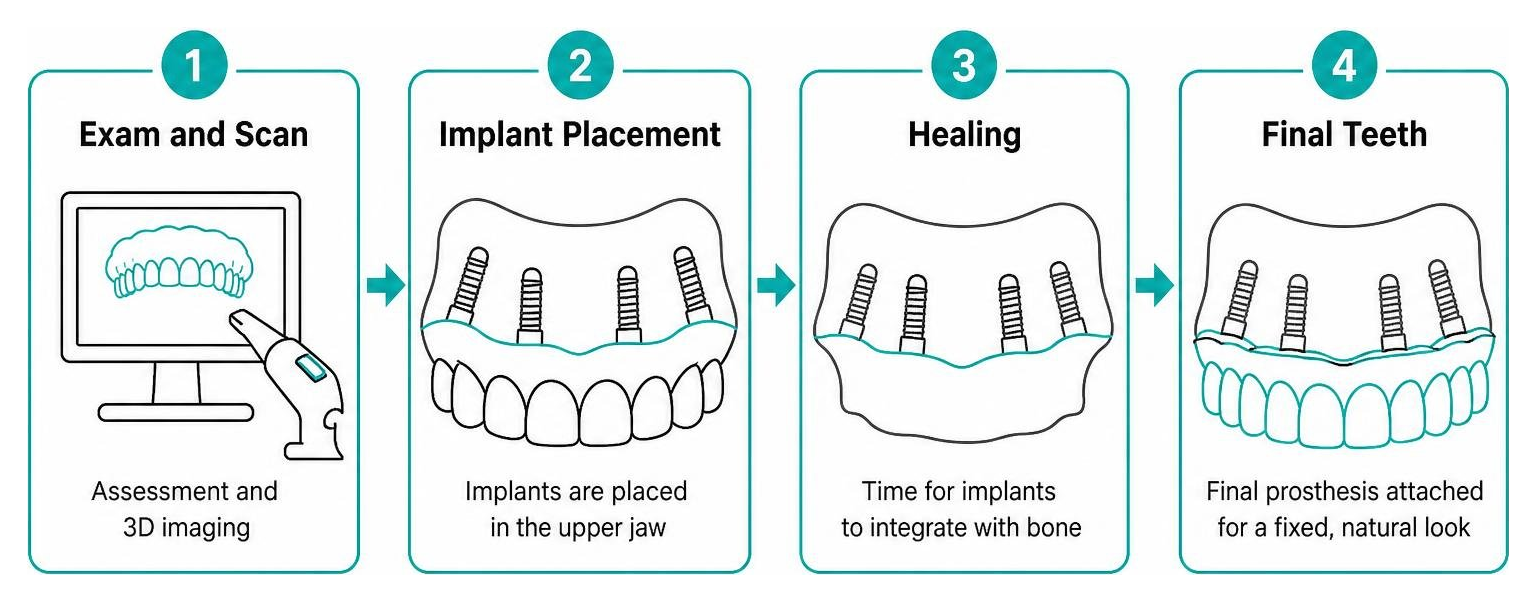
We recommend beginning with an examination and 3D imaging, then comparing written treatment plans line by line. At Lemont Dental Clinic & Gentle Touch Dentistry, we serve patients in Lemont and Palos Hills and can discuss restorative options and the factors that shape an estimate. Find more information about dental implants and treatment planning.
Frequently Asked Questions
Can full upper dental implants be placed in one day?
Some patients may qualify for implant placement with temporary teeth attached on the day of surgery. This does not mean the final prosthesis is ready that day. The implants need time to integrate with the bone, often several months, before the final teeth are fitted. Candidacy depends on factors such as bone support, overall health, and the planned restoration.
Are All-on-4 and snap-in dentures the same?
No. All-on-4 generally refers to a fixed bridge supported by implants and removed by a dental professional. A snap-in denture, also called an implant overdenture, attaches to implants but can be removed by the patient for cleaning. Their costs, daily care, and maintenance needs differ.
What additional costs might arise after treatment?
Later expenses can include routine professional cleanings and checkups, adjustments, replacement of worn attachments, repairs to the prosthesis, or eventual replacement of the restoration. Ask the provider what aftercare is included in the original estimate and what services may be billed separately.