Why Understanding Medicare Covered Dental Services Matters in 2026
What are Medicare covered dental services? The short answer: very few, but the exceptions matter.
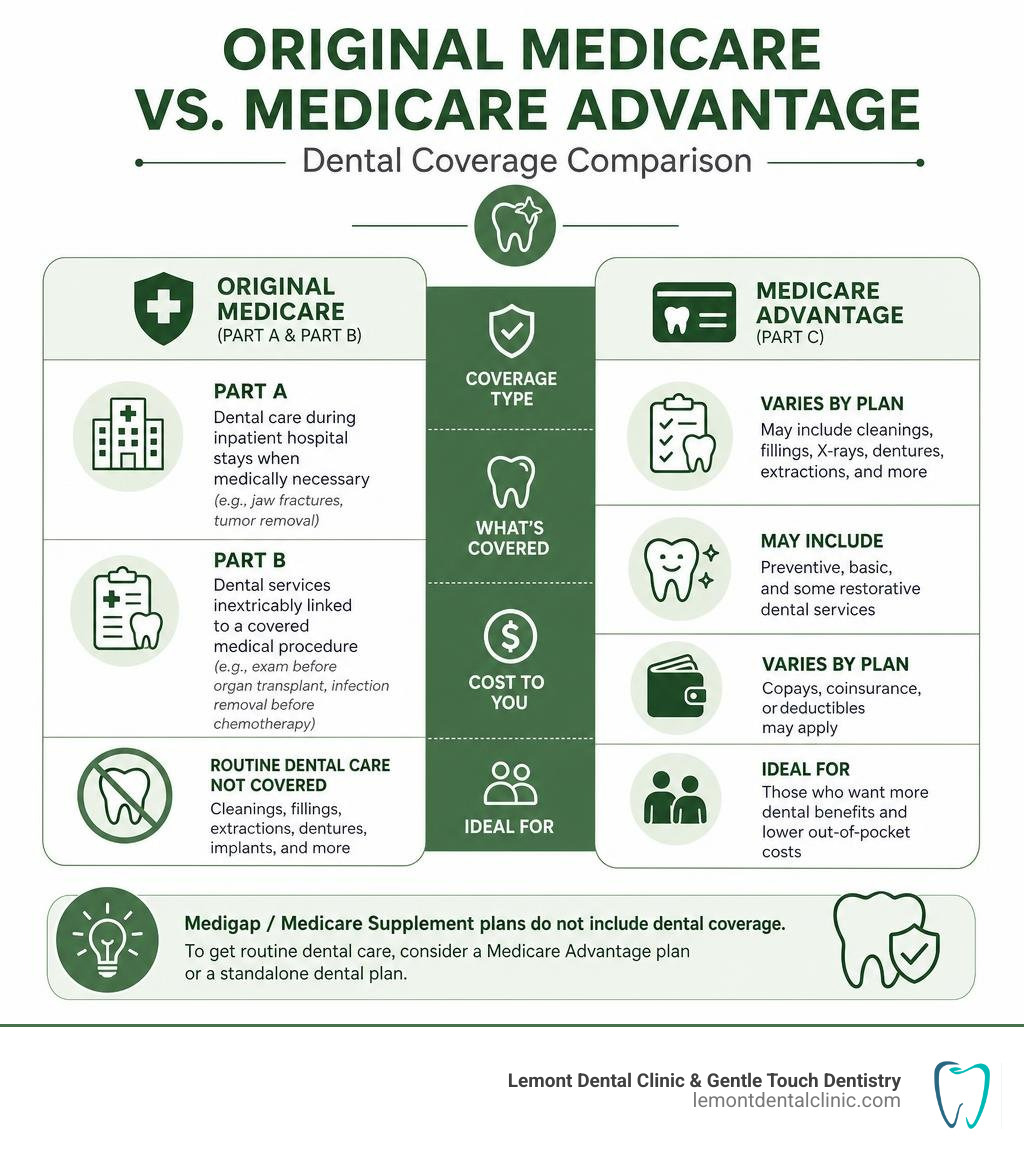
Here is a quick summary so you can get the key facts right away:
Coverage Type
What’s Covered
Original Medicare (Part A)
Dental care during inpatient hospital stays when medically necessary (e.g., jaw fractures, tumor removal)
Original Medicare (Part B)
Dental services inextricably linked to a covered medical procedure (e.g., exam before organ transplant, infection removal before chemotherapy)
Medicare Advantage (Part C)
Varies by plan — may include cleanings, fillings, X-rays, dentures, and more
Medigap / Medicare Supplement
No dental coverage
Routine dental care — cleanings, fillings, extractions, dentures, implants — is not covered by Original Medicare. That has been the rule since Medicare launched in 1965.
But there are real exceptions. Recent rule changes in 2023, 2024, and 2025 expanded coverage for patients with specific medical conditions. If you are preparing for an organ transplant, undergoing cancer treatment, or receiving dialysis for end-stage renal disease, Medicare may pay for certain dental services tied directly to your medical care.
In 2018, nearly half of all Medicare beneficiaries skipped dental visits entirely — and cost was the top reason. Among those who did get dental care, average out-of-pocket spending was $874. Knowing exactly what your coverage includes (and doesn’t) can make a real difference in your health and your wallet.
This guide breaks down every situation where Medicare covers dental care, what it costs you, and what your options are when it doesn’t.
Basic what are medicare covered dental services vocab:
What Are Medicare Covered Dental Services Under Original Medicare?
To understand what Original Medicare (Parts A and B) will pay for, we have to look at the law that created it. Under Section 1862(a)(12) of the Social Security Act, Medicare is explicitly prohibited from paying for services “in connection with the care, treatment, filling, removal, or replacement of teeth or structures directly supporting teeth.”
This means that for the vast majority of beneficiaries, everyday dental needs are completely excluded. However, the Centers for Medicare & Medicaid Services (CMS) has clarified that this exclusion does not apply when dental work is an integral part of treating a broader medical issue.
The core distinction lies in whether the dental service is considered “routine” or if it is “inextricably linked” to the clinical success of an otherwise covered medical service. If a dental infection threatens to derail an upcoming heart surgery, or if a damaged tooth must be removed to treat a fractured jaw, the dental care shifts from a standard elective procedure to a medically necessary intervention. You can find more details on these basic parameters on the official Dental service coverage page.
What Are Medicare Covered Dental Services Under Part A Inpatient Care?
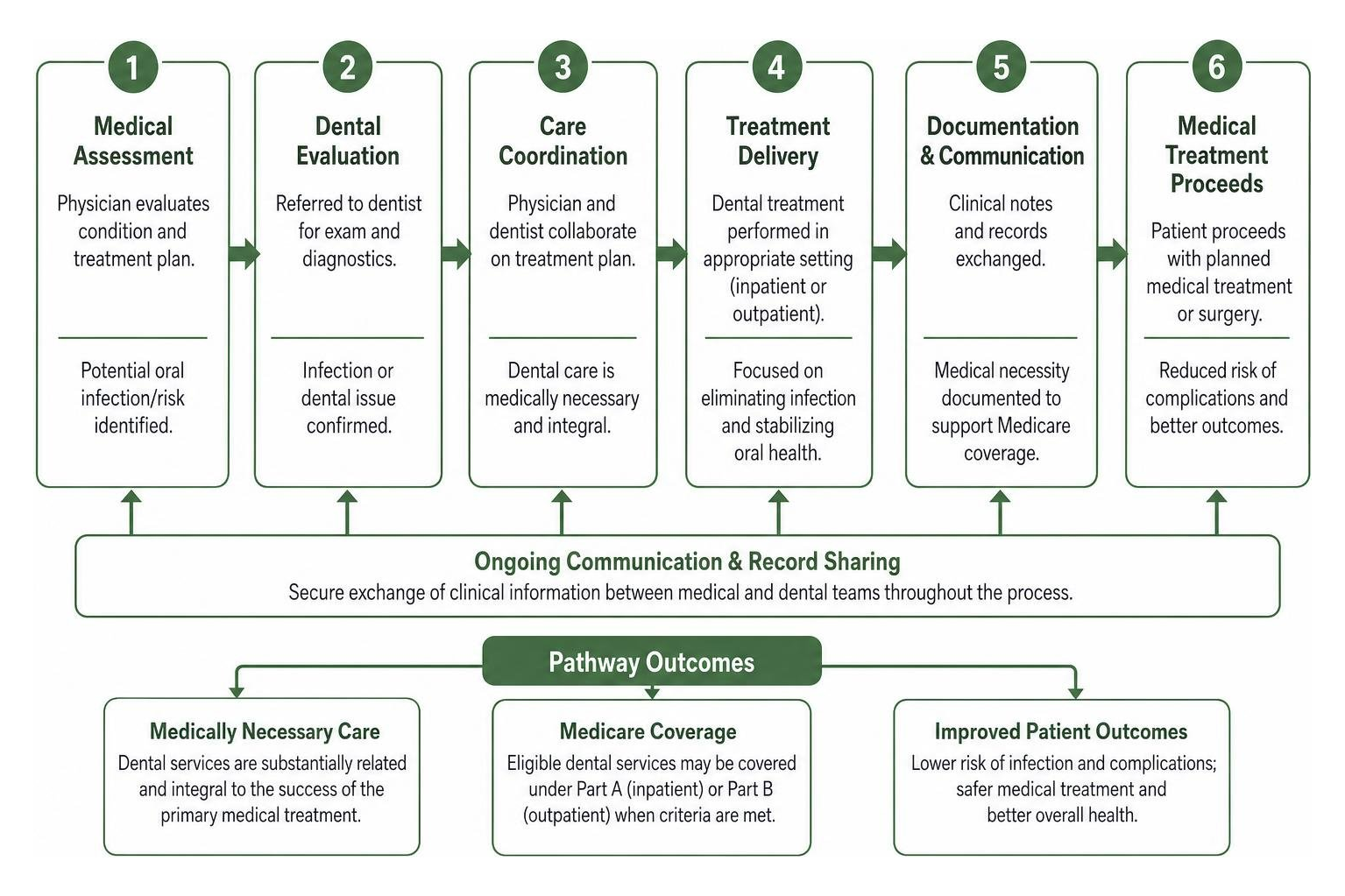
Medicare Part A covers inpatient hospital stays. If you require hospitalization because of the severity of a dental procedure, or if your dental care is an integral part of an inpatient medical procedure, Part A may cover the hospital costs and the dental services.
Historically, Part A has stepped in under very specific circumstances:
Severe Jaw Fractures: If you suffer a traumatic injury requiring the stabilization or wiring of teeth to repair a broken jaw, Part A covers both the dental work and the hospital stay.
Tumor Removal: If a tumor in the jaw or mouth requires surgical removal, and teeth must be extracted or the dental ridge reconstructed as part of that surgery, these services are covered.
Inpatient Dental Exams: In rare cases, if a patient has a severe underlying medical condition (such as advanced cardiovascular disease) that makes performing a dental extraction in a standard clinic too dangerous, Part A may cover the inpatient stay, though the extraction itself might still be billed separately depending on the primary medical diagnosis.
Part B and Medically Necessary Outpatient Dental Care
Medicare Part B covers outpatient medical services. While Part B has historically excluded dental care, recent regulatory updates have significantly expanded what qualifies as “medically necessary” outpatient dental care.
If a dental service is performed in an outpatient clinic setting (like our modern offices in Lemont or Palos Hills) and is directly tied to a covered medical procedure, Part B can cover:
The dental exam and diagnostic X-rays.
Active treatments to eliminate oral or dental infections (such as extractions or deep cleanings).
Ancillary outpatient services, including the administration of local anesthesia, sedation, or the use of an outpatient surgical facility.
The key rule here is that the dental services must be substantially related and integral to the success of the primary medical treatment. If you are simply getting a tooth pulled because it hurts, Part B will not cover it. But if that same tooth is pulled to eliminate an active infection before you receive a new heart valve, Part B is designed to cover the procedure.
Key Medical Conditions That Qualify for Medically Necessary Dental Care
The expansion of Medicare dental coverage relies entirely on the concept of an “inextricable link” between oral health and systemic medical success. Clinical evidence has long shown that oral infections can cause severe complications during major medical treatments.
To bridge this gap, CMS requires close care coordination between your medical physician and your dentist. This means we must actively communicate with your specialists, exchange medical records, and document that the dental work is required to safely proceed with your medical therapy.
What Are Medicare Covered Dental Services for Cancer and Transplant Patients?
For patients facing cancer treatments or major surgeries, an untreated dental infection can be life-threatening. CMS has finalized rules that explicitly allow Medicare payment for dental exams and treatments in several clinical scenarios:
Organ Transplants: Before undergoing any solid organ transplant (such as a kidney, liver, or heart transplant), patients must undergo a comprehensive oral exam and receive treatment to eliminate any active dental infections. This is because the immunosuppressive drugs required after a transplant make it incredibly difficult for the body to fight off oral bacteria.
Cardiac Procedures: Dental clearance is covered prior to cardiac valve replacements or valvuloplasty procedures. Bacteria from a tooth infection can easily travel through the bloodstream and colonize a newly implanted heart valve, leading to a dangerous condition called endocarditis.
Head and Neck Cancer Treatments: Medicare covers dental exams and treatments prior to, and during, radiation therapy or chemotherapy for head and neck cancers. Radiation can irreversibly damage the salivary glands, leading to severe dry mouth (xerostomia) and rapid tooth decay. It also carries a high risk of osteoradionecrosis—the death of jawbone tissue—if extractions are performed after radiation has begun. Pre-treatment dental care is vital to protect the bone.
Advanced Cancer Therapies: Coverage also extends to dental exams prior to chemotherapy, CAR T-cell therapy, and the administration of high-dose bone-modifying agents (which are often used to treat bone metastases but carry a risk of medication-related osteonecrosis of the jaw).
CMS estimates that these rules help approximately 190,000 transplant and cardiac patients and an additional 155,000 cancer patients access critical oral care before starting their treatments.
End-Stage Renal Disease (ESRD) and Dialysis
In the 2025 Physician Fee Schedule, CMS expanded coverage to include patients diagnosed with End-Stage Renal Disease (ESRD). For the roughly 30,000 traditional Medicare beneficiaries receiving dialysis, oral health is highly critical.
Medicare now covers dental or oral examinations, alongside diagnostic and treatment services, to eliminate oral or dental infections prior to or concurrent with Medicare-covered dialysis services. Eliminating these infections reduces the risk of systemic infections (sepsis) and vascular access complications, which are common and dangerous for dialysis patients. CMS estimated that providing this vital dental care to ESRD patients represents a highly efficient use of resources, costing the Medicare program less than $1 million annually while significantly improving patient safety.
Out-of-Pocket Costs and Cost-Sharing for Covered Services
Just because Medicare covers a dental service does not mean it is completely free of charge. We must emphasize that Medicare-covered dental services are subject to the exact same deductibles, coinsurance, and cost-sharing rules as any other medical treatment under Part A or Part B.
Medicare Part
Applicable Cost-Sharing (2026 Rules)
What You Pay
Part A (Inpatient)
$1,736 Deductible per benefit period
$0 copayment for days 1–60; daily copayments apply for days 61–150
Part B (Outpatient)
Annual Part B Deductible
20% coinsurance of the Medicare-approved amount after meeting the deductible
Part A Deductibles and Lifetime Reserve Days
If your dental care requires an inpatient hospital stay, your costs are determined by Medicare Part A benefit periods.
The Deductible: For each benefit period in 2026, you must first pay a Part A deductible of $1,736 before Medicare begins to pay.
Days 1 to 60: You pay a $0 copayment for each day.
Days 61 to 90: You pay a daily copayment of $434.
Days 91 to 150: If you must remain hospitalized longer than 90 days, you will begin drawing from your 60 lifetime reserve days, which carry a daily copayment of $868 in 2026. Once these lifetime reserve days are exhausted, you are responsible for all hospital costs.
Part B Coinsurance and Deductibles
If your medically necessary dental services are performed in an outpatient clinic or surgical center, they fall under Medicare Part B.
The Deductible: You must first meet your annual Part B deductible.
The Coinsurance: Once the deductible is met, you are responsible for a 20% coinsurance of the Medicare-approved amount for the dental services, x-rays, or anesthesia.
Medicare Assignment: To minimize your out-of-pocket spending, it is highly important to ensure your provider accepts Medicare assignment. Providers who accept assignment agree to accept the Medicare-approved payment amount as payment in full, preventing them from billing you for any balance beyond your 20% coinsurance.
Medicare Advantage (Part C) vs. Original Medicare Dental Benefits
Because Original Medicare’s dental coverage is so strictly limited to medical necessity, nearly half of all Medicare beneficiaries choose to enroll in Medicare Advantage (Part C) plans instead. Offered by private, Medicare-approved insurance companies, these plans are required to provide at least the same level of coverage as Original Medicare, but they frequently bundle extra benefits—like routine dental care—to attract members.
Routine Care Covered by Medicare Advantage Plans
Unlike Parts A and B, many Medicare Advantage plans do cover routine, preventive, and restorative dental care. Depending on the plan you select, your benefits may include:
Routine cleanings, oral exams, and basic diagnostic X-rays (often covered at 100%).
Basic restorative care, such as dental fillings and simple extractions (often covered at around 80%).
Major restorative care, including root canals, crowns, bridges, and dentures (often covered at 50%).
While this sounds highly convenient, the scope of coverage varies dramatically by plan, and you must review your plan’s specific Evidence of Coverage to understand what is actually paid for.
Understanding the Limitations of Part C Dental Coverage
Before enrolling in a Medicare Advantage plan solely for the dental benefits, it is vital to understand their limitations:
Network Restrictions: Most Part C plans operate as HMOs or PPOs. This means you must visit a dentist who is in the plan’s specific network. If you visit an out-of-network dentist, your plan may not pay anything, leaving you with the full bill.
Annual Maximums: Virtually all Medicare Advantage plans place a strict cap on how much they will pay for your dental care in a single calendar year. This annual maximum typically ranges from $1,000 to $2,000. If you require major work—like a crown or a bridge—a single procedure can easily exhaust your entire annual maximum, leaving you to pay the remaining balance out of pocket.
Prior Authorization: For major procedures, your plan may require your dentist to submit a pre-treatment estimate and obtain prior authorization before they agree to cover the service. To learn more about how these limitations affect complex treatments, read our article on Will Your Insurance Pay for Implants or Leave You Frowning?.
Excluded Dental Services and Alternative Coverage Options
Even with recent rule changes and the availability of Medicare Advantage, many dental procedures remain entirely excluded from traditional Medicare coverage.
The most notable exclusions include:
Routine Preventive Care: Standard cleanings, routine exams, and regular X-rays.
Basic and Major Restorative Work: Fillings, root canals, crowns, and bridges that are not tied to a qualifying medical condition.
Dentures and Implants: Traditional dentures, partials, and dental implants are almost never covered by Original Medicare, even if they are needed to restore your ability to chew after a medically necessary extraction. For a detailed look at how private insurance handles these complex procedures, see our guide on Medical Insurance for Dental Implants: A Step-by-Step Guide to Coverage.
Standalone Dental Insurance and Medigap Limitations
If you choose to stay on Original Medicare but still want coverage for routine dental care, you must look at alternative options.
Medigap (Medicare Supplement Insurance) Limitations: Many beneficiaries assume that buying a Medigap policy will help pay for their dental bills. However, Medigap policies are only designed to cover the “gaps” in Original Medicare (such as your Part A or Part B deductibles and coinsurance). Because Original Medicare does not cover routine dental care, a Medigap policy will not cover it either.
Standalone Dental Plans: You can purchase an individual dental insurance policy directly from a private insurance carrier. These plans typically follow a standard 100-80-50 coverage model and can help offset the costs of cleanings, fillings, and crowns.
Dental Discount Plans: These are not insurance policies but rather membership clubs. You pay an annual fee to access a network of dentists who have agreed to provide services at discounted rates.
For a Medicare beneficiary to receive coverage for a medically necessary dental service, the dentist performing the work must be properly enrolled in the Medicare program.
Dentists must enroll through the Provider Enrollment, Chain, and Ownership System (PECOS) as either a participating, non-participating, or ordering/referring provider. If a dentist has completely “opted out” of Medicare, Medicare cannot pay for any services they provide, even if those services are medically necessary.
Furthermore, billing for these services requires highly meticulous documentation:
Care Coordination Documentation: The dental provider must document active coordination with the referring medical physician. This includes keeping copies of the medical referral, written consultations, and shared treatment plans in the patient’s file.
The KX Modifier: When submitting claims to Medicare Administrative Contractors (MACs), providers must use the KX modifier on the claim form. This modifier serves as a formal certification by the provider that the dental services are “inextricably linked” to a covered medical procedure and that all required care coordination documentation is on file.
Billing Formats: Claims must be submitted using the appropriate standard billing formats (such as the 837D dental format, or 837P/837I for professional and institutional medical claims) depending on the setting where the care was delivered.
Frequently Asked Questions About Medicare Dental Coverage
Does Original Medicare cover routine cleanings and fillings?
No. Original Medicare (Parts A and B) does not cover routine cleanings, exams, X-rays, fillings, or extractions. You are responsible for 100% of the costs of these services out of pocket unless you have a Medicare Advantage plan that includes routine dental benefits or a standalone private dental policy.
Does Medigap cover dental procedures?
No. Medigap (Medicare Supplement) policies only pay for cost-sharing (like copayments and deductibles) for services that are already covered by Original Medicare. Since Original Medicare excludes routine dental care, Medigap will not pay for routine dental procedures.
How do I know if my dental procedure is considered medically necessary?
A dental procedure is considered medically necessary by Medicare only if it is “inextricable linked” to the success of an upcoming, covered medical treatment. This requires your medical specialist (such as your cardiologist, oncologist, or transplant surgeon) to coordinate directly with your dentist to document that the dental work must be completed to safely proceed with your medical care.
Conclusion
Navigating the rules of Medicare dental coverage can feel overwhelming, but understanding the exceptions for medically necessary care is vital to protecting both your health and your finances. While routine care remains excluded under Original Medicare, the expanding rules for cancer, transplant, and dialysis patients offer a critical pathway to safer, integrated medical treatment.
At Lemont Dental Clinic & Gentle Touch Dentistry, we provide high-quality, comprehensive general and restorative dental care to our patients in Lemont, Palos Hills, and surrounding communities like Hickory Hills, Oak Lawn, and Orland Park, IL. Our experienced doctors utilize the latest dental technology to deliver exceptional care at competitive, transparent prices, prioritizing both clinical quality and affordability.
If you are preparing for a major medical procedure and need to coordinate medically necessary dental clearance, or if you simply want to discuss your private dental insurance options, we are here to help. Explore our comprehensive dental services and schedule your appointment with our dedicated team today.