Why Getting Dental Implants Covered by Medical Insurance Is Harder Than It Should Be
How to get dental implants covered by medical insurance is one of the most common — and most frustrating — questions patients face when they’re told they need implants.
Here’s the quick answer most people are looking for:
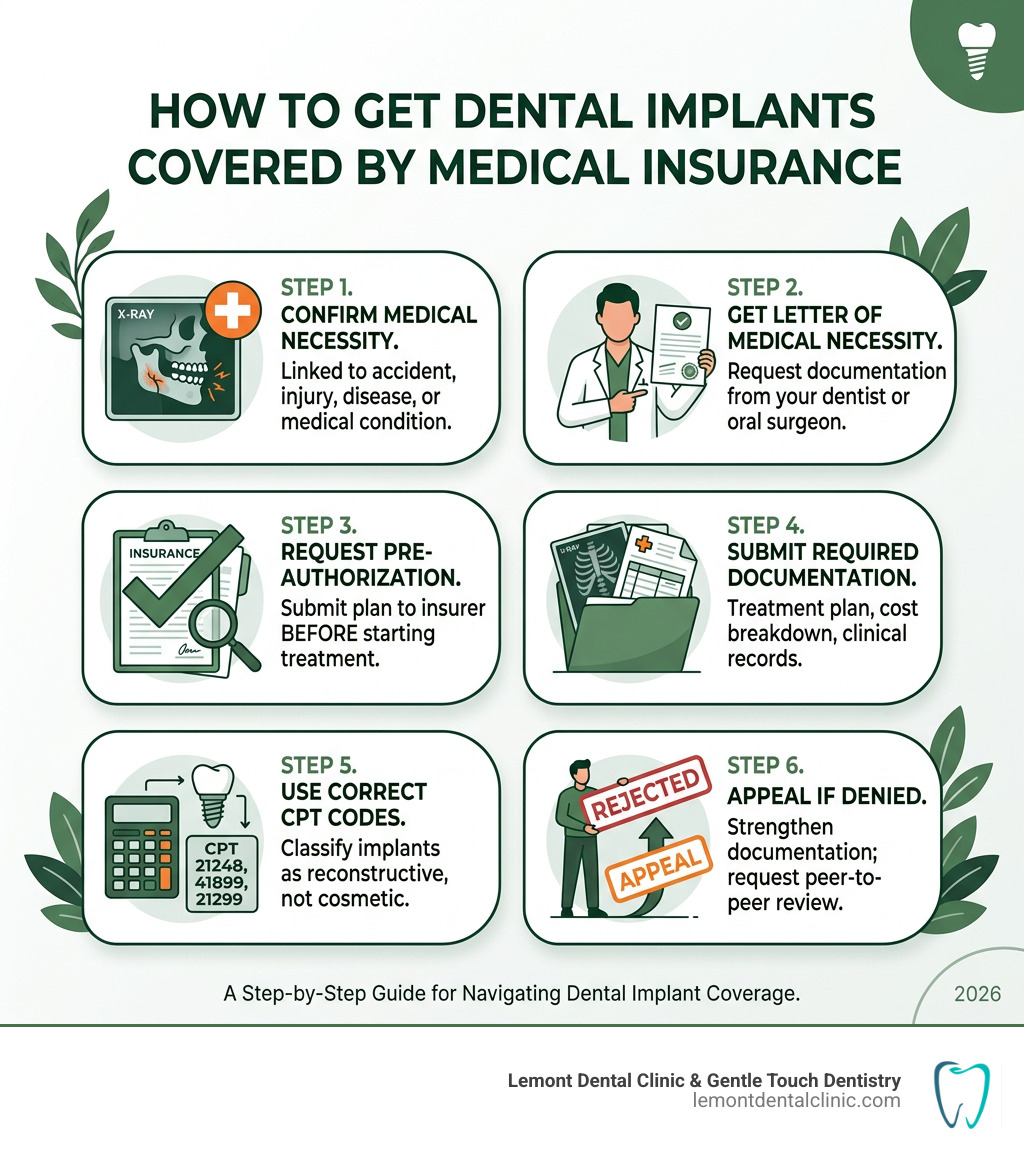
Steps to get dental implants covered by medical insurance:
Confirm medical necessity — your tooth loss must be linked to an accident, injury, disease, or medical condition
Get a Letter of Medical Necessity from your dentist or oral surgeon
Request pre-authorization from your insurer before treatment begins
Submit the right documentation — X-rays, treatment plan, itemized costs, clinical records
Use correct CPT billing codes (such as 21248, 41899, or 21299) to classify implants as reconstructive, not cosmetic
Appeal if denied — many denials are overturned with stronger documentation or a peer-to-peer review
Most medical insurance companies automatically label dental implants as cosmetic — and deny coverage without a second look. But that’s not always the end of the road.
When implants are tied to a medical cause — like a car accident, oral cancer, jaw trauma, or a congenital defect — medical insurance can step in. The key is knowing exactly how to document and present your case.
Dental insurance helps too, but it has real limits. Most plans cap annual benefits at $1,000–$1,500, which barely covers a fraction of implant costs ranging from $1,600 to $2,200 per tooth (and more with grafting or sedation).
That gap between what you need and what insurance pays is exactly why understanding both your dental and medical coverage matters so much.
I’m Piotr Dederowski of Lemont Dental Clinic & Gentle Touch Dentistry, and helping patients navigate the financial side of restorative care — including how to get dental implants covered by medical insurance — is something I work through with patients every day. Let me walk you through everything you need to know to give yourself the best possible shot at coverage.
Key terms for how to get dental implants covered by medical insurance:
Understanding When Medical Insurance Covers Dental Implants
At our offices in Lemont and Palos Hills, IL, we often see patients who are surprised to learn that their health insurance might actually chip in for dental work. While dental insurance is designed for “maintenance” (cleanings, fillings, and the occasional crown), medical insurance is designed for “catastrophe” or “reconstruction.”
To understand how to get dental implants covered by medical insurance, you first have to understand the difference in how these two entities view your mouth.
Feature
Dental Insurance
Medical Insurance
Primary Goal
Preventive & Basic Restorative
Treatment of Illness or Injury
Annual Max
Usually $1,000–$2,000
Often No Annual Max (but high deductibles)
Criteria
Clinical need for tooth function
Medical Necessity for overall health
Implant View
Often “Major” or “Cosmetic”
Reconstructive (if applicable)
According to medical insurance Coverage Criteria, the most critical factor is the direct connection between the implant and a medical necessity. This means the procedure must be essential for your overall physical health, not just your smile’s appearance.
Common Scenarios for Medical Coverage
Medical insurance is most likely to provide coverage for implants in the following cases:
Accidental Injury and Facial Trauma: If you lost teeth in a car accident, a fall, or a sports injury, medical insurance often covers the replacement as part of reconstructive surgery.
Oral Cancer and Tumor Resection: If teeth were lost due to the removal of a tumor or as a side effect of radiation therapy, medical plans frequently cover the restoration of the jaw and teeth.
Congenital Defects: Conditions like cleft palate or ectodermal dysplasia that result in missing teeth from birth are often covered.
Severe Jawbone Atrophy: If you have lost so much bone that you cannot eat or speak properly, and traditional dentures won’t work, medical insurance may cover implants to stabilize the jaw.
Medical Conditions Impacting Oral Health: Conditions like Sjogren’s Syndrome (which causes severe dry mouth and tooth decay) or complications from diabetes can sometimes qualify.
How to Get Dental Implants Covered by Medical Insurance: A 6-Step Playbook
Securing coverage isn’t just about having the right condition; it’s about following a very specific “paper trail.” If you miss a step, the insurance company has an easy excuse to say “no.”
Step 1: The Comprehensive Evaluation
Everything starts with a thorough exam. We use advanced diagnostic imaging, such as 3D Cone Beam CT scans, to document the exact state of your jawbone and teeth. You can learn more about what to expect during this phase by reviewing Dental Implants: What You Should Know. This documentation is the foundation of your claim.
Step 2: Proving Medical Necessity
This is where we bridge the gap between “dental” and “medical.” We don’t just say you need a tooth; we explain why your health will suffer without it. For example, if tooth loss has led to significant weight loss because you can’t chew, or if it has caused severe TMJ issues, we document those functional impairments. Having a dental-implants specialist who knows how to frame these issues is vital.
Step 3: Physician Collaboration
If your tooth loss is related to a systemic condition (like bone loss from osteoporosis) or an injury, a letter from your primary care physician or a specialist (like an oncologist or rheumatologist) can be a game-changer. When your doctor and your dentist agree that implants are necessary for your recovery, the insurance company listens.
Step 4: Navigating the Pre-Authorization Process
Never start the procedure until you have a written pre-authorization. You should Work with Your Insurance Provider to clarify exactly what they need. We provide a detailed treatment plan, itemized costs, and the necessary medical codes. This step helps you understand your out-of-pocket responsibility before the first surgery date. For more on managing these costs, see our page on service-post/implant-financing.
Step 5: Using the Correct Medical Billing (CPT) Codes
Medical insurance doesn’t use the same “D-codes” that dental insurance uses. Instead, they use CPT (Current Procedural Terminology) codes. Using the wrong code is the fastest way to get a denial. Common codes include:
21248: Reconstruction of mandible or maxilla with endosteal implant (partial).
21299: Unlisted craniofacial vàriable.
Using these codes helps frame the procedure as reconstructive surgery rather than a simple dental visit. Check our dental-implants-cost-estimate for more details on how these procedures are structured.
Step 6: Filing the Claim and Following Up
Once the procedure is done (or authorized), the claim is filed with all supporting X-rays and clinical notes. Persistence is key here. Insurance companies are famous for “losing” paperwork or asking for the same document twice.
Overcoming Denials and Coordinating Benefits
Even with a perfect playbook, denials happen. In fact, many medical claims for dental work are denied on the first try. Don’t panic — this is often a “soft no” designed to see if you’ll give up.
Common Denial Reasons
The “Cosmetic” Label: The most common reason. They claim the implant is just for looks.
The “Missing Tooth Clause”: Some plans won’t cover a tooth that was missing before you joined the plan.
Lack of Documentation: They might claim they never received the X-rays or the letter of medical necessity.
Exclusion Terms: Some policies explicitly state they do not cover “dental implants” regardless of the reason.
If you’re denied, you have the right to an appeal.
Request a Peer-to-Peer Review: This allows your oral surgeon to speak directly with a medical director at the insurance company. Often, a five-minute doctor-to-doctor conversation can overturn a denial that a clerk issued.
Submit Additional Evidence: Sometimes a new X-ray or a more detailed letter from your physician can tip the scales.
Be Persistent: Statistics show that a significant percentage of denied claims are eventually paid if the patient and provider continue to appeal. You can find more about pricing and advocacy at dental-implants-near-me-prices.
Strategies for Coordinating Medical and Dental Insurance
Think of your medical insurance as your “primary” and your dental as your “secondary” for these types of cases.
Maximize Annual Maximums: Use your dental insurance for the components medical won’t cover (like the final aesthetic crown).
Time Your Procedures: If you need multiple implants, consider splitting the treatment across two calendar years to maximize two years of dental insurance maximums.
Dual Coverage: If you and your spouse both have insurance, you can sometimes “stack” the benefits. For more on making this work in the Chicago suburbs, check affordable-dental-implants-cost-near-me.
Alternatives and Financial Planning for Implant Costs
If medical insurance simply isn’t an option, there are other ways to manage the cost. About 3 million people in the U.S. already have implants, and that number grows by 500,000 every year. They aren’t all paying cash upfront!
Using FSAs and HSAs to Get Dental Implants Covered by Medical Insurance
Flexible Spending Accounts (FSAs) and Health Savings Accounts (HSAs) are powerful tools.
Pre-Tax Savings: You can use pre-tax dollars to pay for your implants, which effectively gives you a 20-30% discount depending on your tax bracket.
FSA Limits: For 2024, you can contribute up to $3,200 (though research notes $2,850 was a previous limit, always check current IRS rules).
HSA Benefits: If you have a high-deductible health plan, your HSA funds roll over year to year, allowing you to save up for a major procedure.
Documentation: You will likely need a receipt and a letter of medical necessity to prove the expense was for a health-related reason, not just cosmetic whitening.
If your current plan is lacking, you might consider:
Supplemental Dental Insurance: Some plans have higher maximums or specific “implant riders.”
Dental Savings Plans: These are not insurance but “club memberships” that give you a 20-50% discount at participating providers.
Third-Party Financing: Companies like CareCredit allow you to break the cost into monthly payments. This is a very common way our patients in Lemont and Palos Hills manage their care. Explore these options at cheap-dental-implants-near-me-prices.
Frequently Asked Questions about Medical Insurance for Dental Implants
Do Medicare, Medicaid, or Illinois-specific plans cover dental implants?
Original Medicare: Generally does not cover dental implants. However, it may cover the medical aspects of a dental procedure if you are hospitalized or if the dental work is a prerequisite for another covered surgery (like a heart transplant).
Medicare Advantage (Part C): Many of these private plans do offer dental benefits that may include partial coverage for implants.
Medicaid in Illinois: Medicaid coverage for adults is generally limited to extractions and basic care. Implants are rarely covered unless there is an extreme medical necessity (like reconstruction after oral cancer).
What are the most common reasons for claim denial?
The most common reason is the “cosmetic” exclusion. Insurance companies would rather pay for a $700 denture that needs to be replaced every five years than a $2,000 implant that lasts a lifetime. Other reasons include “lack of clinical necessity” or “missing tooth prior to effective date.”
How do I find a provider who bills medical insurance for implants?
Not all dental offices are equipped to handle medical billing—it is much more complex than dental billing. You should look for oral surgeons or restorative dentists who have experience with “medical necessity” cases. At Lemont Dental Clinic, we work closely with patients to help them navigate these hurdles.
Conclusion
Navigating insurance can feel like a full-time job, but your oral health is worth the effort. Dental implants are more than just a “new tooth”; they are an investment in your ability to eat, speak, and live with confidence. They preserve your jawbone and protect your remaining natural teeth from shifting or breaking.
At Lemont Dental Clinic & Gentle Touch Dentistry, we believe that high-quality restorative care should be accessible. Whether you are in Lemont, Palos Hills, or surrounding areas like Oak Lawn or Bolingbrook, we are here to help you understand how to get dental implants covered by medical insurance.
We combine decades of experience with the latest technology to ensure your procedure is successful and your insurance benefits are maximized. Don’t let the complexity of insurance stop you from getting the care you need.
Ready to start your journey to a healthier smile? Visit our dental implants page to schedule a consultation and let us help you build a plan that works for your health and your budget.