If you are dealing with a missing or damaged tooth, calculating the cost of one fake tooth is likely your very first step toward getting your smile back.
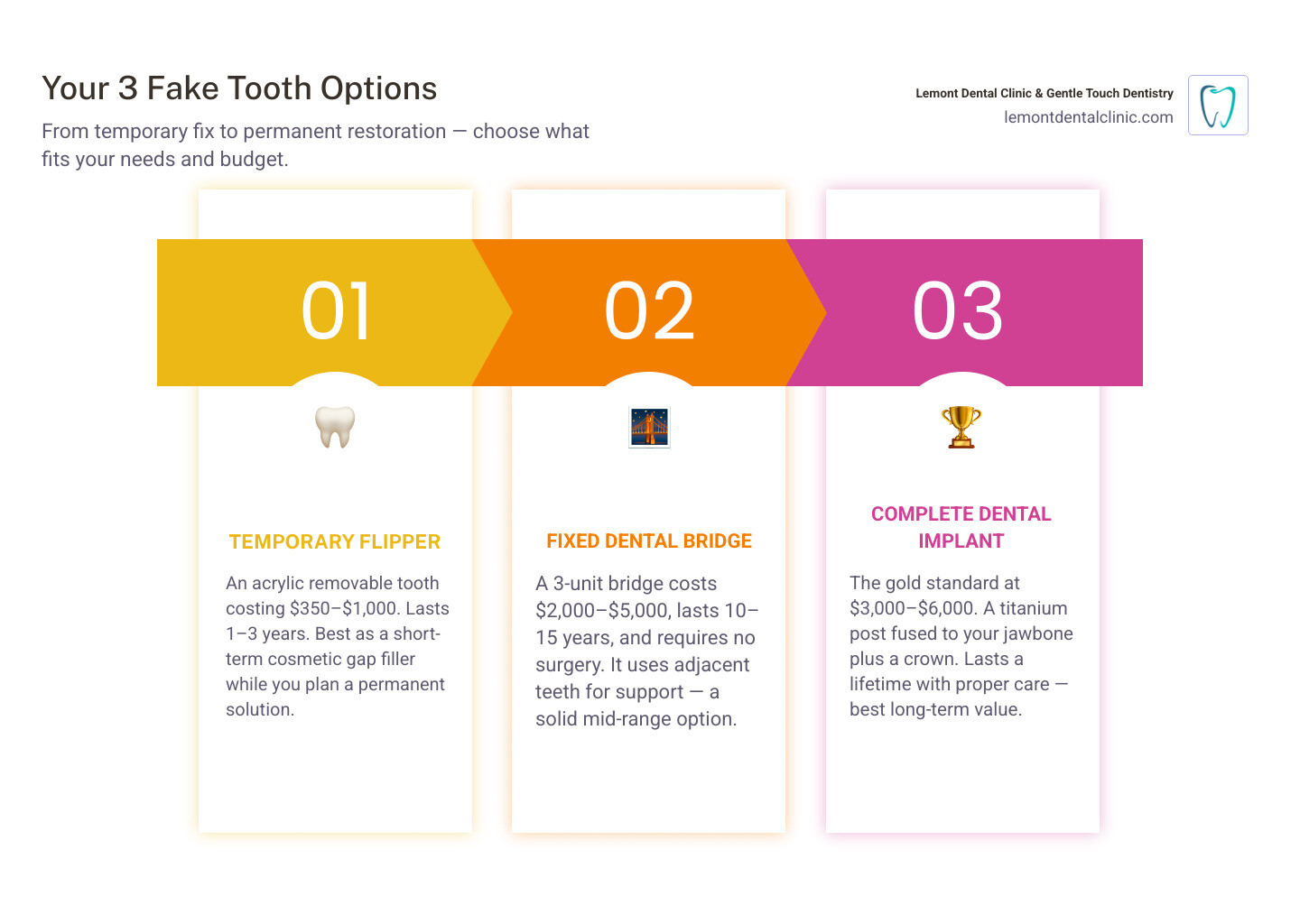
The short answer is that the price varies widely depending on whether you choose a temporary cosmetic fix, a dental bridge, or a permanent dental implant.
Here is a quick breakdown of what you can expect to pay in 2026:
Tooth Replacement Type
Typical Cost Range
Average Lifespan
Best For
Temporary Cosmetic Tooth (DIY Kit)
$50 – $200
Days to weeks
Quick, emergency visual fix
Temporary Flipper Tooth (Acrylic)
$350 – $1,000
1 – 3 years
Transitioning to a permanent fix
Fixed Dental Bridge (3-Unit)
$2,000 – $5,000
10 – 15 years
Replacing a tooth without surgery
Complete Dental Implant (Post & Crown)
$3,000 – $6,000
Lifetime (Post)
Permanent, natural-feeling restoration
Note: In 2026, the national average for a complete single dental implant—including the surgical post, abutment, and crown—is $4,507.
We know that dental costs can feel overwhelming. Past dental anxiety or worries about unexpected fees should not keep you from getting the care you deserve.
Let’s break down these options, look at the real-world numbers, and find the path that fits both your health and your budget.
Temporary vs. Permanent: Understanding Your Options and the Cost of One Fake Tooth
When you lose a tooth, your immediate reaction might be to find the fastest, most direct way to plug the gap. However, there is a massive difference between a temporary cosmetic patch and a permanent medical restoration. Understanding these differences will help you avoid spending money on a quick fix that could cause more trouble down the road.
At the lowest end of the price spectrum are DIY temporary tooth replacement kits, which typically cost between $50 and $200. These products, often found online, use thermal plastic beads that soften in hot water so you can mold a plastic tooth to wedge into the empty space.
While they might save you from closing your lips in photos for a weekend event, they are strictly cosmetic. They do not bond to your gums, they rely entirely on friction against adjacent teeth, and manufacturers explicitly warn against eating or sleeping with them. Using too much of the thermal bead material can also leave you looking like you had a bad lip filler mishap or walked away with “horse teeth.”
A professional temporary option is an acrylic flipper tooth, which typically ranges from $350 to $1,000. This is a lightweight, removable partial denture fabricated by a lab. It is an excellent transitional tool while you wait for a permanent solution, but it is not built for heavy chewing and can degrade your gum health if worn long-term.
For a true, lifelong solution, a permanent dental implant is the gold standard. Unlike temporary options, an implant undergoes a biological process called osseointegration. This is where a biocompatible titanium post is surgically placed into your jawbone, and over a period of two to six months, your bone actually grows around and fuses with the metal. This creates a solid anchor that functions exactly like a natural tooth root.
While the upfront cost is higher, implants protect your jawbone from shrinking and do not put stress on your surrounding teeth. To explore the wider variety of options available, read our guide on the different types of fake teeth or read more about the basic Cost of a Fake Tooth – Cost Digest to see how temporary and permanent options compare.
The Complete Breakdown of Single Dental Implant Costs
If you decide to invest in a permanent solution, it is important to know exactly what goes into the pricing of a dental implant. Many online advertisements feature misleadingly low prices, but those quotes often only cover the surgical placement of the metal post, leaving out the essential parts needed to actually complete your smile.
When looking at a complete single-tooth dental implant, the national average price in 2026 sits at $4,507, with a typical range of $3,000 to $6,000. This range covers the surgical post, the connector piece (abutment), and the custom-made crown that looks like a real tooth.
To make sure you are budgeting accurately and avoiding unexpected “surprise” fees, it is highly recommended to request a comprehensive dental implants cost estimate that outlines every single step of the process. For a complete look at the overall timeline and clinical steps, check out the Single Tooth Dental Implants Cost and Procedure Guide.
The Average Cost of One Fake Tooth Implant by Component
To understand why a single dental implant costs what it does, we can break it down into its three core physical components:
The Surgical Post ($1,500 – $2,500): This is the titanium or ceramic screw that acts as your new tooth root. It requires surgical placement by a skilled dentist or oral surgeon.
The Abutment ($500 – $1,000): This is the custom metal or ceramic collar that screws into the implant post and sits just above the gumline, serving as the connector for your new tooth.
The Dental Crown ($1,000 – $2,500): This is the visible “fake tooth” that is custom-shaded and shaped to match your surrounding teeth.
The material you choose for your crown plays a major role in the final price. High-end materials like zirconia or solid porcelain offer incredible durability and a natural, translucent look, but they sit at the higher end of the pricing spectrum.
Geographic Price Variations: What You Pay Across the U.S.
Dental costs are heavily influenced by where you live. Because running a dental practice involves significant overhead—such as rent, commercial property costs, staff wages, and specialized equipment—the cost of living in your specific region accounts for roughly 70% of the price variance in dental procedures.
In 2026, the cost of a complete single dental implant ranges from $3,759 in lower-cost states like Alabama to as high as $5,733 in high-overhead states like California.
Here in Illinois, the average cost of a complete single implant is $4,589, placing our state slightly above the national average. However, prices can also vary significantly between bustling urban centers like downtown Chicago and suburban communities.
For patients living in Lemont, Palos Hills, Bolingbrook, Orland Park, or Oak Lawn, seeking care in a suburban setting can often save you 10% to 25% compared to downtown Chicago rates, without sacrificing any quality of care.
Cost-Effective Professional Alternatives to a Permanent Dental Implant
While dental implants are the ideal long-term solution, they are not the only professional option available. If you need a more budget-friendly approach, or if you are not a candidate for dental surgery due to medical reasons, there are several reliable alternatives that we can design to restore both your bite and your confidence.
These professional alternatives include dental bridges, removable partial dentures, and temporary transitional crowns. By working with a trusted clinical team, you can find a solution that fits your budget while still protecting your oral health.
To learn more about finding restorative options near you, read about our competitive pricing on dental implants.
Comparing the Cost of One Fake Tooth Alternative: Bridges, Partials, and Flippers
If you are weighing your options, it helps to compare the exact costs, benefits, and lifespans of these implant alternatives:
Fixed Dental Bridge ($2,000 – $5,000): A traditional 3-unit bridge replaces a single missing tooth by placing crowns on the two healthy teeth on either side of the gap, with a floating fake tooth (pontic) suspended in the middle. It is a highly stable, non-surgical option that looks completely natural. However, it requires filing down healthy adjacent teeth, which can make them more vulnerable to decay in the future.
Removable Partial Denture ($1,000 – $2,800): This is a removable appliance that clips onto your remaining natural teeth using a metal or acrylic framework. It is highly cost-effective and easy to repair, but it can feel bulky and may slip while eating or speaking.
Acrylic Flipper Tooth ($350 – $1,000): As a temporary partial denture, a flipper is the most affordable professional option. It is primarily cosmetic and designed to keep your teeth from shifting while you prepare for a more permanent restoration.
Key Factors and Hidden Fees That Influence the Final Price
When budgeting for a fake tooth, the price tag on the crown or the implant post is rarely the only expense. There are several behind-the-scenes clinical steps and preparatory procedures that can influence your final out-of-pocket cost.
Some of the most common factors and potential hidden fees include:
Diagnostic Imaging ($50 – $500): Before any work begins, we need precise digital X-rays or a 3D CBCT scan to evaluate your bone density and map the nerves in your jaw.
Tooth Extraction ($150 – $650): If the damaged tooth is still in your mouth, it must be removed. A simple extraction is relatively inexpensive, while a complex, surgical extraction of a fractured tooth will cost more.
Bone Grafting ($300 – $3,000): If your tooth has been missing for a while, your jawbone may have thinned. A bone graft uses specialized material to rebuild the bone structure so it can safely support an implant.
Sinus Lift ($1,500 – $3,000): If you are replacing an upper back molar, your sinus cavity may be too close to the jaw. A sinus lift gently raises the sinus floor to make room for a bone graft and implant.
Anesthesia and Sedation ($200 – $800): Depending on your comfort level and the complexity of the procedure, you may opt for local numbing, nitrous oxide (laughing gas), or IV sedation.
Dentist Experience: Specialists with advanced training (like prosthodontists or oral surgeons) often charge higher fees than general practitioners, but their expertise can significantly lower the risk of complications.
To make sure you are fully prepared, always ask for an itemized treatment plan upfront. For a complete guide on how to navigate these variables, read our beginners guide to dental implants cost.
Long-Term Value: A 20-Year Cost and Health Comparison
When looking at the cost of one fake tooth, it is easy to focus only on the immediate, upfront price. However, a smart financial decision requires looking at the 10-to-20-year lifetime cost of your restoration.
While temporary options and dental bridges have a lower upfront cost, their shorter lifespans mean you will have to pay to replace them multiple times over the decades.
Feature
Dental Implant (Single)
Fixed Dental Bridge (3-Unit)
Removable Partial Denture
Upfront Cost (2026)
$3,000 – $6,000
$2,000 – $5,000
$1,000 – $2,800
Lifespan
Lifetime (Post), 15–25 years (Crown)
10 – 15 years
5 – 8 years
Replacement Cycles (20 Yrs)
0 (Post may need 1 crown change)
1 – 2 replacements
2 – 3 replacements
20-Year Est. Total Cost
$4,500 – $7,500
$4,000 – $10,000
$3,000 – $8,400
Jawbone Preservation
Excellent (Prevents bone loss)
None (Bone shrinks under bridge)
None (Accelerates bone loss)
Impact on Adjacent Teeth
None (Independent)
High (Requires shaving adjacent teeth)
Moderate (Clasps can wear enamel)
As you can see, while a removable partial denture seems more economical at first, the cost of professional relines ($200 – $500 every 1–2 years), adhesive creams, and multiple replacements over 20 years can easily close the price gap.
More importantly, implants are the only option that preserves your natural jawbone. Without a tooth root to stimulate the bone, your jaw will naturally shrink over time, which can alter your facial structure and cause neighboring teeth to shift or loosen.
Does dental insurance cover the cost of a fake tooth?
Most traditional dental insurance policies classify dental implants as an “elective” cosmetic procedure, meaning they rarely cover the surgical post. However, many PPO plans will cover 40% to 50% of the custom dental crown or a dental bridge, as these are classified as major restorative services.
That most dental insurance plans have an annual maximum benefit cap of $1,000 to $2,500 and may enforce a 6-to-12-month waiting period for major work. We always recommend submitting a pre-authorization request to your provider before starting your treatment so you know exactly what is covered.
How long does a single dental implant last compared to a bridge?
With proper care—including daily brushing, flossing, and routine dental cleanings—a titanium implant post is designed to last a lifetime. The custom crown attached to it typically lasts 15 to 25 years before normal wear and tear requires a replacement.
In contrast, a dental bridge has an average lifespan of 10 to 15 years, and a removable partial denture generally needs to be replaced every 5 to 8 years due to natural changes in your jawbone and gum structure.
What professional financing options are available for a fake tooth?
Because major dental work is a significant investment, we offer several flexible ways to help fit your treatment into your budget. Many patients choose to pay using pre-tax dollars from a Health Savings Account (HSA) or Flexible Spending Account (FSA), which can save you 20% to 35% depending on your tax bracket.
We also partner with trusted third-party financing companies like CareCredit, which offer convenient monthly payment plans, often featuring promotional interest-free periods of 12 to 24 months for qualified patients.
Conclusion
Replacing a missing tooth is not just about aesthetics—it is about restoring your ability to chew comfortably, speak clearly, and preserve your long-term jaw health. Whether you choose a temporary flipper, a durable dental bridge, or a permanent dental implant, there is a solution that can fit both your clinical needs and your personal budget.
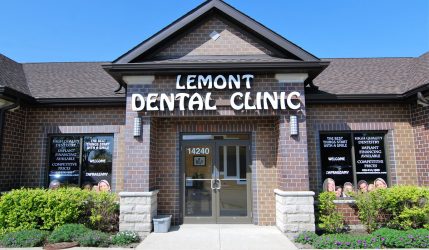
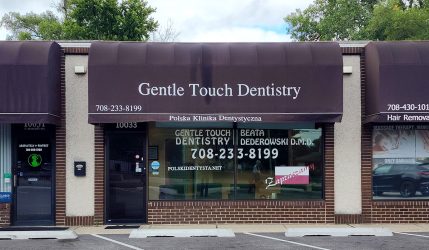
At Lemont Dental Clinic & Gentle Touch Dentistry, we are proud to serve our local communities in Lemont, Palos Hills, and surrounding suburbs like Bolingbrook, Orland Park, and Oak Lawn. We focus on providing high-quality, comprehensive restorative care using the latest dental technology at highly competitive prices.
If you are ready to explore your options and get an accurate, personalized quote for your new smile, contact us today to schedule a comprehensive restorative consultation. To learn more about our state-of-the-art implant services, visit our dedicated dental implants page.