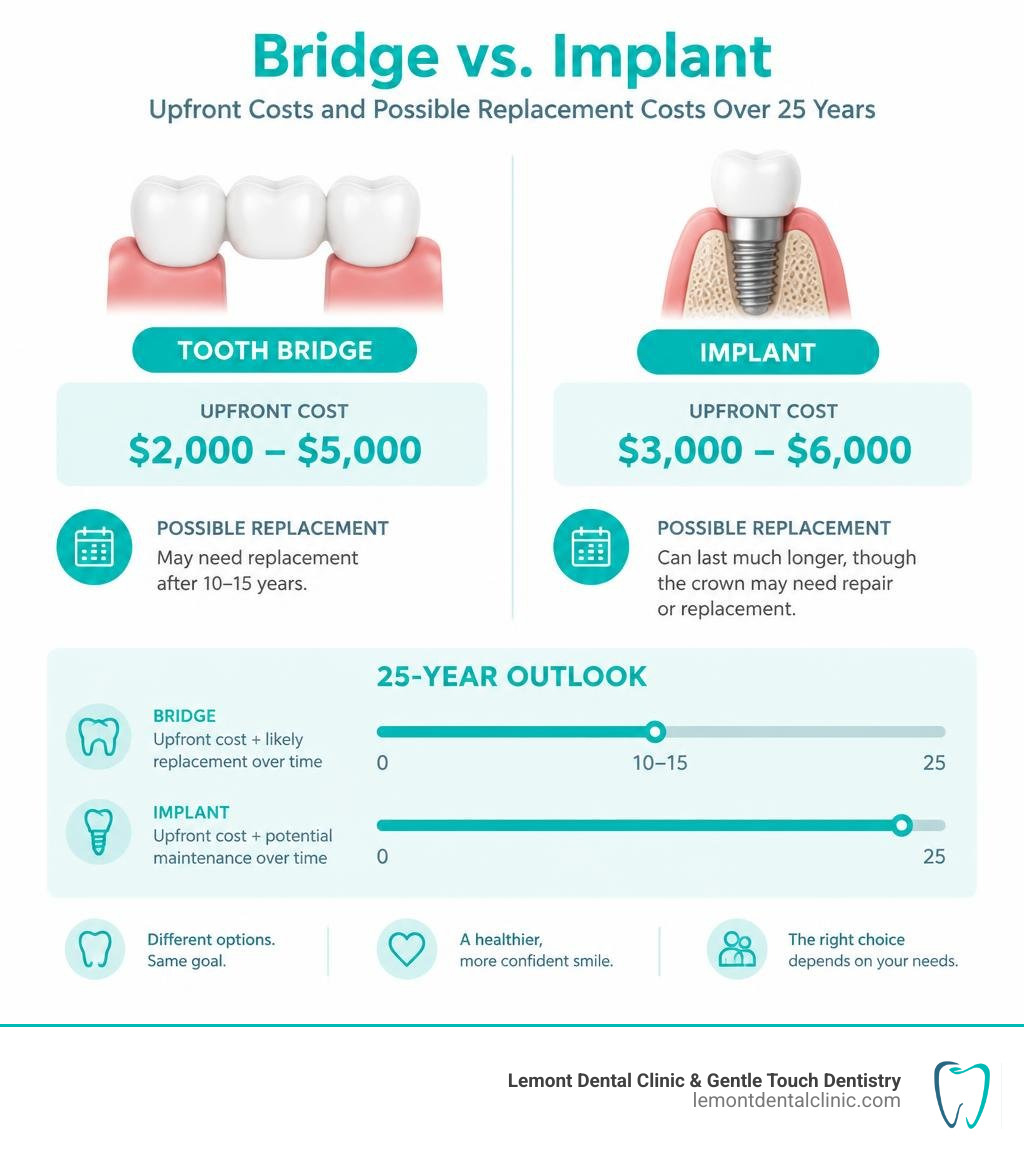
The cost of a tooth bridge vs. an implant usually favors the bridge upfront. A traditional three-unit bridge often costs $2,000–$5,000, while a single implant with its post, abutment, and crown often costs $3,000–$6,000. Your actual cost depends on treatment needs and insurance.
The longer view can change the math. A bridge may need replacement after 10–15 years; an implant can last much longer, though its crown may need repair or replacement. For patients in Lemont and Palos Hills, the useful comparison is the out-of-pocket cost now plus likely care over time, not the first bill alone.
Upfront Tooth Bridge Cost vs Implant: Immediate Pricing Breakdown
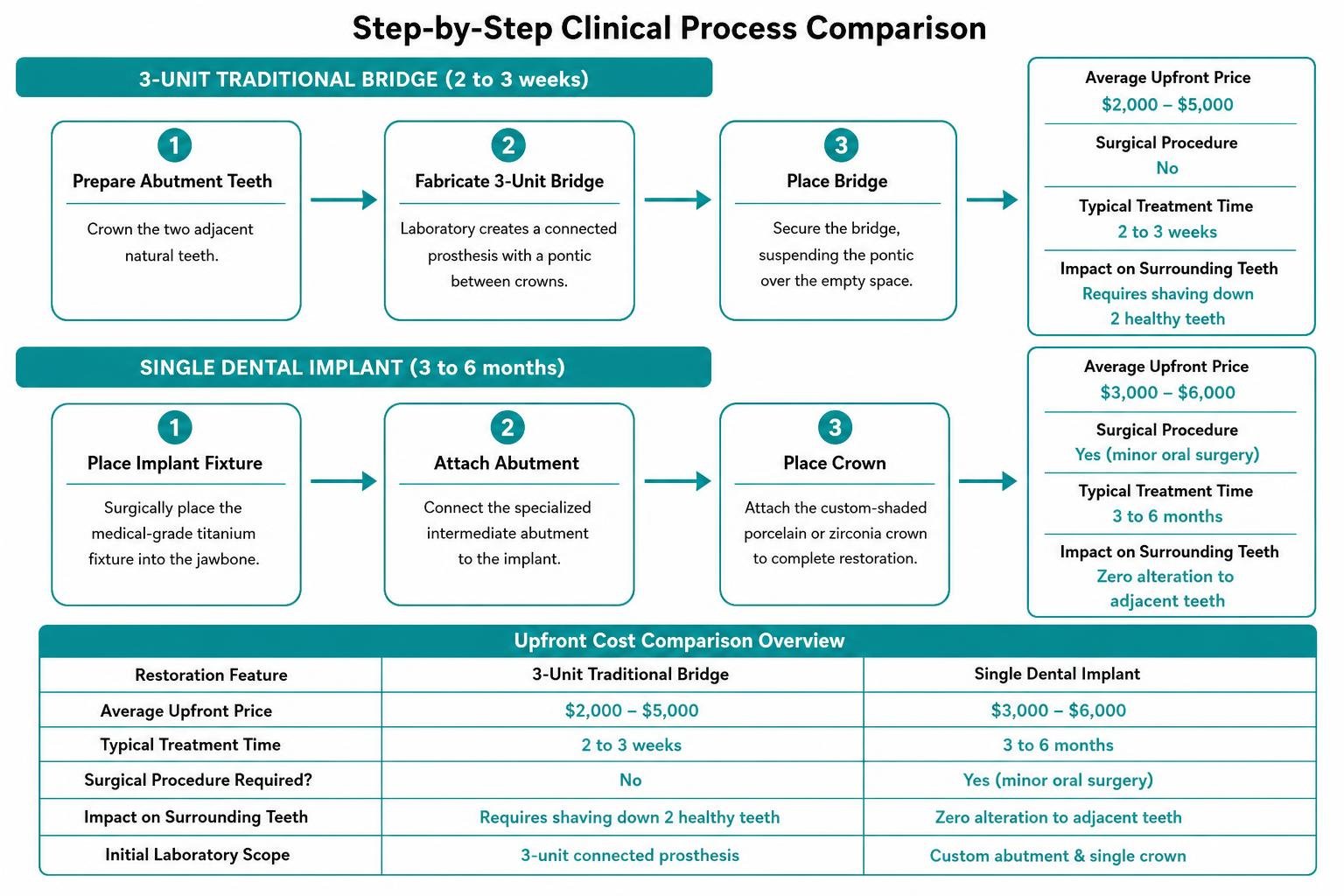
When dealing with a missing tooth, balancing clinical durability against immediate out-of-pocket expenses is essential. The two primary fixed options—a three-unit fixed bridge and a single dental implant—approach tooth restoration from fundamentally different mechanical angles.
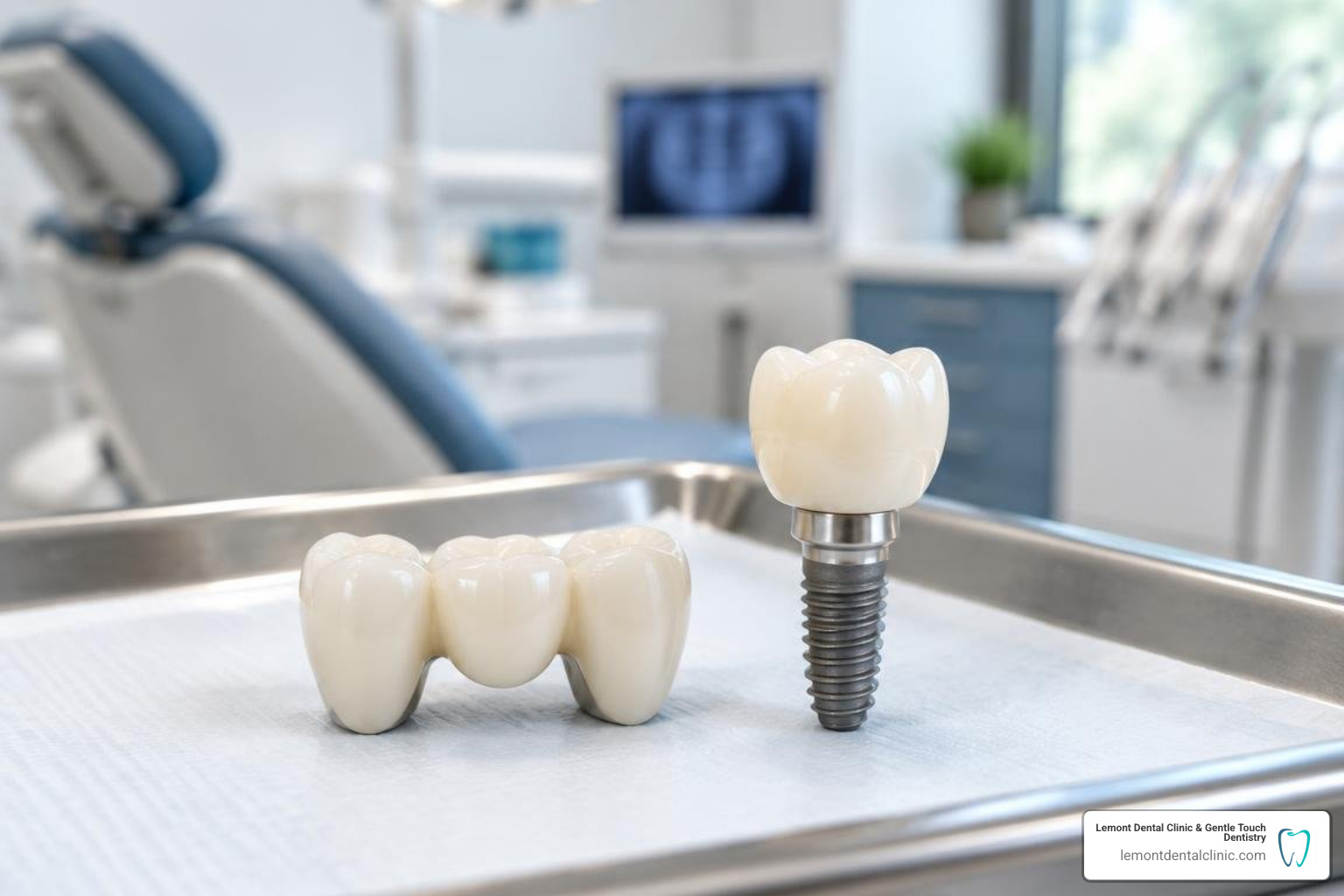
A traditional bridge spans the empty space by crowning the two adjacent natural teeth, suspending a prosthetic tooth (a pontic) between them. Conversely, an implant restores the missing tooth independently from the root up. It consists of a biocompatible titanium fixture surgically placed into the jawbone, a connecting abutment, and a lifelike custom ceramic crown.
Across our service areas—including Lemont, Palos Hills, Hickory Hills, and Orland Park—initial price points reflect the differing complexity of laboratory fabrication, surgical precision, and component materials.
Average Upfront Costs for a Traditional Bridge
The upfront investment for a standard three-unit bridge typically spans $2,000 to $5,000. The final fee depends heavily on the materials used (such as porcelain fused to metal versus monolithic zirconia) and the structural requirements of the anchoring abutment teeth. For a thorough review of unit variations, explore our complete guide to tooth bridge costs.
Because a bridge involves non-surgical placement, it requires no surgical recovery period or bone-grafting fees. Treatment is usually completed across two to three appointments within a span of two to three weeks.
Average Upfront Costs for a Dental Implant
A single standalone dental implant generally ranges from $3,000 to $6,000 from start to finish. This fee covers three distinct structural phases:
Surgical placement of the medical-grade titanium fixture.
The specialized intermediate connector (the custom abutment).
The custom-shaded porcelain or zirconia crown.
To dive deeper into the line-item expenses associated with surgical restorations, review our detailed guide to compare implant costs. While the initial invoice is higher than a bridge, the implant acts as a true single-tooth replacement that leaves neighboring teeth intact.
Upfront Cost Comparison Overview
Restoration Feature
3-Unit Traditional Bridge
Single Dental Implant
Average Upfront Price
$2,000 – $5,000
$3,000 – $6,000
Typical Treatment Time
2 to 3 weeks
3 to 6 months
Surgical Procedure Required?
No
Yes (minor oral surgery)
Impact on Surrounding Teeth
Requires shaving down 2 healthy teeth
Zero alteration to adjacent teeth
Initial Laboratory Scope
3-unit connected prosthesis
Custom abutment & single crown
10, 15, and 25-Year Cost Horizons: The Long-Term Value Equation
While looking at immediate prices provides a clear baseline, true financial clarity comes from examining cumulative expenses over a multi-decade horizon. When reviewing single tooth replacement considerations, evaluating how each restoration performs over 10, 15, and 25 years changes the mathematical value of your investment.
Calculating the 25-Year Tooth Bridge Cost vs Implant Replacement Cycle
A dental bridge offers an average clinical lifespan of 10 to 15 years before natural wear, cement washout, or recurrent decay beneath the anchor crowns warrants total replacement. Landmark clinical studies show that while about 89% of bridges survive at 10 years, systematic reviews of over 4,000 conventional bridges demonstrate that survival drops to approximately 74% at 15 years.
Each time a bridge fails, the entire three-unit structure must be removed, the underlying teeth reassessed and reshaped, and a new unit fabricated at current market rates ($2,000 to $5,000+).
In contrast, a dental implant integrates directly into living bone tissue via osseointegration, achieving a 10-year success rate of 95% to 98%. The titanium post itself is designed to last 25 years or even a lifetime. The custom crown resting atop the implant may experience minor mechanical wear after 15 to 20 years, but replacing a single crown ($1,200 to $2,000) is far less expensive than remanufacturing an entire multi-unit bridge.
Over a 25-year timeline:
Traditional Bridge: Initial cost ($3,500 average) + One replacement at Year 12 ($4,000) + Possible secondary replacement or root canal by Year 24 ($4,500+) = $12,000+ total cumulative expense.
Single Dental Implant: Initial placement and crown ($4,500 average) + Single crown refresh around Year 18 ($1,500) = $6,000 total cumulative expense.
Hidden Expenses: Bone Grafting, Enamel Alteration, and Bridge Maintenance
Both options carry potential supplementary costs that should be accounted for early:
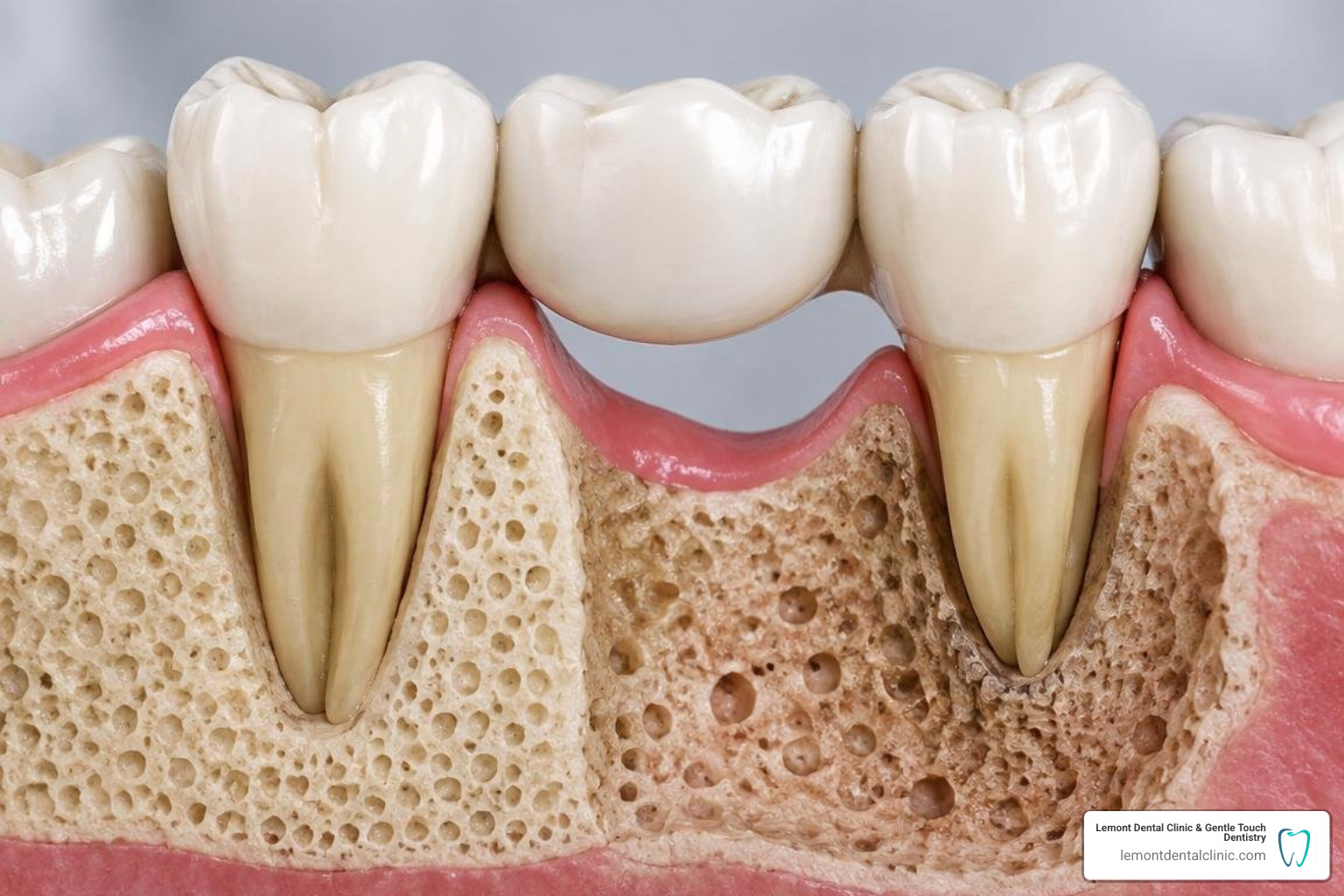
Jawbone Resorption under Bridges: When a natural tooth root is missing, the underlying jawbone loses mechanical stimulation and can shrink by up to 25% in width during the first year alone. Over decades, this creates an unhygienic gap beneath the pontic that traps food debris and compromises facial aesthetics.
Structural Compromise to Neighboring Teeth: To seat a traditional bridge, healthy neighboring teeth must be irreversibly shaved down, losing significant protective enamel. Clinical data indicates that up to 15% of bridge abutment teeth eventually require root canal therapy due to nerve trauma or recurrent decay under the crowns.
Pre-Implant Bone Grafting: If a tooth has been missing for years, socket preservation or ridge augmentation may be required before placing an implant fixture. A supplemental bone graft typically adds $300 to $1,200 to the surgical phase.
Peri-Implantitis Management: Just as natural teeth require routine hygiene, implants must be kept clean to avoid peri-implant inflammation, which requires regular professional cleanings.
Insurance Coverage and Financing Realities in 2026
Navigating insurance policies for major restorative dentistry requires an understanding of standard plan designs and annual benefit maximums.
How Dental Insurance Treats Bridges vs Implants
Most PPO dental plans categorize traditional bridges as standard major restorative care, frequently covering 50% to 60% of the allowable fee up to your annual maximum (typically $1,000 to $2,500).
Coverage for dental implants has improved significantly, but variations remain:
Many modern insurance policies cover the implant post, abutment, and crown at tiered rates (30% to 50%).
Some plans invoke a Least Expensive Alternative Treatment (LEAT) Clause. Under this rule, if a missing space can be restored with a removable partial denture or bridge, the insurance carrier may only reimburse the amount equivalent to the lower-cost treatment, leaving the patient to pay the difference for an implant.
Pre-existing “missing tooth clauses” may restrict coverage if the natural tooth was extracted prior to your policy’s effective start date.
To help manage any out-of-pocket differences, we coordinate pre-treatment estimates and work with flexible third-party healthcare financing solutions, such as CareCredit, allowing patients across Palos Heights, Bolingbrook, and Romeoville to spread treatment costs into manageable monthly plans.
Clinical Decision Guide: Determining the Most Cost-Effective Choice for You
Deciding on the best path involves matching your personal anatomy and lifestyle with clinical realities. Our team conducts an in-depth dental bridge vs implant evaluation to establish the right solution.
When a Bridge Is the More Cost-Effective Solution
A traditional fixed bridge is often the clinically and financially sound choice when:
Adjacent Teeth Already Need Restorations: If the teeth on either side of the gap already have large fillings, fractures, or failing crowns, placing a bridge addresses multiple restorative issues in one cohesive treatment via high-grade crowns and bridges.
Surgical Contraindications Exist: Patients with uncontrolled chronic health conditions, active periodontal disease, or those undergoing therapies that compromise bone healing may prefer a non-invasive restorative process.
Time Constraints Are Paramount: When a rapid aesthetic fix is needed for work or major life events, a bridge delivers a fully functional smile in just a few weeks.
When an Implant Is the Smarter Financial Investment
Choosing an implant delivers clear clinical and financial advantages when:
Adjacent Teeth Are Completely Healthy: Grinding down pristine enamel on healthy adjacent teeth simply to anchor a bridge introduces unnecessary future dental risks.
Jawbone Preservation Is a Priority: If you want to permanently prevent localized bone atrophy and maintain natural facial contours, dental implants are the only restorative option that stimulates living jawbone tissue.
You Want a Permanent Solution: For young or middle-aged adults, an implant’s 25+ year lifespan provides superior return on investment by avoiding the costly replacement cycle inherent to bridges.
Frequently Asked Questions About Tooth Bridge and Implant Costs
How does the tooth bridge cost vs implant compare over 20 years?
Over 20 years, an implant is frequently more affordable than a bridge. While a bridge costs less on day one, it typically requires complete replacement after 10 to 15 years, along with potential root canal treatments on the abutment teeth. An implant’s titanium base rarely needs replacement, making its lifetime maintenance significantly lower.
Does insurance cover the full cost of an implant or a bridge?
No dental insurance plan covers 100% of major restorative treatments. Most policies cover 50% to 60% of a bridge and 30% to 50% of an implant assembly, subject to annual deductibles and policy maximum limits ($1,000–$2,500 per calendar year).
Can I get a dental implant years after having a bridge?
Yes. If an old bridge fails or recurrent decay develops beneath an anchor crown, the site can often be transitioned to a standalone implant. If significant bone loss occurred under the pontic while the bridge was in place, a localized bone graft may be completed first to build an ideal foundation for the implant post.
Conclusion
Both dental bridges and dental implants provide dependable ways to restore chewing ability, smile aesthetics, and dental alignment. When choosing between the two, evaluating both immediate affordability and multi-decade value helps you make the right choice for your smile and your budget.
At Lemont Dental Clinic & Gentle Touch Dentistry, we provide comprehensive restorative dentistry across our modern offices in Lemont and Palos Hills, IL, proudly serving neighbors throughout Oak Lawn, Palos Park, Lockport Heights, and Chicago Ridge. Our doctors utilize advanced 3D CBCT digital imaging and diagnostic planning to offer clear pricing and personalized care.