What Advanced Tooth Bridge Technology Really Costs in 2026
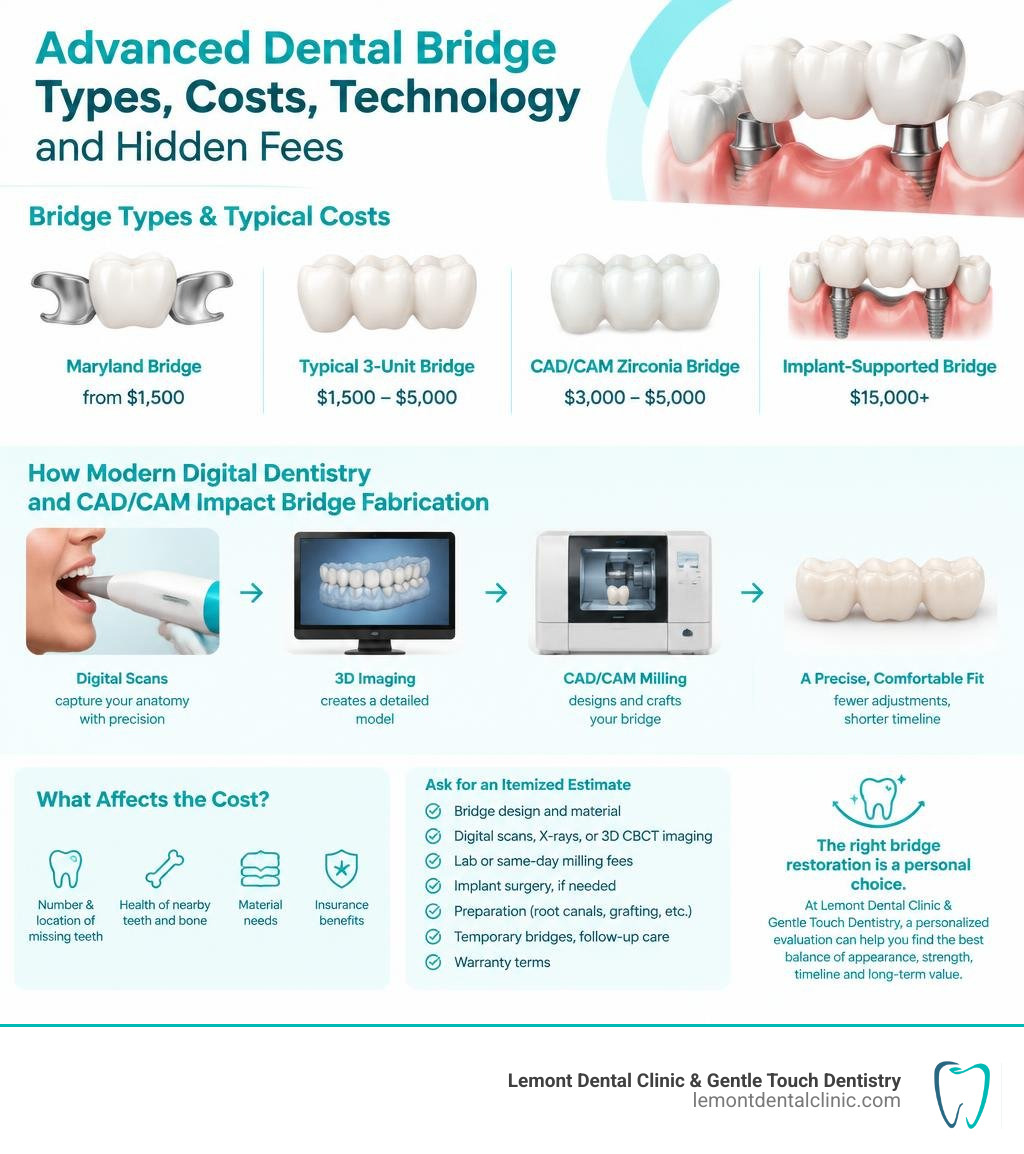
Modern tooth bridge cost advanced technology options range from about $1,500 for a Maryland bridge to $15,000 or more for an implant-supported bridge. A typical three-unit bridge costs roughly $1,500 to $5,000, while a premium CAD/CAM zirconia bridge often falls around $3,000 to $5,000. When patients evaluate tooth bridge cost advanced technology factors, they should weigh digital precision against traditional fabrication methods.
Digital scans, 3D imaging, computer-guided implant placement, and CAD/CAM milling can raise the upfront price. But they may also improve fit, reduce adjustment visits, and shorten fabrication time. The right choice depends on the number and location of missing teeth, the health of nearby teeth and bone, material needs, and insurance benefits.
Before choosing a bridge, ask for an itemized estimate that separates:
The bridge design and material
Digital scans, X-rays, or 3D CBCT imaging
Lab or same-day milling fees
Implant surgery, if needed
Preparation such as root canals, core buildups, grafting, or extractions
Temporary bridges, follow-up care, and warranty terms
At Lemont Dental Clinic & Gentle Touch Dentistry, a personalized evaluation can help clarify which modern restoration offers the best balance of appearance, strength, timeline, and long-term value for your smile.
How Modern Digital Dentistry and CAD/CAM Impact Bridge Fabrication
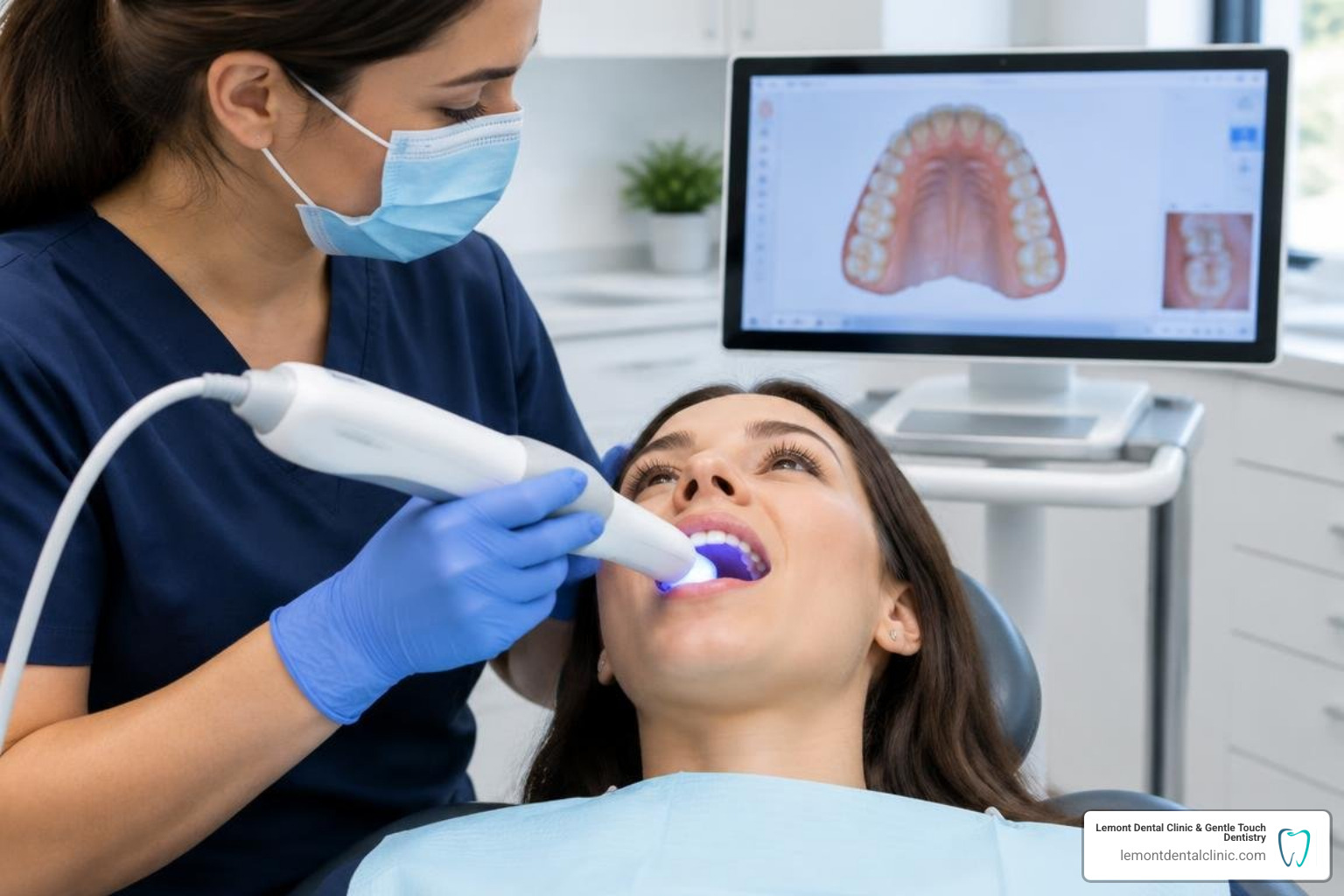
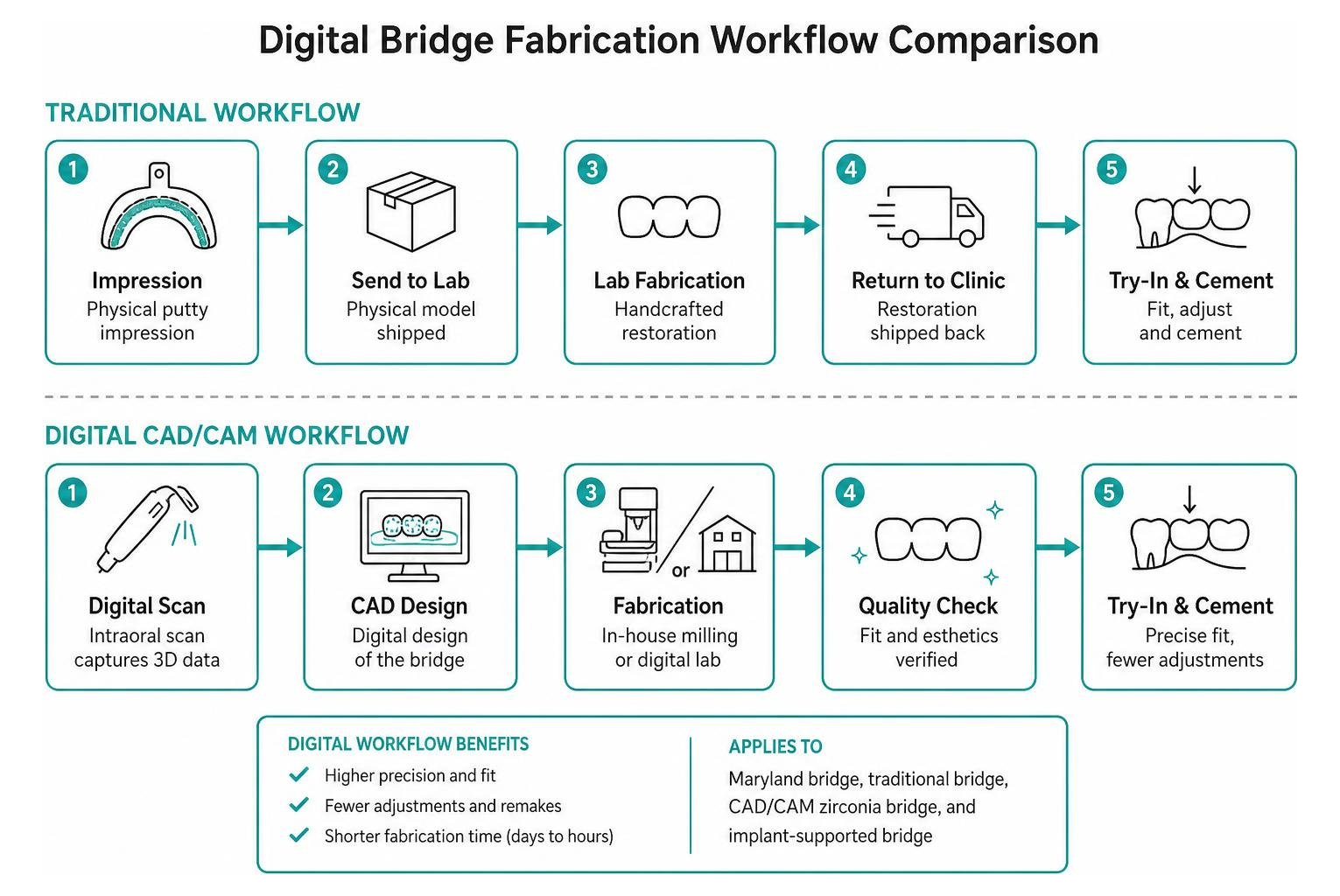
The field of restorative dentistry has evolved significantly beyond the era of messy, uncomfortable putty impressions. Modern digital workflows utilize advanced CAD/CAM (Computer-Aided Design and Computer-Aided Manufacturing) systems to map your oral anatomy with microscopic precision.
Intraoral digital scanners capture tens of thousands of high-resolution data points in seconds. This creates a virtual 3D rendering of your prepared abutment teeth and surrounding gum architecture.
By eliminating the dimensional distortion common with traditional alginate or polyvinyl siloxane molds, digital scanning dramatically reduces the need for bridge remakes and extensive chairside adjustments.
While digital scanning units and specialized CAD software represent significant clinical investments, they streamline fabrication time from weeks to mere days—or even hours. This precision translates directly into a more comfortable fit, exceptional marginal integrity that prevents recurrent decay, and predictable long-term clinical outcomes.
In-House Milling vs. External Digital Laboratories
When receiving a high-tech bridge, your restoration is produced either through in-house chairside milling or a specialized external digital laboratory:
In-House Chairside Milling: Clinics equipped with chairside milling units design and mill single-unit or short-span bridges during a single extended appointment. This approach saves valuable patient time and eliminates the need for temporary restorations, though the equipment carries substantial capital overhead.
External Digital Laboratories: For complex multi-unit spans, high-stress posterior bridges, or specialized layered ceramics, digital files are securely transmitted to master dental laboratories. External lab fees for premium materials like monolithic zirconia generally range between $600 and $1,200 per bridge. This fee covers specialized ceramic sintering, custom characterization, and hand-applied aesthetic layering.
Evaluating Tooth Bridge Cost Advanced Technology and Material Innovations
The materials used in modern bridges offer distinct mechanical and aesthetic benefits:
Monolithic Zirconia: Known as “ceramic steel,” monolithic zirconia delivers extraordinary flexural strength (exceeding 1,100 to 1,200 MPa). It is virtually chip-proof, making it the premier choice for posterior teeth where chewing forces are highest. A 3-unit zirconia bridge typically costs between $3,000 and $5,000.
Lithium Disilicate (e.g., IPS e.max): Offering unmatched translucency and lifelike light transmission, lithium disilicate is ideal for anterior (front) teeth. With a flexural strength of approximately 400 to 500 MPa, it provides high aesthetic value at a price range of $3,000 to $5,500 for a 3-unit restoration.
Porcelain-Fused-to-Metal (PFM): Once the industry gold standard, PFM bridges ($2,000 to $4,500) rely on a metal substructure coated with porcelain. While durable, they lack the natural translucency of all-ceramic options and can eventually reveal an unsightly dark gray metal line along the gumline as tissue recedes over time.
Comprehensive Breakdown: Tooth Bridge Cost Advanced Technology Options in 2026
Modern dental bridge pricing in Illinois typically averages around $3,000 to $3,500 for a standard restoration, though overall costs range widely based on complexity, unit count, and the foundational support mechanism. According to comprehensive data on dental bridge pricing and associated procedures, understanding the structural category of your bridge is essential for accurate budgeting:
Bridge Type
Support Mechanism
Typical Span
Average Cost (No Insurance)
Key Aesthetic & Functional Advantage
Traditional 3-Unit Bridge
Natural Abutment Teeth
3 Units (1 Pontic)
$2,000 – $5,000
Replaces a missing tooth quickly using adjacent crowned teeth.
Cantilever Bridge
Single-Sided Abutment
2 Units (1 Pontic)
$1,500 – $4,000
Preserves natural tooth structure when only one adjacent anchor tooth is available.
Maryland Bonded Bridge
Resin-Bonded Wings
1 Pontic + Wings
$1,500 – $2,500
Highly conservative for front teeth; requires no heavy enamel grinding.
Implant-Supported Bridge
Titanium/Zirconia Fixtures
3–4 Units (2 Implants)
$5,000 – $15,000+
Avoids altering natural teeth and prevents underlying jawbone resorption.
Full-Arch Implant Bridge
4–6 Dental Implants
10–14 Units (Full Arch)
$13,495 – $34,000+
Replaces an entire dental arch with fixed monolithic zirconia or PMMA.
Comparing Traditional Tooth-Supported vs. Implant-Supported Bridges
The choice between a natural tooth-supported bridge and an implant-supported restoration involves evaluating biological tradeoffs alongside immediate and long-term costs.
Traditional bridges require permanent enamel reduction on the neighboring anchor (abutment) teeth. If those adjacent teeth are perfectly healthy and virgin, shaving them down represents irreversible tissue loss. Furthermore, the jawbone beneath the artificial tooth (pontic) naturally resorbs over time due to the lack of root stimulation.
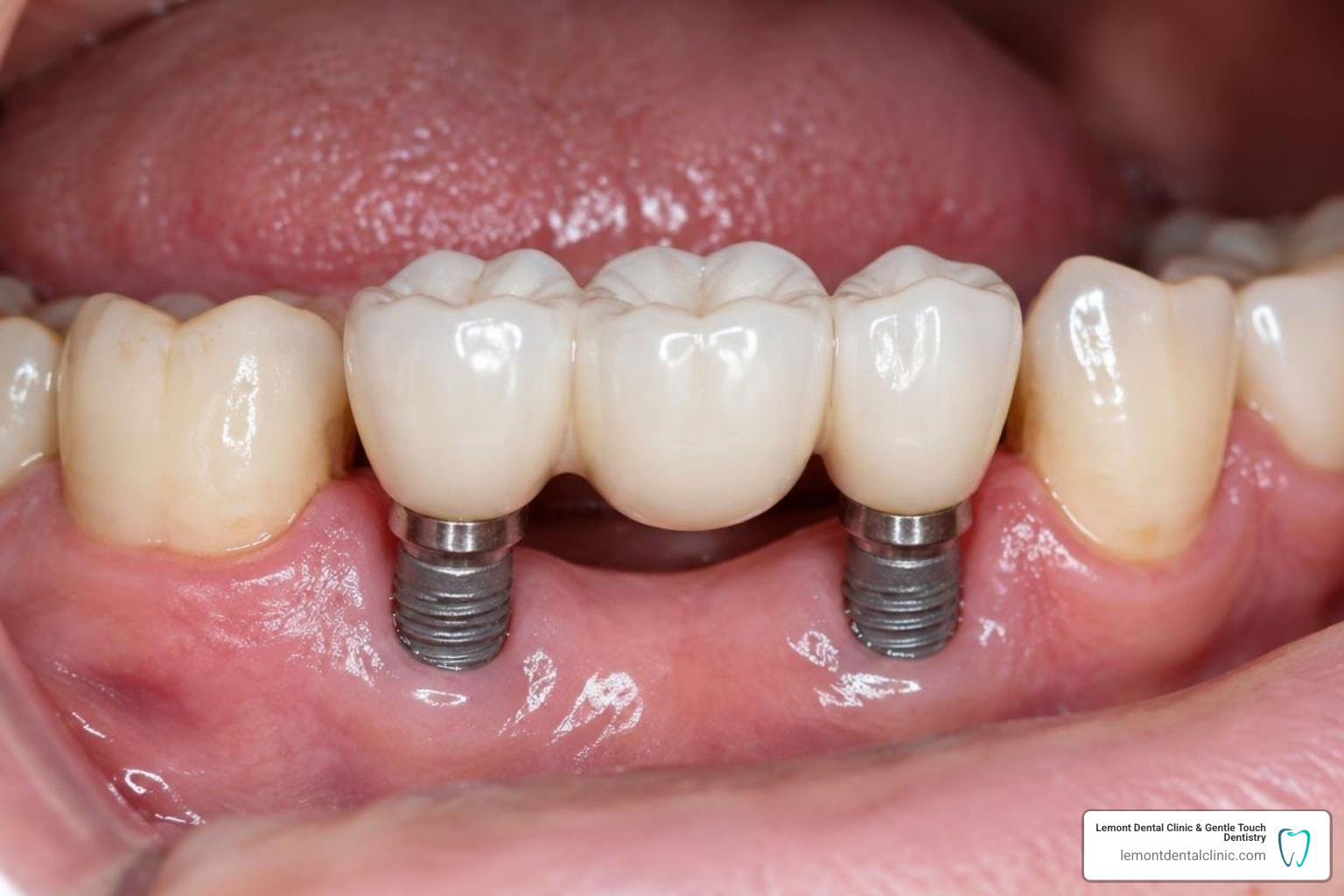
In contrast, implant-supported bridges utilize medical-grade titanium or zirconia fixtures placed directly into the jawbone. These fixtures act as artificial roots, stimulating bone remodeling and preserving facial structure.
While an implant-supported bridge costs more upfront ($5,000 to $15,000+ compared to $2,500 to $5,000 for a traditional bridge), long-term financial modeling over a 20-year horizon reveals striking value. Traditional bridges often require replacement every 10 to 15 years—potentially requiring root canal treatment on failing abutments—whereas dental implants boast success rates exceeding 95% over several decades.
Full-Arch Solutions: All-on-4 and Screw-Retained Implant Bridges
For patients facing extensive tooth loss across an entire upper or lower arch, modern full-arch implant bridges provide fixed stability without requiring a single implant per missing tooth:
Provisional PMMA Bridges: During initial healing and osseointegration, a high-density, computer-milled polymethyl methacrylate (PMMA) bridge is loaded onto the implants. Complete treatment packages utilizing provisional acrylics typically start around $13,495 to $22,000 per arch.
Solid Monolithic Zirconia Arches: For the permanent restoration, custom-milled monolithic zirconia screwed directly into multi-unit abutments represents the peak of modern restorative strength. Impervious to chipping and staining, complete full-arch zirconia restorations range from $25,000 to $34,000+ per arch.
Preparatory Procedures and Additional Expenses in Advanced Bridge Work
When planning complex bridge treatments, several preparatory procedures may be required to establish a stable oral foundation.
3D Cone-Beam Computed Tomography (CBCT): Low-dose 3D volumetric scans ($200 to $500) provide high-resolution anatomical views of bone density, nerve pathways, and sinus cavities.
Computer-Generated Surgical Guides: CAD/CAM-printed surgical templates ($250 to $750) guide the exact angle, depth, and orientation of implant placement.
Bone Grafting & Sinus Lifts: If the alveolar ridge has atrophied, bone augmentation ($500 to $3,000 per site) or a sinus lift ($1,500 to $3,500) creates sufficient structural volume to seat implants securely.
Endodontic Therapy & Core Buildups: For tooth-supported bridges, compromised abutment teeth may require root canals ($700 to $1,500 per tooth) followed by composite resin core buildups ($200 to $450) to retain crown retainers.
Diagnostic Digital Smile Design & Mock-ups: Digital aesthetic preview software and 3D provisional mock-ups ($150 to $400) allow you to test your bite and smile aesthetics prior to final sintering.
Navigating Dental Insurance, Warranties, and Long-Term Value
Standard dental insurance plans generally categorize traditional bridges under major restorative care, reimbursing roughly 50% of allowable fees up to your policy’s annual maximum (commonly $1,000 to $2,000).
Down-Coding Clauses: Insurance carriers may “down-code” a premium CAD/CAM monolithic zirconia bridge to the lower reimbursement rate of an older porcelain-fused-to-metal (PFM) code. The patient remains responsible for the remaining balance.
Missing Tooth Clauses: If a tooth was extracted prior to your policy’s effective start date, the insurer may decline coverage for replacing that specific unit.
Replacement Age Rules: Most plans will not cover the replacement of an existing bridge until 5 to 7 years have elapsed since initial placement.
Maximizing Benefits with Tooth Bridge Cost Advanced Technology Solutions
To optimize your out-of-pocket investment for advanced restorative solutions, consider these financial strategies:
Split-Year Treatment Scheduling: For extensive bridge restorations requiring multi-phase preparation, scheduling tooth preparation or implant surgery in November/December and seating the permanent bridge in January allows you to utilize two consecutive annual insurance maximums.
FSA and HSA Accounts: Paying for out-of-pocket procedural balances with pre-tax Flexible Spending Account (FSA) or Health Savings Account (HSA) dollars reduces your effective cost by your marginal tax rate.
In-House Dental Membership Plans: For uninsured patients, our in-house membership plans offer transparent discounted fees on restorative and preventive treatments without waiting periods or annual benefit caps.
Laboratory Warranties: Premium labs provide written warranties ranging from 5 to 10 years on CAD/CAM zirconia and all-ceramic structures against mechanical fractures, protecting your investment.
Frequently Asked Questions About Advanced Dental Bridges
How long does an advanced zirconia or implant-supported bridge last?
A precision-milled monolithic zirconia bridge typically lasts 10 to 15 years, and often over 20 years when supported by excellent daily oral hygiene and regular dental checkups. The titanium dental implants anchoring an implant bridge integrate permanently into the jawbone and can last a lifetime.
Does dental insurance cover high-tech ceramic or zirconia bridges?
Most PPO dental plans provide major restorative benefits for bridges at approximately 50% of the standard allowable charge. However, many insurers cap their payout at the PFM equivalent rate. Check with your insurance coordinator to obtain a formal pre-treatment estimate prior to starting fabrication.
Why does an advanced technology bridge cost more upfront than a traditional bridge?
Advanced technology bridges incorporate medical-grade monolithic zirconia or custom-milled ceramics, high-resolution digital scanning, 3D diagnostic software, and specialized lab sintering. This upfront investment ensures a superior marginal seal, lifelike aesthetics, higher fracture resistance, and fewer adjustments over the lifespan of the restoration.
Conclusion
Restoring missing teeth is essential for clear speech, balanced chewing mechanics, and preserving long-term facial symmetry. At Lemont Dental Clinic & Gentle Touch Dentistry, our experienced team provides comprehensive restorative care across our locations in Lemont and Palos Hills, IL, proudly serving patients throughout Chicago Ridge, Worth, Palos Park, Hickory Hills, Oak Lawn, Orland Park, Palos Heights, Bolingbrook, Romeoville, Palisades, and Lockport Heights.
By pairing modern digital scanning with master laboratory milling, we deliver high-strength, natural-looking bridges tailored to your budget and clinical needs. To review specific pricing breakdowns for multi-unit restorations, explore our guide on the cost of 3-tooth bridge treatments and schedule your personalized consultation today.