More Teeth, More Problems? Here’s How to Pick the Right Denture
Figuring out what type of denture is best for your situation can feel overwhelming — there are more options than most people expect, and the wrong choice can affect how you eat, speak, and feel every day.
Here’s a quick answer to help you get oriented:
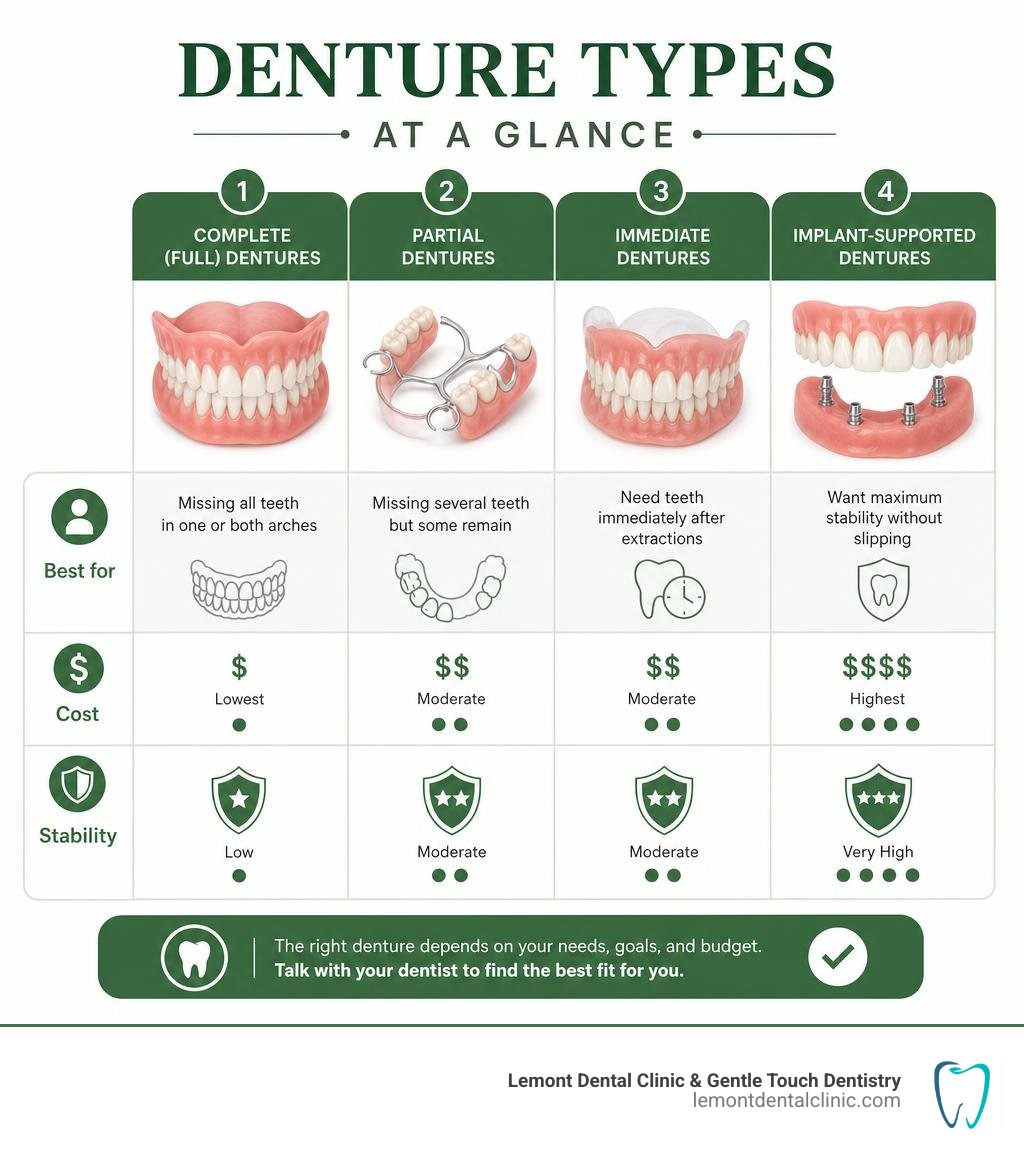
Situation
Best Denture Type
Missing all teeth in one or both arches
Complete (full) dentures
Missing several teeth but some remain
Partial dentures
Need teeth immediately after extractions
Immediate dentures
Want maximum stability without slipping
Implant-supported or snap-in dentures
Budget is the primary concern
Traditional acrylic removable dentures
Want the closest feel to natural teeth
Fixed implant-supported (hybrid) dentures
No single denture type is best for everyone. The right choice depends on how many teeth you’re missing, your jawbone health, your budget, and how much daily maintenance you’re willing to do.
What makes this decision tricky is that each option involves real trade-offs — in cost, comfort, durability, and lifestyle. An estimated 42.46 million Americans wear dentures, and the choices they face range from economy options under $500 to premium implant-supported systems costing well over $10,000.
This guide walks you through every major type, compares them honestly, and helps you ask the right questions before sitting down with your dentist.
Understanding Your Options: What Type of Denture Is Best for Your Smile?
When exploring tooth replacement options for edentulism (the complete or partial loss of teeth), understanding the fundamental differences between various dental prosthetics is key. Modern restorative dentistry has come a long way from the heavy, wooden, or generic “false teeth” of the past. Today, we customize prosthetics to match your unique facial structure, skin tone, and functional needs.
Let’s look at the three primary categories of removable dentures and how they function to restore your smile.
Complete Dentures for Full Arch Replacement
If you have lost all your teeth in either your upper jaw, lower jaw, or both, a complete denture (often called a full set) is the traditional restorative path. These prosthetics consist of a flesh-colored acrylic base that mimics natural gum tissue, topped with custom-fabricated prosthetic teeth.
Complete dentures rely on natural suction, muscle control, and sometimes a bit of adhesive to stay in place. While an upper denture covers the roof of your mouth to create a strong suction seal, a lower denture is shaped like a horseshoe to accommodate your tongue. Lower dentures are notoriously more challenging to keep stable because they do not have the same suction surface and must compete with constant tongue movement.
Beyond restoring your ability to chew and speak, complete dentures provide vital support for your facial structure. Without teeth, the facial muscles can sag, leading to a sunken appearance that makes you look prematurely aged. A well-designed full set restores the natural volume of your lips and cheeks. To dive deeper into how these prosthetics are designed and customized, read our Everything You Need to Know About Full Set Dentures guide and explore our Complete Guide Full Denture Types.
Partial Dentures for Filling the Gaps
If you are only missing a few teeth and your remaining natural teeth are healthy and strong, you do not need a full set. Instead, partial dentures are designed to fit seamlessly around your existing teeth to fill the gaps.
A partial denture prevents your remaining teeth from shifting, tilting, or drifting into the open spaces. When teeth shift, it can throw off your entire bite alignment, leading to jaw pain (TMJ issues) and an increased risk of gum disease. Partial dentures typically feature a lightweight metal or acrylic framework that connects to your natural teeth using small, supportive metal clasps.
Whether you need to replace highly visible teeth in the front or sturdy chewing surfaces in the back, partials are highly customizable. If you are missing teeth in the smile zone, we design specialized dentures for front teeth to blend perfectly with your natural enamel. For structural support further back, we utilize durable dentures for back teeth designed to withstand heavy chewing forces. For an in-depth breakdown of framework options, check out our Different Types of Partial Dentures Guide.
Immediate Dentures: Your Same-Day Smile
The thought of going weeks or months without teeth while your mouth heals after extractions can be a major source of anxiety. This is where immediate dentures come in.
Immediate dentures are fabricated before your remaining teeth are extracted. On the day of your oral surgery, your dentist places these temporary prosthetics immediately after the teeth are removed.
While they ensure you never have to walk out of the clinic without a smile, immediate dentures require a patient and realistic mindset. As your gums and jawbone heal over the next 6 to 12 months, your tissue will shrink and change shape. Because of this natural tissue recovery, immediate dentures will gradually lose their tight fit. They require temporary liners and eventually a permanent reline or replacement once your jawbone has fully stabilized.
Think of immediate dentures as a protective, natural bandage that shields your sensitive healing gums while keeping your appearance intact. To understand what to expect during this healing phase, read about The Denture Process From Start to Finish.
Comparing Traditional Removable Dentures vs. Implant-Supported Options
For decades, traditional removable dentures were the only solution for widespread tooth loss. However, dental science has advanced significantly, and patients now have the option to combine the coverage of a denture with the unmatched stability of dental implants.
Determining What Type of Denture Is Best for Stability and Biting Force
The single biggest complaint among traditional denture wearers is slippage. Because traditional dentures simply rest on top of the gums, they can slip, click, or wobble when you eat or speak. This movement is not just embarrassing; it also limits your diet. Traditional removable dentures only restore about 20% to 50% of your natural biting force.
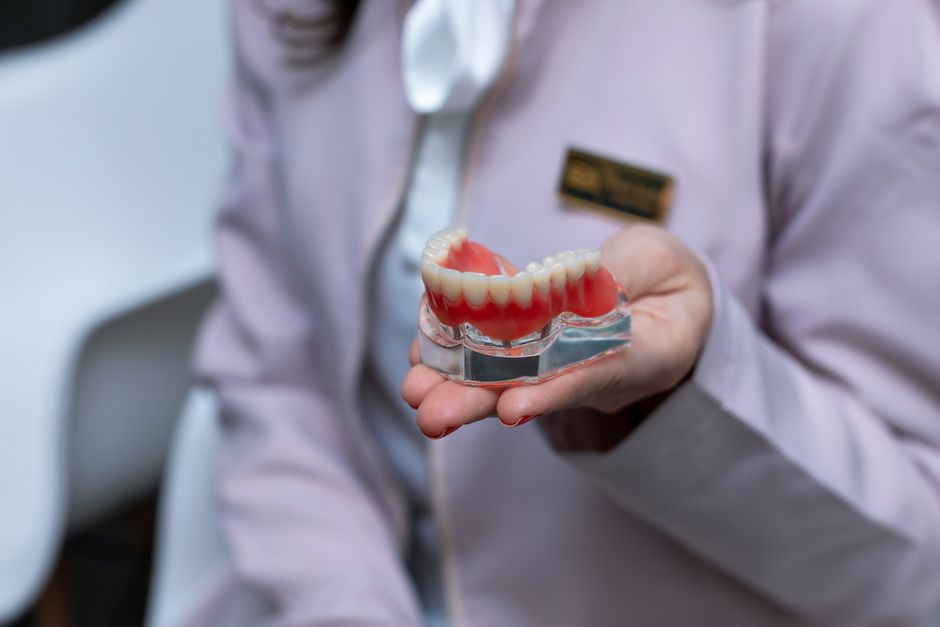
Implant-supported options change the game entirely. By surgically placing biocompatible titanium posts directly into your jawbone, we create permanent anchors. Through a biological process called osseointegration, your jawbone actually fuses with the titanium posts, treating them like natural tooth roots.
Once integrated, these implants secure your prosthetic teeth. Implant-retained dentures can restore up to 90% of your natural biting force. This means you can confidently eat apples, nuts, and steak without worrying about your teeth moving.
These systems generally fall into two categories:
Snap-on Dentures: Also known as implant-retained overdentures, these snap onto two to four implant posts. They offer excellent stability but can still be removed at night for easy cleaning. Learn more in our guide to Snap on Dentures.
Fixed Implant Dentures: Often referred to as hybrid dentures or All-on-4, these are permanently screwed into four or more implants. They can only be removed by a dentist and feel the closest to natural teeth. Read more about Implant Dentures and explore our comprehensive Types of Denture Implants Guide.
Choosing between traditional and implant-supported dentures requires balancing your immediate budget against long-term value, comfort, and lifestyle goals.
Traditional dentures have a lower upfront cost and require a non-invasive, surgery-free process. However, because they do not stimulate the jawbone, your bone structure will gradually shrink over time. This constant bone loss means traditional dentures must be adjusted, relined, or completely replaced every 5 to 7 years.
Implant-supported dentures require a higher initial financial investment and a surgical healing period of three to six months. However, they preserve your jawbone, prevent the “sunken” facial look associated with tooth loss, and can last decades — often a lifetime — with proper care.
To help you visualize these differences, we have outlined the core metrics below:
Feature
Traditional Removable Dentures
Implant-Supported Dentures
Stability
Moderate (can slip or click)
High (anchored to bone; no slipping)
Biting Force
Restores 20% – 50%
Restores 70% – 90%
Bone Preservation
None (jawbone will shrink over time)
High (titanium posts stimulate bone)
Lifespan
5 – 7 years (requires replacement)
20+ years / Lifetime (with proper care)
Adjustment Period
4 – 8 weeks (high chance of sore spots)
2 – 4 weeks (highly stable, less friction)
Average Cost (U.S.)
$1,520 – $3,648 per arch
$3,055 – $7,294+ per arch (excludes surgery)
If you are researching the overall financial commitment of restorative care, our resource on the Types of Dentures and Cost provides additional insights.
Key Factors to Consider When Choosing Your Dentures
Determining what type of denture is best for you is a highly personal decision. To make an informed choice, you must evaluate your budget, lifestyle, jawbone health, and aesthetic preferences.
Evaluating What Type of Denture Is Best for Your Budget and Lifestyle
Your daily routine, age, and long-term goals play a major role in your decision:
The Treatment Timeline: If you need teeth immediately for an upcoming event or career commitment, traditional or immediate dentures offer a faster turnaround. Implant options require patience during the osseointegration period.
The Daily Care Routine: Are you comfortable removing your teeth every night to soak them, or do you prefer a fixed solution that you brush just like natural teeth?
Your Overall Health and Age: Dental implants require adequate jawbone density and good systemic health (uncontrolled diabetes or active bone disease can impact success rates). If surgery is not recommended for you, a premium traditional denture is an excellent alternative.
Material Matters: Acrylic, Metal, Porcelain, and Flexible Bases
The materials used to construct your prosthetic teeth and base directly impact how natural they look, how long they last, and how comfortable they feel.
Acrylic Resin: The most common material for denture bases. It can be easily colored and characterized to match natural gum tissue. Acrylic teeth are lightweight and quiet when chewing, but they wear down faster than porcelain.
Metal Frameworks: Typically made from a biocompatible cobalt-chromium alloy, metal frameworks are used in partial dentures. They are incredibly strong, allowing the prosthetic to be much thinner and less bulky than all-acrylic options.
Porcelain: Porcelain teeth offer unmatched aesthetic appeal because they reflect light exactly like natural tooth enamel. They are highly stain-resistant and durable. However, they are heavier and can chip if dropped on hard surfaces.
Flexible Thermoplastic Nylon: Used for flexible partial dentures, this material is lightweight, slightly bendable, and contains no metal clasps. It is exceptionally comfortable and blends beautifully with your gums.
No matter which denture you choose, your mouth will change over time. When you lose teeth, the jawbone naturally shrinks because it no longer receives stimulation from tooth roots. This process, called resorption, causes your dentures to gradually loosen.
To maintain a healthy, comfortable fit, you will need to plan for:
Professional Relines: Every 1 to 2 years, your dentist will resurface the tissue-facing side of your denture to match the updated shape of your gums. Learn more about this quick maintenance step in our guide on What Happens During a Denture Reline.
Denture Adhesives: While adhesives should never be used to fix a poorly made, ill-fitting denture, they can provide an extra boost of confidence and prevent food particles from getting trapped. Explore our Complete Guide Denture Adhesive Types to find the right formula.
Adjustments for Sore Spots: It is completely normal to experience minor irritation during the first few weeks of wearing a new prosthetic. If you are struggling with discomfort, read our practical Denture Discomfort Solutions That Actually Work and find out how we handle Fixing Loose Dentures.
Frequently Asked Questions About Dentures
How long do different types of dentures last?
Traditional complete and partial dentures typically last 5 to 7 years (sometimes up to 10 years with exceptional care). Over time, the acrylic base wears down, the teeth lose their chewing texture, and your jawbone changes shape, requiring a completely new prosthetic.
Implant-supported overdentures also last about 7 to 10 years for the removable prosthetic portion, but the titanium implant posts embedded in your bone can easily last 20 to 30 years—or even a lifetime with diligent oral hygiene and regular dental check-ins.
Is it okay to sleep with dentures in?
Generally, no. It is highly recommended that you remove your dentures for at least 8 hours every day (typically while you sleep).
Your gums and jawbone need a chance to rest from the constant pressure of supporting a prosthetic. Leaving your dentures in overnight deprives your tissue of blood flow, increases the risk of bone loss, and creates a dark, moist breeding ground for bacteria and yeast, which can lead to painful conditions like denture stomatitis. Always soak your dentures overnight in water or a specialized cleaning solution.
When are dental bridges or full implants a better choice than dentures?
Removable dentures are an excellent, non-invasive solution for widespread tooth loss, but they aren’t always the best fit.
A dental bridge is often a superior choice if you are only missing one or two teeth in a row and the neighboring teeth are strong enough to support crowns. Bridges are permanently fixed in place, meaning they won’t slip, and they do not require a removable base.
Full dental implants (replacing individual teeth with single implants and crowns) are the gold standard if you have excellent jawbone density, want to preserve your remaining bone perfectly, and desire a solution that looks, feels, and functions exactly like your natural teeth.
Conclusion
Finding what type of denture is best for your unique smile is not a journey you have to take alone. At Lemont Dental Clinic & Gentle Touch Dentistry, we believe that restoring your smile is about more than just replacing missing teeth — it is about reclaiming your confidence, your comfort, and your quality of life.
Whether you live in Lemont, Palos Hills, Chicago Ridge, Worth, Palos Park, Hickory Hills, Oak Lawn, Orland Park, Palos Heights, Bolingbrook, Romeoville, Palisades, or Lockport Heights, our experienced clinical team is here to guide you. We combine advanced dental technology with a warm, personalized approach to craft custom prosthetics that fit your life, your budget, and your aesthetic goals perfectly.
Ready to take the first step toward a beautiful, stable, and natural-looking smile? Visit our specialized page to find Dentures Near Me and schedule your personalized restorative consultation with us today!