The Border Molding Material That Makes or Breaks Your Denture Fit
The border molding material used during denture fabrication is one of the most important — and most overlooked — factors in how well your dentures will fit, stay in place, and feel comfortable every day.
Here is a quick overview of the most common border molding materials used in dentistry today:
Material
Type
Best For
Green stick compound
Thermoplastic
Sectional/incremental molding
PVS putty (polyvinyl siloxane)
Elastomeric
Single-step molding
Polyether
Elastomeric
Single-step, high accuracy
Impression wax
Thermoplastic
Minor border corrections
Visible light-polymerizing resin
Resin-based
Rigid, stable trays
Each material has different handling requirements, setting times, and clinical strengths. The right choice depends on your anatomy, tissue health, and the technique your dentist uses.
As prosthodontic educator M.M. Devan put it: “Ideal impression must be in the mind of the dentist before it is in his hand.” That philosophy starts with choosing the right border molding material.
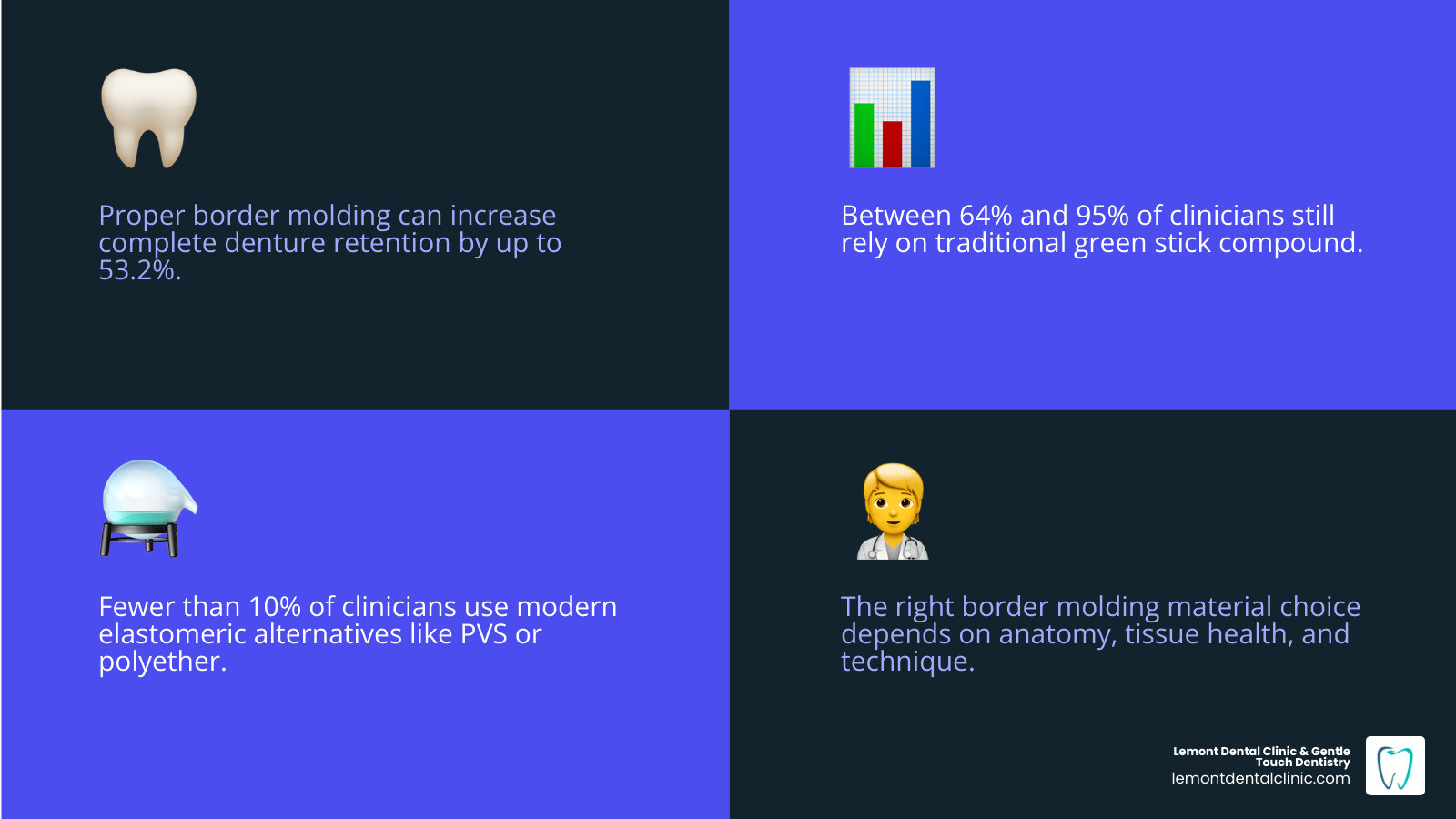
Research shows that proper border molding can increase complete denture retention by up to 53.2% — a significant difference in how secure and stable your dentures feel. Yet between 64% and 95% of clinicians still rely on traditional green stick compound, while fewer than 10% use modern elastomeric alternatives.
This guide breaks down what each material does, how they compare, and what your dental team considers when choosing between them.
What is a Border Molding Material and Why is It Critical for Dentures?
When we fabricate a custom denture, our goal is to create a perfect peripheral seal. This seal acts like a suction cup against your gums, preventing air and food from slipping underneath the prosthetic. To achieve this, we must precisely capture the shape, depth, and width of the dynamic tissues surrounding your jaw — specifically the mucobuccal fold and tissue reflections.
This is where a specialized border molding material comes into play. It is placed along the edges of a custom acrylic tray, inserted into the mouth, and shaped by the active movements of your cheeks, lips, and tongue (a process also known as muscle trimming).
Instead, a dental border molding material is a highly specialized, biocompatible substance designed to record the delicate, moving anatomical landmarks of your mouth. Capturing the exact vestibule contour and sulcus depth ensures that the final denture does not pinch, cause painful ulcers, or dislodge when you speak, smile, or chew. Understanding this step is a key milestone in the denture process from start to finish.
Key Categories of Border Molding Materials
To understand how we customize this process for our patients in Lemont, IL, and Palos Hills, IL, we must look at the primary families of materials used in modern prosthodontics. These materials generally fall into two categories: thermoplastics and elastomers.
Property
Green Stick Compound (Thermoplastic)
PVS Putty (Elastomer)
Polyether (Elomer)
Technique
Sectional (Incremental)
Single-Step (Simultaneous)
Single-Step (Simultaneous)
Working Time
Short (hardens as it cools)
3 to 5 minutes
Medium (extended catalyst control)
Adjustment
Easy (reheat and modify)
Difficult (requires trimming/re-running)
Moderate
Patient Comfort
Moderate (requires multiple insertions)
High (quick, single insertion)
High (uniform pressure)
Cost
Low
Moderate to High
High
Thermoplastic Border Molding Material Options
Thermoplastics are materials that soften when heated and harden as they cool. The most famous example is low-fusing green stick compound.
To use it, we heat the compound over an open flame until it begins to droop, then temper it in a warm water bath to ensure it is at a safe temperature that will not burn your oral tissues. Once placed on the custom tray, it is inserted into the mouth, where it quickly cools and records the tissue borders.
The primary advantage of green stick compound is its dimensional stability and the ability to be reheated and adjusted incrementally. If we do not capture a specific section perfectly the first time, we can simply warm that area and try again.
Elastomeric Border Molding Material Alternatives
Elastomers are modern, rubber-like materials that set via a chemical reaction. The two main types used for border molding are polyvinyl siloxane (PVS) putty and polyether.
Elastomers exhibit a property called shear-thinning (or thixotropy). This means the material flows smoothly under pressure but stays put when the pressure is released, making it excellent for capturing the subtle folds of your dynamic tissues.
Polyvinyl Siloxane (PVS) Putty: Putty-type PVS is mixed by hand or dispensed via a modified cartridge gun. It offers a comfortable working time of 3 to 5 minutes, which can be extended by about 1.5 minutes if the material is refrigerated before mixing.
Polyether: Polyether is highly accurate and hydrophilic, meaning it performs exceptionally well in the moist environment of the mouth. It is the most common material used for single-step, simultaneous border molding.
Sectional vs. Single-Step Border Molding Techniques
How we apply these materials depends on the clinical technique selected for your treatment. There are two primary methods:
Sectional (Incremental) Border Molding
This is the traditional method, most commonly performed with green stick compound. We divide the custom tray into distinct sections (usually 6 to 8 segments for the upper jaw) and mold one section at a time.
The Process: We apply the heated compound to one segment, insert the tray, perform muscle trimming, remove the tray, and chill it in cold water. We then repeat this process for every single section.
The Reality: On average, it takes 17 separate placements of the tray in the mouth to obtain a definitive maxillary impression using this conventional sectional technique. While highly accurate because we can focus on one small area at a time, it can be tedious for both the dentist and the patient.
Single-Step (Simultaneous) Border Molding
With modern elastomeric materials like PVS putty or polyether, we can perform the entire border molding process in a single step.
The Process: We apply a uniform 3 to 4 mm roll of the elastomeric material along the entire periphery of the custom tray. The tray is inserted once, and the patient actively performs functional movements (swallowing, yawning, puckering, smiling) while the material sets over 3 to 5 minutes.
The Reality: This technique is incredibly efficient, reducing chair time and minimizing patient discomfort. It captures the entire border in a single, continuous, homogeneous sweep, eliminating the risk of step-like errors at the junctions of different sections. For patients prone to gagging or jaw fatigue, this is often the preferred path to finding denture discomfort solutions that actually work.
Clinical Handling and Best Practices to Avoid Errors
Achieving a flawless peripheral seal requires strict adherence to clinical best practices. Whether using thermoplastic or elastomeric materials, we follow a rigorous protocol to prevent common errors like overextension or insufficient working time:
Tray Preparation: Before applying any border molding material, the custom acrylic tray must be verified in the mouth. The flanges of the tray should be trimmed so they are exactly 2 mm short of the dynamic tissue reflection. This leaves adequate space for the molding material to sit without the rigid tray pushing through and causing sore spots.
Adhesive Application: For elastomeric materials, we apply tray adhesive 2 mm onto both the inner and outer flanges of the tray and let it dry completely to prevent the material from pulling away during removal.
Temperature Control: When using green stick compound, we must always temper the heated material in a warm water bath. This step is critical to avoid mucosal burns and patient discomfort.
Active vs. Passive Muscle Trimming: Passive manipulation (where the dentist manually pulls the patient’s cheeks) often stretches the tissues unnaturally. We encourage active muscle trimming, where the patient actively moves their tongue, licks their lips, and mimics yawning and swallowing. This captures true physiological muscle contractions.
Escape Vents and Wash Relief: Once the border molding is complete, we scrape away approximately 0.5 to 1 mm of the tracing material from the outer and inner borders to make space for the final wash impression. We also drill escape holes (typically using a no. 6 round bur) in relief areas of the tray to allow the final light-body impression material to escape without building up distorting pressure. This attention to detail is essential when we are fixing loose dentures or constructing new ones from scratch.
Frequently Asked Questions About Border Molding
Can digital intraoral scanning replace physical border molding?
While digital dental technology has advanced rapidly, capturing dynamic, mobile soft tissues remains a challenge for intraoral scanners. Scanners utilize a “mucostatic” approach, meaning they capture tissues at rest.
To get an accurate peripheral seal digitally, clinicians often have to use special scan retractors or apply physical markers (like pressure indicating paste) to help the scanner read the vestibule. For many patients, conventional physical border molding remains the gold standard for achieving maximum denture suction, though digital workflows are continually improving and already significantly reduce post-insertion adjustments.
How does material viscosity affect the final denture seal?
Viscosity is crucial. If a material is too runny (low viscosity, like a light-body wash), the cheek muscles will easily push it out of the vestibule, resulting in an underextended, thin border that cannot maintain a seal.
Conversely, if the material is too thick and rigid, it will displace the active tissues, leading to an overextended border that will cause soreness and cause the denture to pop loose when you speak. A medium-to-heavy body viscosity (like PVS putty or polyether) is ideal because it has the body to displace resting tissues slightly while remaining pliable enough to be shaped by active muscle movements.
How do you verify if the border molding is successful?
We look for specific visual and physical indicators:
Visual Indicators: When using green stick compound, a properly molded border will have a smooth, uniform, rounded, and matte finish. If any section of the compound is still shiny, it means it did not make proper contact with the tissues and must be reheated and remolded.
Physical Indicators (The Retention Test): We insert the molded tray and gently apply pulling forces. A successful border mold will offer noticeable resistance to displacement, indicating that a negative pressure vacuum has been established. In clinical studies, successful border molding consistently achieves a measurable vacuum seal of between -0.05 and -0.1 bar of negative pressure.
Conclusion
The journey to a stable, comfortable, and beautiful smile relies on the precision of the initial steps. Choosing the correct border molding material — and handling it with expert clinical care — is what separates a loose, frustrating denture from one that stays securely in place.
At Lemont Dental Clinic & Gentle Touch Dentistry, we combine years of clinical expertise with the latest dental materials to design custom dentures that fit your unique anatomy perfectly. Whether we utilize the time-tested precision of sectional green stick compound or the streamlined comfort of modern elastomeric putties, our focus is always on your long-term comfort, function, and confidence.
If you are ready to explore your options for high-quality, custom-fit dentures, we invite you to read more about the various denture types of material we offer, or contact our experienced team in Lemont and Palos Hills, IL, to schedule your personalized restorative consultation today!