Why Knowing Your Dental Implant Cost Before You Walk In Matters
A dental implant cost calculator gives you a reliable starting point for estimating what you’ll pay before you ever sit in a dental chair. Here’s a quick snapshot of typical costs:
Treatment
Typical Cost Range (US)
Single dental implant (post + abutment + crown)
$3,000 – $6,000
Bone grafting (if needed)
$500 – $3,000 per site
All-on-4 (per arch)
$20,000 – $30,000
Full mouth restoration
$30,000 – $60,000+
Note: These are estimates. Your actual cost depends on your specific clinical needs.
Over 3 million Americans already have dental implants — and 500,000 more choose them every year. Yet one of the first questions almost every patient asks is the same: “How much is this going to cost me?”
That question is completely fair. Dental implant pricing can feel like a mystery. Costs vary by location, material, the number of teeth involved, and whether you need additional procedures like bone grafting. Prices between providers in the same city can differ by 40 to 60 percent.
That’s exactly why a dental implant cost calculator is such a useful first step. It helps you move from anxiety and guesswork to a clear, informed starting point — so you can plan your investment with confidence.
At Lemont Dental Clinic & Gentle Touch Dentistry, we believe no one should feel blindsided by the cost of restoring their smile. This guide walks you through how these calculators work, what they include, and how to use them to plan your path forward.
Understanding the Dental Implant Cost Calculator
When you use a dental implant cost calculator, you aren’t just getting a random number pulled from a hat. These tools are designed to break down a complex surgical and restorative process into its individual financial parts. Think of it like a “build-your-own” menu for your mouth.
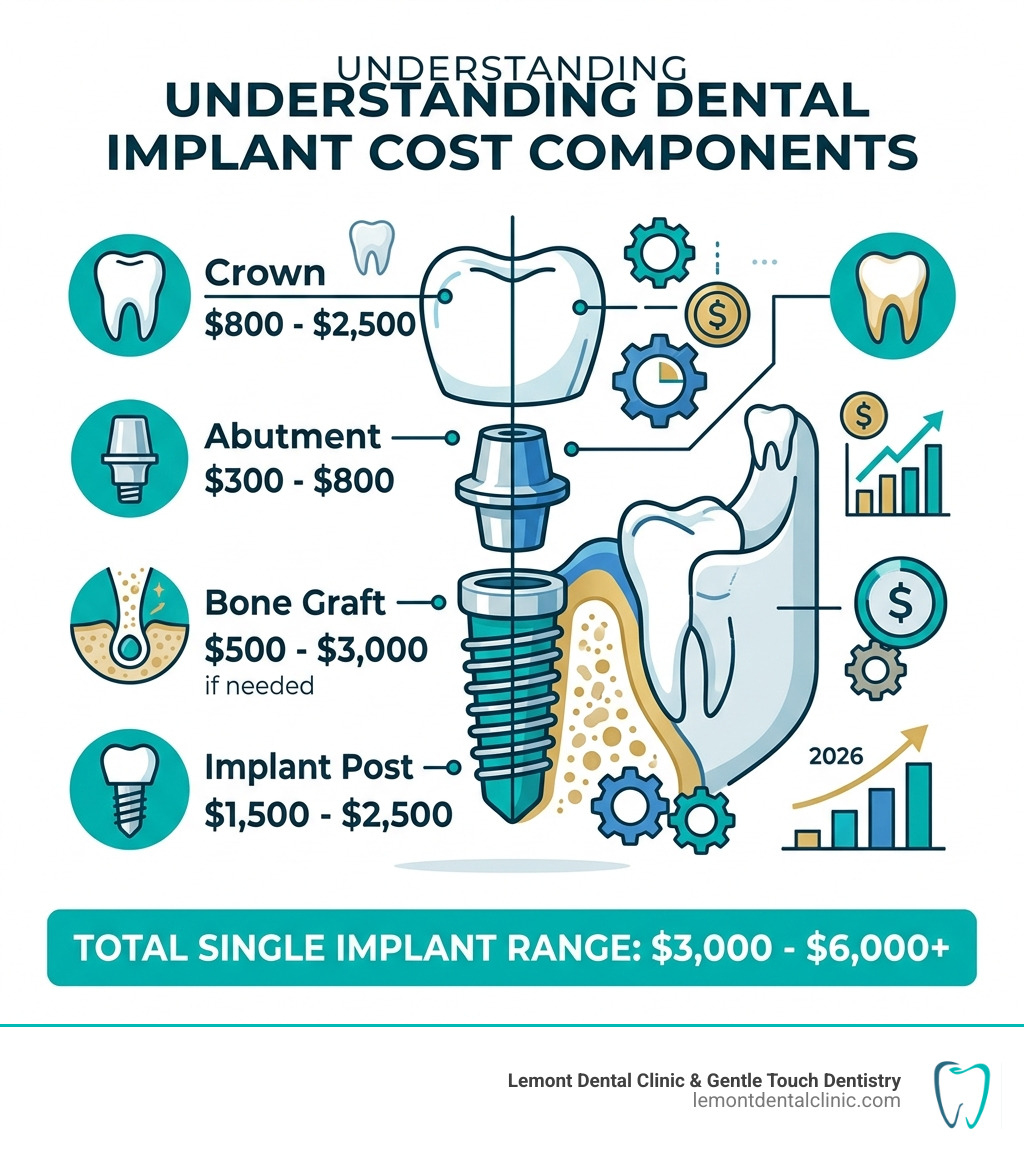
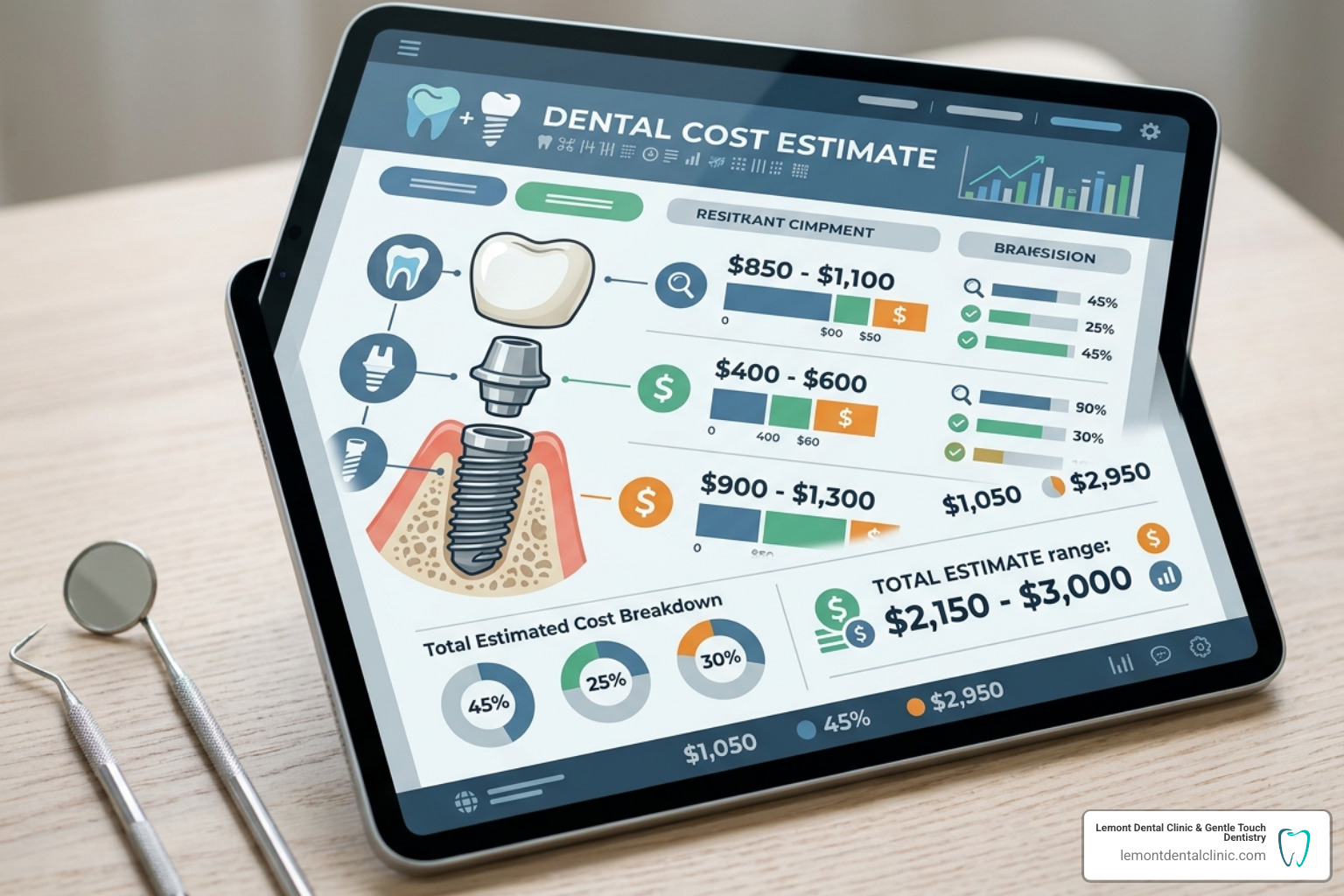
At its core, a calculator adds up the three primary physical components of an implant: the fixture (the screw), the abutment (the connector), and the prosthetic crown (the tooth you see). However, a truly accurate Dental Implant Cost Breakdown Calculator goes much further. It factors in surgical fees, the level of diagnostic imaging required (like 3D CBCT scans), and the quality of the materials used.
In our experience serving patients in Lemont and Palos Hills, IL, the “hidden” variables often make the biggest difference. For instance, the type of anesthesia used—ranging from local numbing to full IV sedation—can shift the total by hundreds or even thousands of dollars. A reliable calculator helps you account for these details so you can compare “apples to apples” when looking at different providers.
The Core Components of Your Estimate
To understand your calculation, you need to know what you are actually buying. A dental implant isn’t a single piece; it’s a three-part system:
The Implant Fixture (The Post): This is a titanium or zirconia screw that acts as your new tooth root. Titanium is the gold standard due to its 95-98% long-term success rate and its ability to fuse with your bone (osseointegration).
The Abutment: This is the connector piece that sits on top of the post and holds the crown in place.
The Crown: This is the custom-made porcelain or zirconia tooth. This is where the artistry happens, as it must match your surrounding teeth perfectly.
For a deeper dive into how these pieces are priced, you can see more info about teeth implants price to see how different materials affect the final tally.
Step-by-Step: Using a Dental Implant Cost Calculator
Using these tools is straightforward, but accuracy depends on the data you provide. Most high-quality calculators will ask for:
Your Zip Code: Costs in the Chicago area, including suburbs like Oak Lawn, Orland Park, and Bolingbrook, vary based on local overhead and regional demand.
Number of Teeth: Are you replacing one tooth, a bridge of three, or a full arch?
Bone Density Status: Do you know if you need a graft? (About 50% of patients do).
Insurance Details: Entering your expected coverage percentage helps calculate your actual out-of-pocket expense.
Tools like the Dental Procedure Cost Estimator allow you to input these variables to get a localized range. While these tools are excellent for planning, they cannot replace a clinical exam where we check your actual bone volume and gum health.
Key Factors That Influence Your Total Investment
Why does one person pay $3,500 while another pays $6,000 for a single tooth? It usually comes down to the “prep work.”
Procedure Type
Estimated Cost (Before Insurance)
Impact on Total
Single Implant
$3,000 – $6,000
Baseline
Bone Grafting
$500 – $3,000
Medium-High
Sinus Lift
$1,500 – $2,500
High
Simple Extraction
$150 – $500
Low
All-on-4 (Per Arch)
$20,000 – $30,000
Very High
If a tooth has been missing for a long time, the jawbone often shrinks. In these cases, we must perform a bone graft or a sinus lift (for upper back teeth) to create a solid foundation. Without a sturdy base, the implant is at risk of failing. You can find more info about dental implants cost estimate details regarding these preparatory steps.
Geographic and Provider Variations
Location matters significantly. If you are looking for dental implants in the Illinois suburbs—such as Lockport Heights, Romeoville, or Hickory Hills—you’ll find that prices are often more competitive than in the heart of downtown Chicago, yet they reflect the high standard of care expected in the Midwest.
Provider expertise also plays a role. A specialist like a periodontist or an oral surgeon might charge a premium compared to a general dentist who has extensive implant training. At Lemont Dental Clinic, we focus on providing all-in-one care, which often reduces costs because you aren’t being shuffled between multiple offices with multiple consultation fees. For more localized pricing trends, check out more info about dental implants near me prices.
Material Selection and Longevity
The materials you choose aren’t just about looks; they’re about how long the investment lasts.
Titanium: Proven over 40 years, highly durable, and cost-effective.
Zirconia: A metal-free, ceramic alternative. It’s great for patients with metal sensitivities or thin gums where metal might show through, but it often comes at a higher price point.
Crown Materials: Porcelain-fused-to-metal (PFM) is a traditional choice, but full zirconia or E-max crowns offer superior aesthetics and strength for modern restorations.
When comparing your options, it’s also worth looking at the more info about dental implants vs bridge debate. While a bridge is cheaper upfront, it usually needs replacement every 10–15 years, whereas an implant can last a lifetime, making it the more affordable choice over 20+ years.
Advanced Solutions: All-on-4 and Full-Mouth Restoration
For patients missing most or all of their teeth, individual implants for every single tooth would be prohibitively expensive (often exceeding $60,000 per arch). This is where advanced systems like All-on-4 or All-on-6 come in.
The All-on-4 system uses four strategically placed implants to support an entire permanent arch of teeth. Because it often avoids the need for bone grafting by tilting the posterior implants, it can cut the total cost of full-mouth restoration by nearly 50%. This procedure not only restores your smile but also provides critical facial structure support, preventing the “sunken” look often associated with traditional dentures.
We love calculators for the clarity they provide, but they have their limits. A dental implant cost calculator cannot see inside your jaw. It can’t measure the exact density of your bone or detect underlying gum disease that needs treatment first.
A personalized assessment is the only way to get a “to-the-penny” quote. Factors like your systemic health (e.g., controlled diabetes) and lifestyle habits (e.g., smoking) can influence the surgical approach and the types of materials we recommend. For a professional evaluation, visiting a dental implant center near me is the necessary next step after you’ve run your initial numbers.
Navigating Insurance and Financing Options
One of the most common misconceptions is that dental insurance won’t cover implants. While it’s true that many “basic” plans label implants as cosmetic, many modern plans now offer 10% to 50% coverage for the surgical or restorative portions.
Here is how to maximize your budget:
Annual Maximums: Most dental insurance has a cap (often $1,500 – $2,500). We can sometimes “phase” your treatment across two calendar years to use two years’ worth of benefits.
HSA/FSA: Dental implants are a qualified medical expense. Using pre-tax dollars from your Health Savings Account or Flexible Spending Account can save you 20-30% depending on your tax bracket.
Third-Party Financing: We work with providers like CareCredit, which often offer 0% interest plans for 6 to 24 months. This turns a large investment into a manageable monthly payment.
Frequently Asked Questions about Dental Implant Costs
How accurate are online dental implant cost calculators?
They are excellent estimation tools. Think of them like a “Zestimate” for a house—they give you a very good ballpark based on market data, but a physical “appraisal” (a clinical exam) is required for the final price. Most calculators are accurate within 15-20% of the final cost, provided you know if you need extractions or grafting.
Does dental insurance typically cover the full cost?
Rarely. Most insurance plans treat implants as a “Major” procedure, covering about 50% up to your annual maximum. Because the cost of an implant usually exceeds the annual maximum, you should expect to pay a significant portion out-of-pocket. However, some medical insurance plans may cover the surgery if the tooth loss was due to an accident or a specific medical condition.
What hidden costs should I budget for?
When using a dental implant cost calculator, ensure you are accounting for:
Diagnostic Scans: 3D imaging is essential for safety but often billed separately.
Sedation: If you are anxious, IV sedation is a wonderful option but adds to the cost.
Temporary Teeth: If the implant is in the front of your mouth, you’ll want a temporary tooth while the site heals.
Follow-up Care: Post-operative check-ups are usually included in the surgical fee, but long-term maintenance cleanings are separate.
Conclusion
At Lemont Dental Clinic & Gentle Touch Dentistry, we know that dental implants are more than just a “procedure”—they are an investment in your ability to eat, speak, and smile without hesitation. Whether you are in Palos Heights, Orland Park, or Bolingbrook, our goal is to provide restorative excellence that fits your life.
Don’t let the “mystery” of pricing keep you from the health you deserve. Use the tools available, understand the components, and then come see us for a personalized plan that honors both your smile and your budget.