What Is the Denture Manufacturing Process? A Quick Overview
The denture manufacturing process involves a series of carefully coordinated steps between your dentist and a dental laboratory to create a custom-fitted prosthesis that restores your smile, speech, and ability to chew.
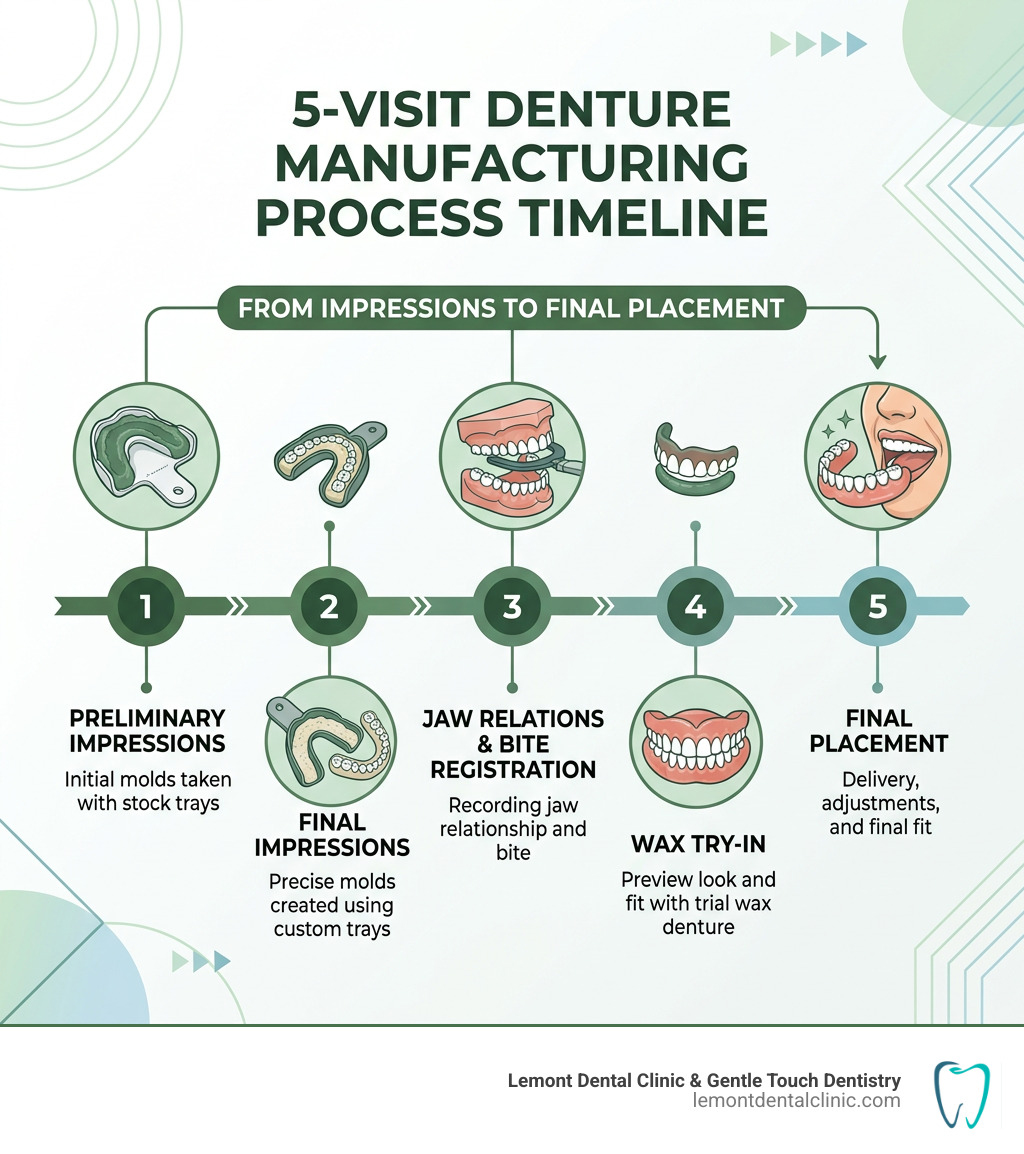
Here is a quick summary of the standard steps:
Preliminary impressions – Your dentist takes initial molds of your mouth using stock trays
Final impressions – Custom trays are made for more precise molds of your gum tissue
Jaw relations and bite registration – Your dentist records how your upper and lower jaws relate to each other
Wax try-in – A trial denture in wax lets you preview the look and feel before anything is permanent
Final placement – The finished acrylic denture is fitted, adjusted, and delivered
Typical timeline: Traditional dentures take 6 weeks to 3 months across roughly 5 appointments. Digital dentures can be ready in as little as 1 week with just 2 visits.
Losing teeth is more than a physical change – it affects confidence, eating, and everyday speech. The good news is that modern dentistry has made the path from tooth loss to a restored smile more predictable and comfortable than ever. Whether you are getting your first set of dentures or replacing an old one, understanding exactly what goes into making them can ease a lot of anxiety about the process.
I’m Piotr Dederowski, and at Lemont Dental Clinic & Gentle Touch Dentistry I’ve guided many patients through the full denture manufacturing process – from that first impression to the moment they leave with a confident new smile. Let’s walk through every stage so you know exactly what to expect.
Before we dive into the “how,” we need to look at the “what.” Dentures aren’t just one-size-fits-all plastic plates; they are sophisticated medical devices made from high-grade materials.
Most modern dentures use Polymethyl Methacrylate (PMMA) acrylic for the base. This material is popular because it’s non-toxic, highly durable, and can be pigmented to perfectly mimic the natural shade of your gum tissue. For the teeth themselves, we typically use specialized acrylic or, in some cases, porcelain. While porcelain teeth offer a very natural look, acrylic teeth are often preferred because they bond more securely to the denture base and are less likely to click when you speak.
Depending on your specific needs in Lemont or Palos Hills, we might recommend several types of fake teeth:
Full Dentures: These replace an entire arch of teeth (top, bottom, or both).
Partial Dentures: If you still have some healthy natural teeth, a partial denture fills the gaps and prevents your remaining teeth from shifting out of place.
Implant-Supported Dentures: Also known as implant dentures, these are anchored to titanium posts in the jawbone for maximum stability.
Overdentures: These fit over a few remaining natural teeth or implants, which helps preserve the jawbone.
Snap-On Dentures: A popular version of snap-on dentures that allows the patient to click the prosthesis into place for a secure fit without messy adhesives.
The Traditional Denture Manufacturing Process: Step-by-Step
The analog or traditional denture manufacturing process is a time-tested method that relies on the physical craftsmanship of a dental technician. It is a meticulous journey that ensures every contour of your mouth is captured.
1. Preliminary Impressions
Everything starts with a mold. We use stock trays and a material called alginate to take a “rough draft” of your upper and lower arches. These impressions are poured with dental stone to create a study model.
2. Custom Trays and Final Impressions
Because every mouth is unique, stock trays aren’t always perfect. We use the study model to create custom-fitted trays. These trays allow us to take a “master impression” using PVS or polyether materials, capturing the fine details of your gum tissue and muscle attachments.
3. Jaw Relations and Bite Registration
This is where the science of the Conventional Complete Denture Fabrication in 9 Steps gets technical. We use wax “bite blocks” to determine your Vertical Dimension of Occlusion (VDO)—essentially, how much space should be between your nose and chin when your mouth is closed. We also use a tool called an articulator, which simulates your jaw’s movements, to ensure your new teeth will meet correctly.
4. The Wax Try-In
The lab sets the chosen teeth into a wax base. This is your “test drive.” You get to see the color, shape, and arrangement of the teeth in your mouth before the denture is finalized.
5. Flasking and Processing
Once you approve the wax model, it goes back to the lab. The technician places the wax denture in a “flask” filled with plaster. The flask is heated to melt away the wax (the “lost wax” technique), leaving a hollow cavity. High-quality acrylic resin is then injected or packed into this space and cured under heat and pressure.
6. Finishing and Polishing
After the acrylic has hardened, the technician removes the plaster. The denture is trimmed of excess material, smoothed with carbide burs, and polished with pumice and specialized pastes to achieve a natural, high-gloss luster.
Clinical Appointments and Patient Feedback
During the denture manufacturing process, your feedback is our most valuable tool. At the wax try-in stage, we perform an extensive esthetic evaluation. We check the “lip support”—making sure the denture fills out your face naturally to prevent a sunken appearance.
We also conduct a phonetics check. We’ll ask you to say certain words (like those starting with “S” or “F”) to ensure the teeth aren’t interfering with your speech. Achieving natural-looking dentures is a collaborative effort; we don’t move to the final processing stage until you are 100% satisfied with the look and feel.
Laboratory Craftsmanship in the Denture Manufacturing Process
A great denture is a work of art. In the lab, technicians use their expertise to perform “stippling”—adding tiny indentations to the wax that mimic the natural “orange peel” texture of real gums. This prevents the acrylic from looking unnaturally smooth and shiny.
They also use selective grinding once the dentures are processed. Because acrylic can shrink slightly during curing, the technician puts the finished dentures back on the articulator to “equilibrate” the bite, ensuring the teeth meet perfectly without any high spots. This level of detail is what separates a standard set from the fake-teeth-101-understanding-the-different-types-available premium options.
The Digital Revolution in Denture Fabrication
The world of dentistry is changing, and the denture manufacturing process is no exception. Digital dentures are transforming how we restore smiles in our Illinois locations, offering a faster, more precise alternative to traditional methods.
Instead of “gag-inducing” physical impressions, we use an intraoral scanner to create a 3D digital map of your mouth. This scan is sent instantly to a lab where software designs the denture with mathematical precision.
Traditional vs. Digital: A Comparison
Feature
Traditional (Analog)
Digital (CAD/CAM)
Number of Visits
~5 Appointments
~2 Appointments
Total Timeline
6 – 12 Weeks
~1 Week
Impression Method
Physical Putty/Alginate
Digital Intraoral Scan
Accuracy
High (Technician Dependent)
Extremely High (Computer Precision)
Replacement
Requires New Impressions
Printed from Saved Digital File
Innovations in the Digital Denture Manufacturing Process
Digital dentures are created using either subtractive milling (carving the denture from a solid block of high-density PMMA) or additive 3D printing.
One of the most exciting innovations is the use of Lucitone Digital IPN. This 3D-printed material is “body-activated,” meaning it actually doubles in strength once it reaches the temperature of the patient’s mouth. This makes the denture incredibly resistant to fractures. Furthermore, because the design is saved as a digital file, if you ever lose or break your denture, we can print an exact replica without you having to come in for new scans. This is the gold standard for what-type-of-dentures-are-most-natural-looking.
Advanced Techniques for Challenging Clinical Cases
Not every mouth is a “textbook” case. Some patients deal with severely resorbed jawbones or “flabby ridges” (where the gum tissue is loose and moves easily). In these cases, a standard impression might displace the tissue, leading to a denture that drops or wobbles.
The Neutral Zone Technique: We find the “sweet spot” in your mouth where the outward pressure of your tongue is perfectly balanced by the inward pressure of your cheeks and lips. By building the denture in this zone, it stays stable during speech and eating.
The Admix Technique: For patients with very little bone left, we use a specific 3:7 ratio of impression compound and green stick wax to capture a more stable foundation.
Hobkirk’s Technique: This uses a “window” in the impression tray to record flabby tissue in its natural, resting state without compressing it.
Magnet-Retained Cheek Plumpers: For patients who have lost significant facial volume, we can create detachable “plumpers” that use tiny magnets to attach to the side of the denture, subtly filling out the cheeks for a more youthful appearance.
Caring for Your New Smile and Long-Term Maintenance
Once the denture manufacturing process is complete and you have your new smile, the journey doesn’t end there. Proper care is essential to keep your gums healthy and your dentures fitting well.
Daily Hygiene: Brush your dentures daily with a soft-bristled brush and non-abrasive denture cleanser. Regular toothpaste is too gritty and can create microscopic scratches where bacteria hide.
Soaking: Always soak your dentures overnight. This keeps the acrylic hydrated so it doesn’t warp and gives your gum tissues a much-needed rest.
Annual Checkups: Your jawbone naturally changes shape over time (resorption). We recommend a yearly visit to check for sore spots and ensure the fit is still optimal.
Maintenance: If your dentures start to feel loose, you might need a “reline.” You can learn more about what-happens-during-a-denture-reline to see how we add a new layer of acrylic to the base for a tighter fit.
Professional Repairs: Never try to be a “DIY dentist.” If you drop your denture, bring it to us. Professional labs can perform repairs in 24-48 hours, whereas home repair kits can permanently ruin the bite and fixing-loose-dentures incorrectly can lead to bone loss.
Frequently Asked Questions about Dentures
How long does the denture manufacturing process take?
For a traditional set, expect 6 to 12 weeks. This accounts for healing time (if you’ve had extractions) and the back-and-forth between the clinic and the lab. Digital dentures can significantly shorten this to about 7-10 days.
What is the difference between immediate and conventional dentures?
Immediate dentures are made before your teeth are removed and placed the same day as extractions. They act like a bandage but require more adjustments as you heal. Conventional dentures are made after the gums have fully healed (usually 8-12 weeks later), resulting in a more predictable fit from day one.
Are digital dentures better than traditional ones?
“Better” often depends on the patient’s needs. Digital dentures offer a faster turnaround and a more precise fit, plus the ability to easily replace them. However, traditional dentures allow for a higher degree of hand-customized esthetics (like specific gum tinting) that some patients prefer.
Conclusion
At Lemont Dental Clinic & Gentle Touch Dentistry, we believe that everyone deserves a smile they are proud to show off. The denture manufacturing process is a blend of advanced science and artistic skill, all aimed at giving you back your quality of life. Whether you are in Lemont, Palos Hills, or any of our surrounding communities like Oak Lawn or Orland Park, our team is here to provide high-quality, affordable care using the latest technology.
Ready to start your journey to a better smile? More info about dentures near me is just a click away. We look forward to helping you rediscover the joy of a confident, functional smile!