Finding Dental Insurance That Covers Implants — What You Need to Know
Dental insurance that covers implants exists, but your options are limited and coverage is almost never 100%. Here’s a quick overview of plans that offer implant benefits:
Plan Type
Implant Coverage
Annual Max
Notes
Delta Dental Premium
50%
$2,500
Waiting periods may apply
Fixed Copay Plans (e.g., Delta Clear)
Fixed copay
No annual max
No deductible
Employer Group Plans
Partial (varies)
$1,000–$2,500
Depends on employer
Individual Private Plans
Partial or none
Varies
Review policy carefully
Most private plans cover only parts of the implant — such as the crown or abutment — not the implant post itself. Full coverage is rare.
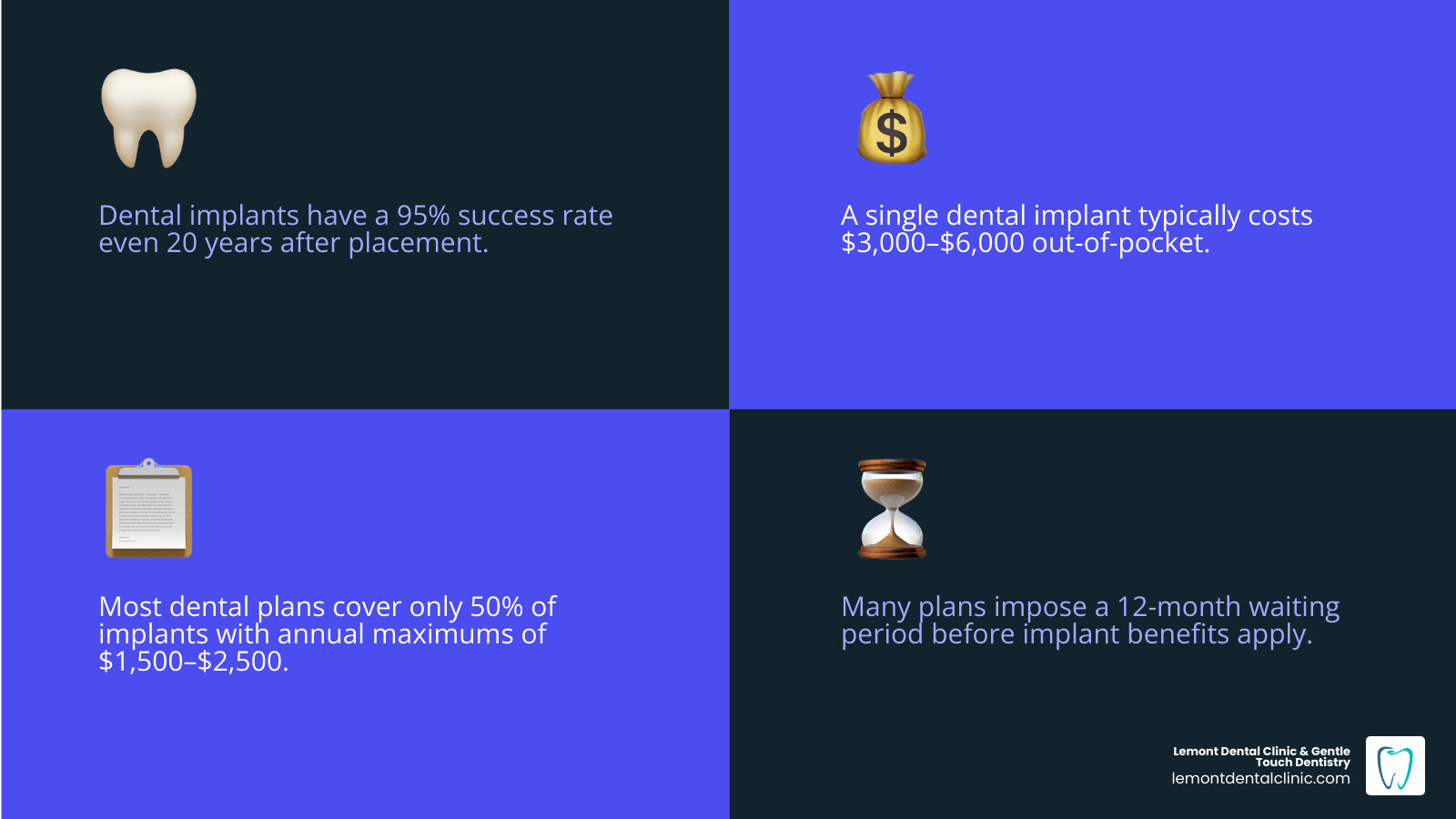
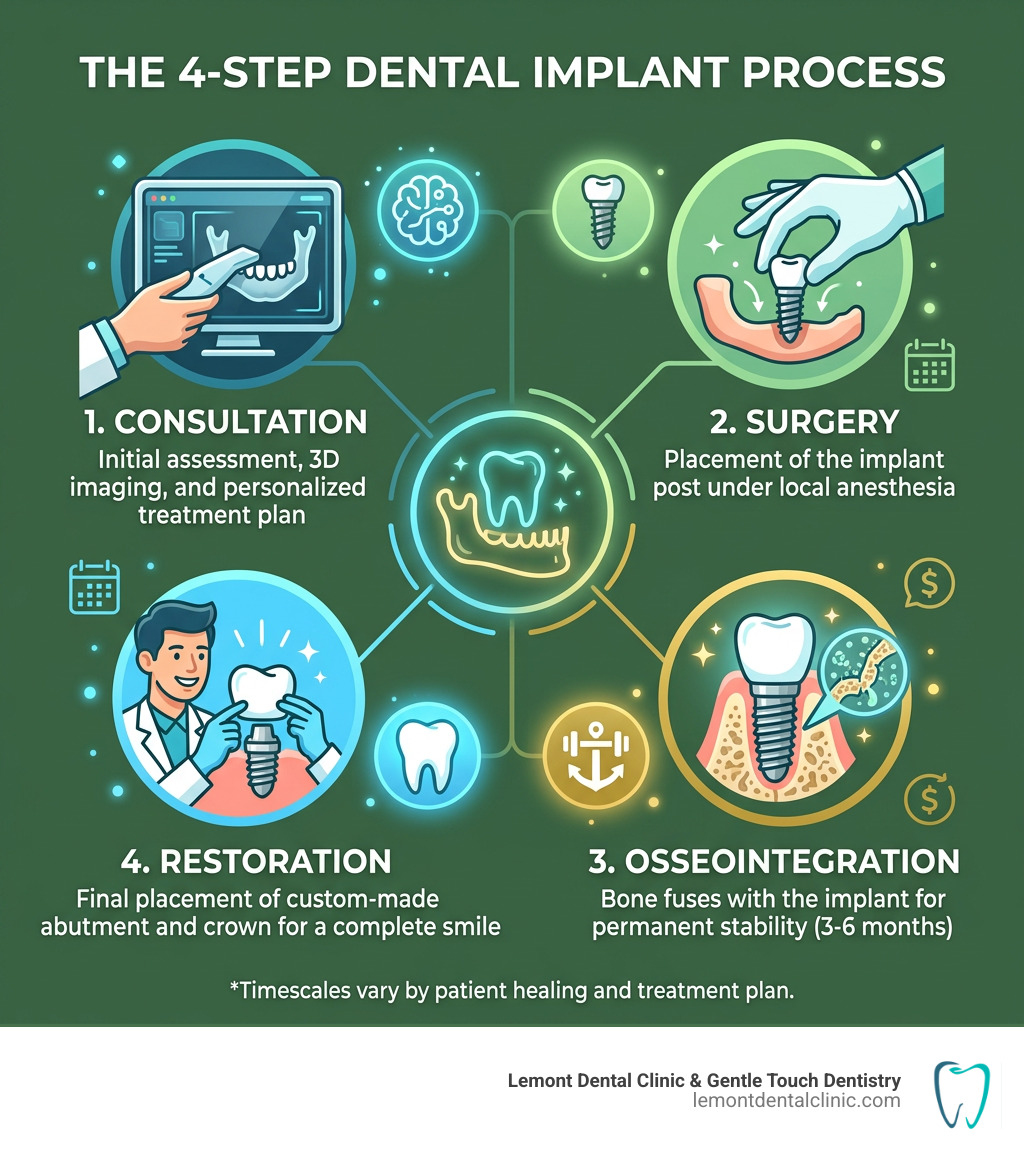
Dental implants are widely considered the gold standard for replacing missing teeth. They fuse directly to your jawbone through a process called osseointegration, functioning and feeling like natural teeth. With a 95% success rate even 20 years after placement, it’s easy to see why so many people want them. The challenge? Cost. A single implant runs $3,000–$6,000, and most insurance plans weren’t built with that price tag in mind.
That gap between what implants cost and what insurance actually pays causes real anxiety — especially for people who’ve already been putting off dental care. Understanding which plans offer meaningful implant coverage can make all the difference in moving forward with treatment.
I’m Piotr Dederowski of Lemont Dental Clinic & Gentle Touch Dentistry, and I’ve helped countless patients navigate dental insurance that covers implants while finding the right restorative path for their budget. In this guide, I’ll walk you through exactly which plans to look at and how to make the most of your coverage.
Quick dental insurance that covers implants terms:
At Lemont Dental Clinic & Gentle Touch Dentistry, we see the transformative power of a restored smile every day. Whether you are in Lemont, Palos Hills, or surrounding areas like Hickory Hills and Oak Lawn, the desire for a permanent solution to missing teeth is universal. Dental implants are popular because they are the only tooth replacement option that actually stimulates the jawbone, preventing the “sunken” facial appearance that often comes with tooth loss.
With a success rate of over 90% even a decade after placement, implants are a lifetime investment. However, the financial aspect is often the biggest hurdle. We know that “unpacking” an insurance policy can feel about as fun as shoveling snow off the car in February—it’s a chore, but necessary to get where you’re going!
Understanding Dental Insurance That Covers Implants
When you start looking for dental insurance that covers implants, you’ll quickly realize that not all plans are created equal. Insurance companies categorize dental services into tiers: Preventive (cleanings), Basic (fillings), and Major (crowns, bridges, and implants).
Most plans classify implants under “Major Restorative Services.” This means they often come with a waiting period, usually ranging from 6 to 12 months after your policy starts, before you can use the benefit. Additionally, you need to be aware of the annual maximum—the total amount the insurance will pay in a year. If your plan has a $1,500 maximum and a single implant costs $4,000, the insurance will only cover a fraction of the total cost.
For a clearer picture of what to expect, you can check out this Dental Implants Cost Estimate to help plan your budget. According to Humana, understanding these limits early is key to avoiding surprise bills.
Key Factors Influencing Coverage
Several factors determine whether your specific plan will help pay for your new smile. The policy type is the biggest factor.
PPO (Preferred Provider Organization): These plans offer the most flexibility. You can see almost any dentist, and they are more likely to offer some level of implant coverage, though you’ll pay more for the premium.
HMO (Health Maintenance Organization): These are often cheaper monthly but usually have very restrictive lists of providers and may not cover implants at all.
Two “fine print” items to watch out for are the pre-existing condition exclusion and the missing tooth clause. If you lost your tooth before you signed up for the insurance, some plans will refuse to pay for the replacement. This is why find the Best Dental Implants Near Me and have a professional team review your specific policy.
The Role of Medical Insurance in Implant Procedures
Many patients are surprised to learn that medical insurance occasionally steps in where dental insurance stops. While rare, medical coverage may apply if the dental implants are deemed a “medical necessity.” This typically occurs in cases of:
Severe Trauma: If you lost teeth in a car accident or a fall.
Congenital Conditions: If you were born missing certain teeth (hypodontia).
Oral Cancer: Reconstruction after tumor removal.
If your tooth loss is linked to a documented medical condition, we can help you explore whether your medical policy might offer a lifeline. You can learn more about the general process here: Dental Implants Near Me.
Top-Rated Insurance Plans for Dental Implants
If you are shopping for a new plan specifically to help with restorative work, look for “Premium” or “High” tiers. For example, Delta Dental offers plans that specifically include implant coverage at a 50% reimbursement rate, often with higher annual maximums (up to $2,500).
Another model gaining popularity is the Fixed Copay Model. In these plans, there is no “percentage” or “annual maximum.” Instead, there is a set price list. You know exactly what the implant will cost you out-of-pocket from day one. This predictability is a huge relief for patients in Palos Park or Orland Park who are planning major dental work. To find out which local providers work best with these plans, consult the Best Dentist for Dental Implants Near Me.
How to Verify Your Dental Insurance That Covers Implants
Don’t guess when it comes to your coverage. We always recommend a pre-determination of benefits. This is where our office sends your treatment plan to the insurance company before we start. The insurer then sends back an estimate of what they will pay.
To do this effectively, you should:
Request your Benefit Booklet: Look for “Implantology” or “Major Restorative.”
Call the Insurer: Ask specifically, “Is code D6010 (surgical placement of implant) covered?”
Check for Lifetime Maximums: Some plans have a separate “lifetime” limit for implants, different from your annual limit.
Our team at the Dental Implant Center Near Me is highly experienced in navigating these phone calls and paperwork hurdles for our patients.
Comparing Employer-Sponsored vs. Individual Plans
Employer-sponsored “Group” plans are generally the “best” because the employer has negotiated better rates and fewer waiting periods. If you are a student or a senior, your options might differ:
Student Plans: Often focus on basic care and may have very low limits for major work.
Senior Plans: Some private Medicare Advantage plans offer dental “riders,” but they often have low annual caps that might only cover half of a single implant.
Regardless of your plan type, the Best Teeth Implant Doctors Near Me can help you strategize how to phase your treatment—perhaps doing the surgery in December and the crown in January—to utilize two years of annual maximums.
Costs and Alternatives to Dental Insurance That Covers Implants
Without insurance, the cost of a single tooth replacement (the implant, the abutment, and the crown) typically ranges from $3,000 to $6,000. If you are looking at full-mouth restoration, such as the Cost of All-on-4 Dental Implants Near Me, the price can range from $20,000 to $50,000 per arch.
While these numbers can be intimidating, it is important to remember the “cheapest” option isn’t always the most cost-effective. Dentures may be cheaper upfront, but they often need relining or replacement every few years and don’t stop bone loss.
Covered Alternatives Under Standard Plans
If dental insurance that covers implants is simply not an option for you, most standard plans will cover alternatives. These include:
Fixed Bridges: Usually covered at 50%. A bridge “bridges” the gap by using the teeth on either side as anchors.
Partial or Complete Dentures: Usually covered at 50%. These are removable.
It is worth noting that in the Canadian context, the Canadian Dental Care Plan (CDCP) specifically excludes implants, focusing instead on these removable options to control costs. In our Illinois locations, such as Romeoville or Bolingbrook, we can help you weigh the pros and cons of these alternatives if you find the Best All-on-4 Dental Implants Near Me are outside your current budget.
Financing and Clinic Memberships
At Lemont Dental Clinic & Gentle Touch Dentistry, we believe that financial constraints shouldn’t stand between you and a healthy smile. If insurance coverage is lacking, we offer several solutions:
Third-Party Financing: We work with reputable providers to offer monthly payment plans. Check our Implant Financing page for details.
Membership Plans: For patients without insurance, some clinics offer membership programs that provide a flat discount (often 20%) on major procedures like implants for a small annual fee.
Frequently Asked Questions about Implant Coverage
Does the Canadian Dental Care Plan (CDCP) cover implants?
No. The CDCP classifies dental implants as “non-essential” and complex. To keep the program sustainable for a large population, the government focuses on basic oral health needs, such as fillings, extractions, and removable dentures. While this is a Canadian program, it reflects a common trend in government-funded or low-cost plans to prioritize basic functionality over advanced restorative technology.
Why do most plans have a 12-month waiting period?
Insurance companies use waiting periods to manage risk. They want to prevent people from signing up for a plan only when they know they need an expensive $5,000 procedure, then canceling the plan immediately after. By requiring a 12-month wait for “Major” services, they ensure that the premiums paid into the system help balance the costs of the claims paid out.
Are implant crowns covered even if the post is not?
Sometimes! This is a “pro-tip” in the dental world. Even if your insurance explicitly says “we do not cover the surgical placement of implants,” they may still cover the abutment (the connector) and the crown (the tooth part) under the category of “Prosthetics.” Since a crown is a crown regardless of what it sits on, some insurers will pay their standard 50% for that portion of the bill.
Conclusion
Navigating dental insurance that covers implants can be complex, but you don’t have to do it alone. At Lemont Dental Clinic & Gentle Touch Dentistry, we are committed to providing high-quality, comprehensive care to our neighbors in Lemont, Palos Hills, Oak Lawn, and beyond.
By combining the latest technology—like 3D CT scanning for precise placement—with a deep understanding of insurance and financing, we make the “gold standard” of tooth replacement accessible. Whether you have premium insurance, a basic plan, or no insurance at all, we will work with you to create a personalized treatment plan that fits your life and your budget.
Stop searching for answers and start smiling again. Start Your Journey to a New Smile Today by scheduling a consultation with our experienced team. We can’t wait to help you regain your confidence and your chewing power!