Understanding Permanent Bridge Teeth: A Complete Solution for Missing Teeth
Permanent bridge teeth are fixed dental appliances that replace one or more missing teeth by anchoring artificial teeth (pontics) to your existing natural teeth or dental implants on either side of the gap. Unlike removable dentures, a permanent bridge is cemented in place and can only be removed by your dentist.
Quick Answer:
What it is: A non-removable dental restoration that “bridges” the gap left by missing teeth
How it works: Crowns on adjacent teeth support artificial teeth in between
Main types: Traditional, cantilever, Maryland, and implant-supported bridges
Lifespan: 5-15 years with proper care
Best for: Restoring chewing function, speech, and preventing remaining teeth from shifting
Missing a tooth creates challenges beyond aesthetics, affecting chewing, speech, and causing other teeth to shift. Over time, this can alter your facial structure and lead to further dental issues.
A permanent dental bridge is a reliable, fixed solution that restores your smile’s function and appearance. Custom-made to match your natural teeth, these durable restorations can last for many years with proper care. The procedure usually requires only two non-surgical dental visits (unless an implant-supported bridge is chosen).
I’m Piotr Dederowski, and at Lemont Dental Clinic & Gentle Touch Dentistry, I’ve helped countless patients restore their smiles with permanent bridge teeth using the latest techniques and materials. With locations serving Lemont and Palos Hills, our team specializes in creating comfortable, natural-looking bridges that give patients back their confidence and full dental function.
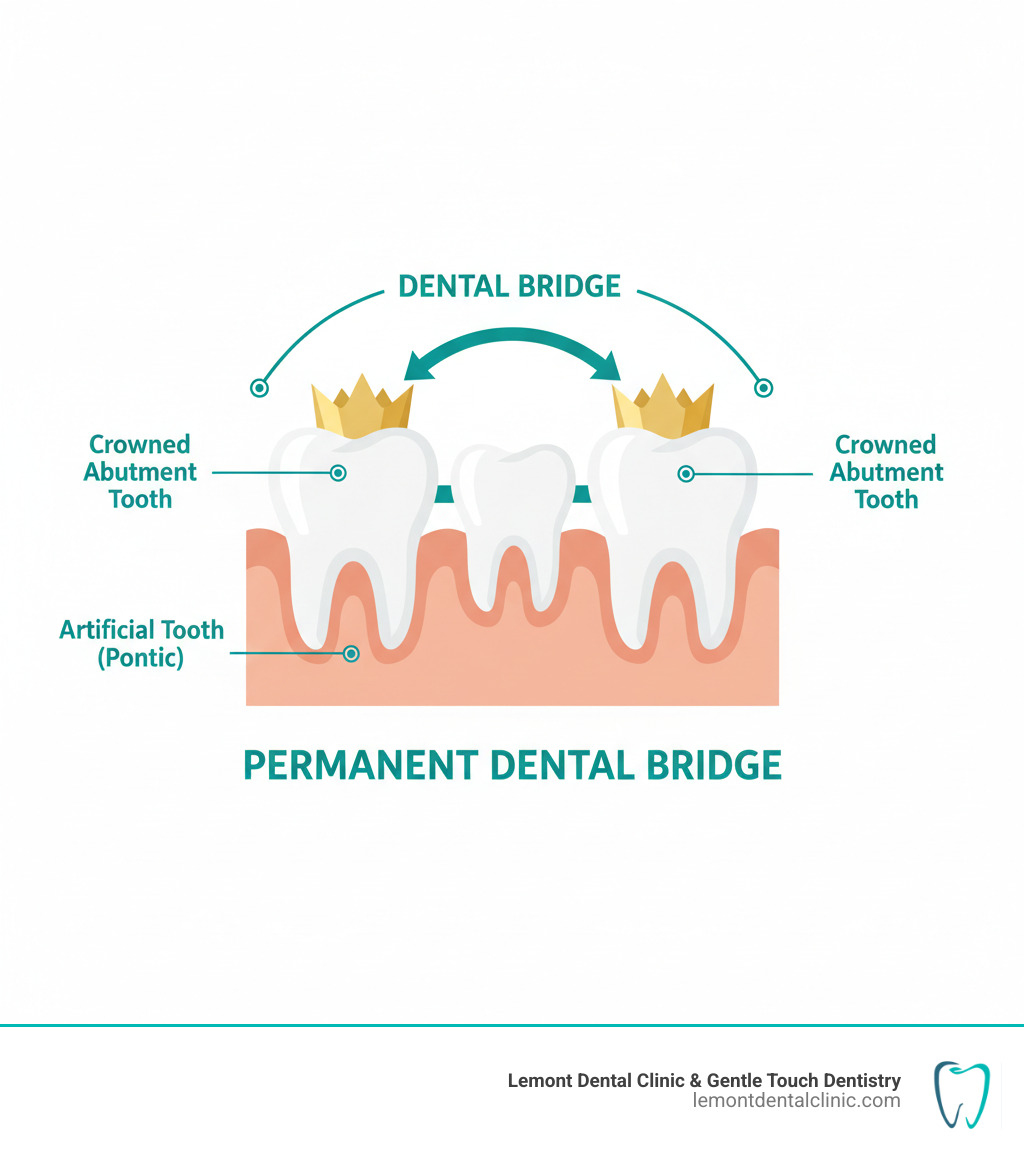
A permanent dental bridge is a fixed restoration that spans the gap left by missing teeth, connecting the teeth on either side. Unlike removable dentures, a bridge is cemented firmly in place by your dentist, becoming a stable part of your mouth.
A permanent dental bridge does more than fill a gap; it restores full mouth function and protects your long-term oral health. It restores chewing ability, improves speech, and prevents neighboring teeth from drifting into the empty space. This shifting can misalign your bite and increase the risk of decay and gum disease. A bridge acts as a placeholder, preventing this domino effect.
Your teeth also support your lips and cheeks. When teeth are missing, your face can take on a sunken appearance. A dental bridge helps maintain your natural facial contour.
At Lemont Dental Clinic & Gentle Touch Dentistry, we see bridges as comprehensive solutions. For more detailed information, check out our page on Crowns and Bridges.
Permanent vs. Temporary Bridges
If you’re getting a bridge, you’ll have a temporary one first. They are two stages of the same treatment.
During the bridge procedure, we reshape the supporting teeth to fit the crowns. A temporary bridge is placed to protect these prepared teeth and gums while your custom permanent bridge is crafted in a dental lab. This temporary restoration allows you to eat and speak normally and maintains the appearance of your smile during the few weeks of waiting.
Temporary bridges are made from acrylic resin and are not designed for long-term use. Your permanent bridge, in contrast, is crafted from high-quality, durable materials like porcelain or zirconia, designed to last 5 to 15 years with proper care. The process involves two main visits: one for preparation and impressions, and a second to fit and cement your final, permanent bridge.
Types and Materials of Permanent Bridge Teeth
Dentists choose from several types of permanent bridge teeth based on your specific needs, including the number of missing teeth and the health of surrounding teeth.
Traditional and Cantilever Bridges
A traditional bridge is the most common type, used when you have healthy teeth on both sides of a gap. It consists of crowns on the adjacent teeth (abutments) that support an artificial tooth (pontic) in between. This solid, cemented restoration is strong and reliable.
A cantilever bridge is used when there is a healthy tooth on only one side of the gap. It anchors the replacement tooth to a crown on that single supporting tooth. Because all chewing force is concentrated on one side, this type of bridge is best for areas with low biting stress, like front teeth. Assessment of various factors for feasibility of fixed cantilever bridge offers more technical insight.
Maryland and Implant-Supported Bridges
The Maryland bridge is a more conservative option, often for front teeth. Instead of full crowns, it uses metal or porcelain “wings” bonded to the back of adjacent teeth, preserving more of your natural tooth structure.
For maximum stability, implant-supported bridges are the gold standard. These bridges attach to dental implants—titanium posts surgically placed in your jawbone. This is an excellent option for replacing several teeth in a row or when natural teeth aren’t strong enough to support a bridge. A key benefit is that implants stimulate the jawbone like natural tooth roots, preventing the bone loss that occurs after tooth loss. Learn more on our page about Dental Implants.
Common Bridge Materials
The material for your permanent bridge teeth is chosen based on strength, aesthetics, and location.
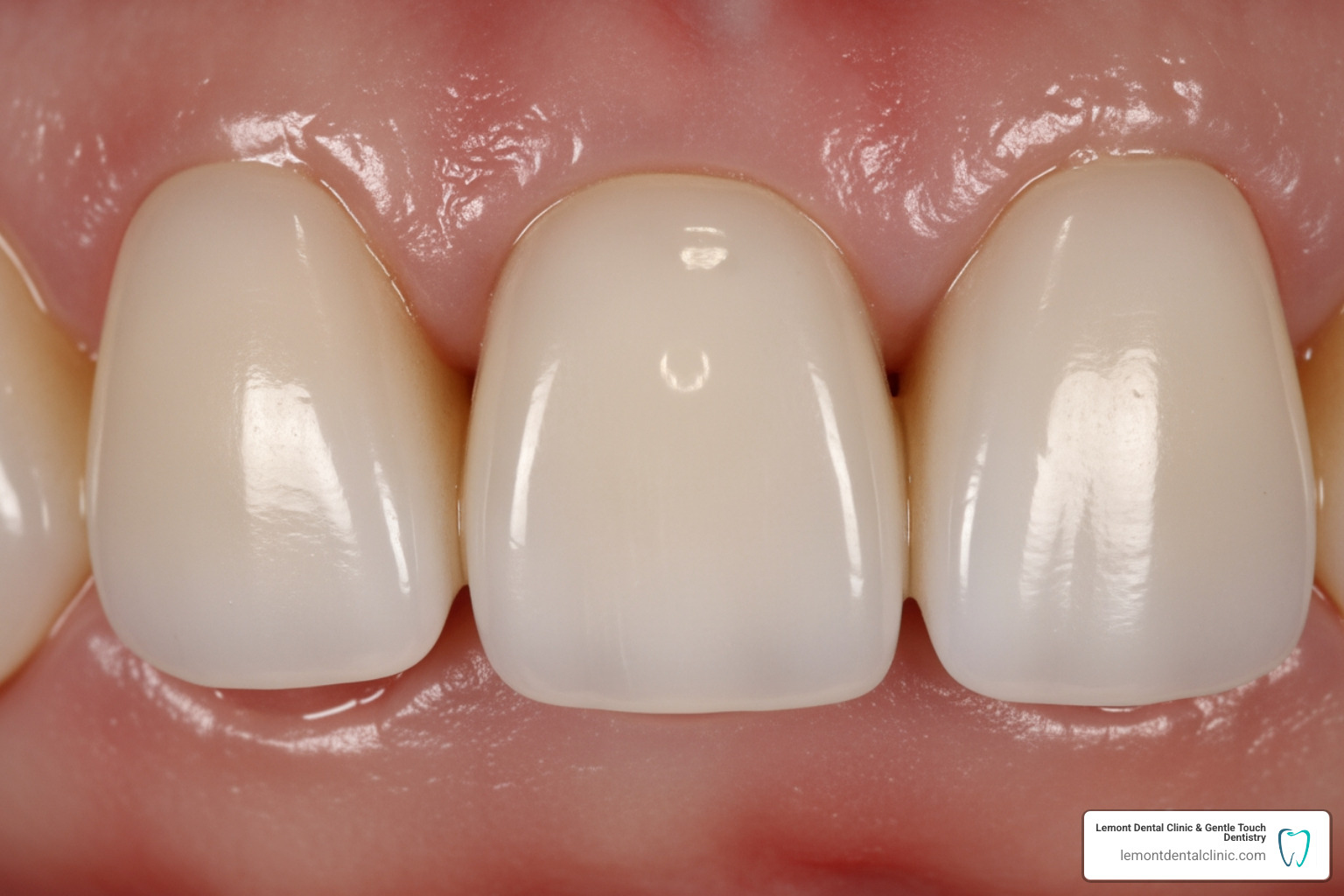
Porcelain: A favorite for visible teeth, as it can be perfectly matched to the color and translucency of your natural teeth.
Zirconia: An advanced, biocompatible ceramic that is incredibly strong and delivers beautiful, natural-looking results for both front and back teeth.
Porcelain-fused-to-metal (PFM): A strong metal core provides durability, while a porcelain layer offers good aesthetics. Often used for back teeth that handle heavy chewing forces.
Gold alloys: Exceptionally strong, long-lasting, and gentle on gums. An outstanding option for back molars where strength is the priority over color.
The Dental Bridge Procedure and Longevity
Getting permanent bridge teeth is an efficient process, typically completed in just two visits. The result is a restored smile that functions like your natural teeth.
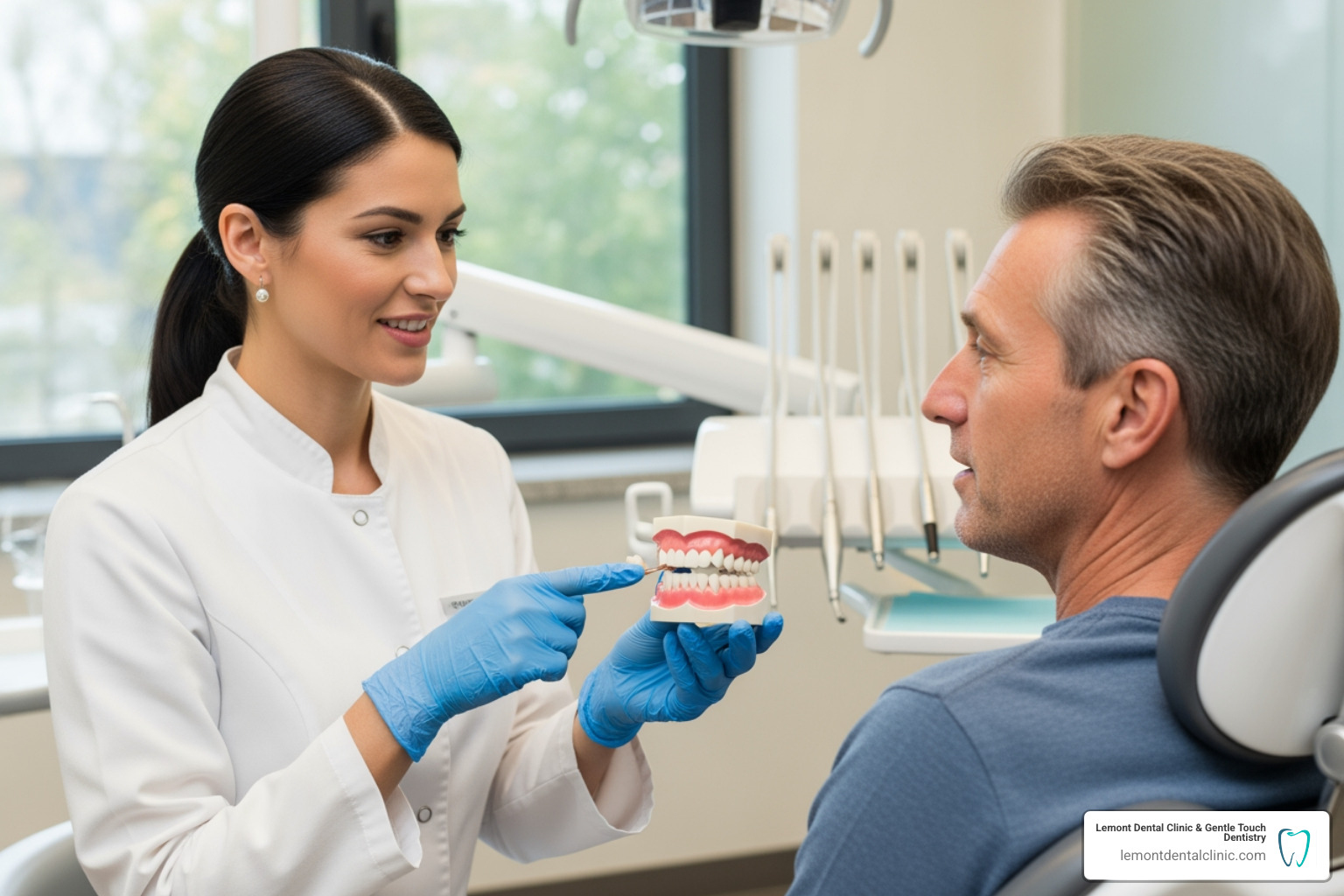
The process starts with a consultation to examine your oral health, discuss your goals, and determine the best type of bridge for you. We’ll consider the health of adjacent teeth, your bite, and your aesthetic preferences.
Your first visit involves preparing the abutment teeth by gently reshaping them under local anesthesia to make room for the crowns. (Maryland bridges require less preparation, while implant-supported bridges involve implant placement). We then take precise impressions of your mouth, which are sent to a dental lab to craft your custom bridge. You’ll leave with a temporary bridge to protect your teeth and maintain your smile while the permanent one is made.
At your second visit, we remove the temporary bridge and check the fit and appearance of your new permanent one. Once we are both satisfied, we permanently cement your bridge into place, making it a fixed part of your smile.
Caring for Your Permanent Bridge Teeth
With proper care, your permanent bridge teeth can last 5 to 15 years or even longer. The key is treating your bridge with the same attention as your natural teeth.
Your daily hygiene is crucial. Brush twice a day, paying extra attention to the gumline around the bridge. Since you can’t floss normally between the fused teeth, you must clean underneath the pontic. Use tools like floss threaders or interdental brushes to remove plaque and food particles from this area. For more tips, see our Regular Cleaning resource.
Be mindful of your diet. Avoid extremely hard foods (ice, hard candy) that can crack the bridge, and be cautious with sticky foods that could dislodge it.
Regular dental check-ups are essential for professional cleaning and to ensure the integrity of your bridge, preventing minor issues from becoming major problems.
Potential Risks and Downsides
While permanent bridge teeth are a great solution, it’s important to understand the potential risks:
Abutment Tooth Preparation: Healthy teeth must be permanently altered to support the bridge. This can lead to sensitivity or, rarely, the need for a root canal.
Decay: Poor hygiene can allow decay to form under the crowns, compromising the abutment teeth and the bridge.
Cement Failure: Over time, the cement holding the bridge can weaken. If your bridge feels loose, contact us, as it can often be re-cemented.
Fracture: The bridge can chip or break under excessive force, such as biting on very hard objects.
Anchor Tooth Failure: The success of the bridge depends on the health of the supporting abutment teeth. If they weaken due to decay or gum disease, the entire bridge is at risk. This makes excellent oral hygiene and regular check-ups essential.
Bridges vs. Other Tooth Replacement Options
While permanent bridge teeth are an excellent choice, it’s helpful to compare them to other solutions like dental implants and partial dentures. Each has unique strengths and trade-offs.
Feature
Dental Bridge
Dental Implant
Partial Denture
Longevity
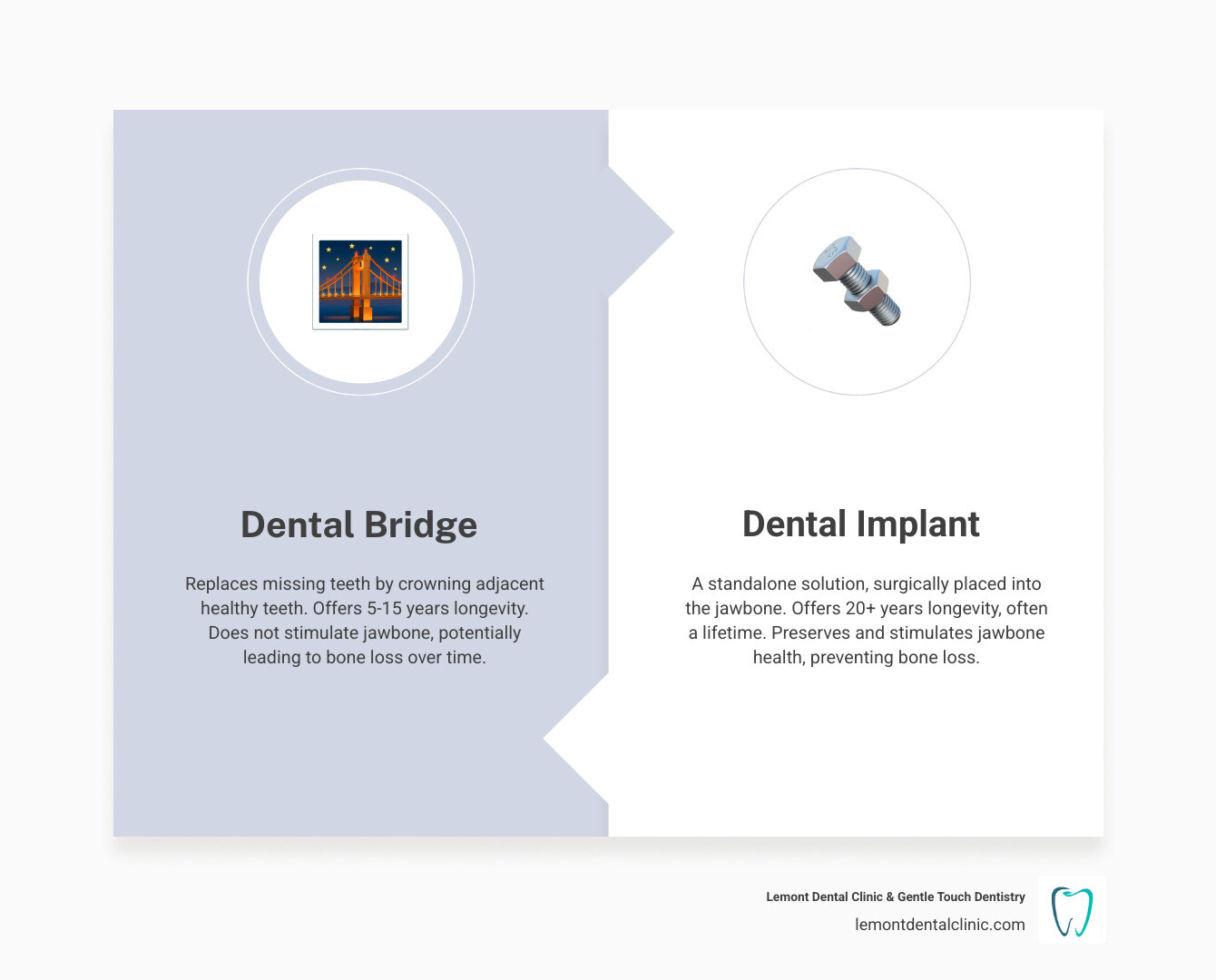
5-15 years (often longer with good care)
20+ years, potentially a lifetime
5-10 years (may need relining/replacement)
Jawbone Health
Does not stimulate bone, potential bone loss
Preserves and stimulates jawbone, prevents loss
Does not stimulate bone, can accelerate bone loss
Adjacent Teeth
Requires preparation/crowning of healthy teeth
Standalone, no impact on adjacent teeth
Clasps can put strain on adjacent teeth
Maintenance
Special flossing tools needed
Brushed like natural teeth
Removable for cleaning
Initial Cost
Mid-range
Higher initial investment
Lower initial investment
When weighing your options, consider long-term value, not just initial cost. For a detailed comparison, see our guide on Dental Implants vs Bridge.
Bridge vs. Dental Implant
This is a common decision point. A key difference is the procedure. A traditional bridge is non-surgical, involving tooth preparation and cementing the restoration. A dental implant is a surgical procedure where a titanium post is placed into the jawbone. This is a minor surgery performed with local anesthesia, as explained by the Mayo Clinic’s overview of dental implant surgery.
A critical long-term difference is jawbone preservation. Dental implants are placed into the jawbone, mimicking a tooth root and stimulating the bone to prevent it from shrinking. A bridge does not stimulate the bone under the artificial tooth, so some bone loss can still occur over time.
In terms of longevity, implants can last a lifetime with proper care, while bridges typically last 5-15 years before needing replacement. The initial cost of a bridge is generally lower than an implant, but the long-term value may differ when considering potential replacements and impact on adjacent teeth.
Bridge vs. Partial Denture
The main distinction is that a partial denture is a removable appliance, while a bridge is fixed and cemented permanently in place. This affects comfort, stability, and maintenance.
In terms of stability and comfort, fixed bridges excel. They are securely cemented, offering rock-solid stability that feels like your natural teeth. Removable partial dentures can sometimes shift, which may cause discomfort or sore spots.
Aesthetically, bridges often provide a more seamless appearance, as they don’t have the visible metal clasps that some partial dentures use. Maintenance also differs; partial dentures must be removed for daily cleaning and soaking, while bridges are cleaned in the mouth. For more on removable options, see our page on Types of Dentures and Cost.
Frequently Asked Questions about Dental Bridges
Here are answers to some of the most common questions we hear about permanent bridge teeth at our Lemont and Palos Hills offices.
Is getting a dental bridge painful?
The procedure itself is not painful. We use local anesthesia to completely numb the area. Afterward, it’s normal to have some mild post-procedure sensitivity for a few days, which is typically manageable with over-the-counter pain relievers. If you experience significant discomfort, please contact us.
How many teeth can a single bridge replace?
A bridge can typically replace one to four consecutive missing teeth. The viability depends on factors like the span length (the size of the gap) and the health of the abutment teeth, which must be strong enough to support the bridge. For longer spans or weaker abutment teeth, an implant-supported bridge may be a better option. A dentist’s assessment is crucial to determine the best solution for you.
Do permanent bridge teeth feel natural?
Yes, after a brief adjustment period, a well-made bridge should feel natural. Because your bridge is made with a custom fit for your mouth, it integrates seamlessly. Most patients quickly forget they have a bridge as their restored function returns, allowing them to eat, speak, and smile confidently. The natural feel over time is one of the key benefits of this restoration.
Conclusion: Is a Bridge the Right Choice for Your Smile?
Choosing permanent bridge teeth is an investment in your quality of life. These fixed restorations restore your ability to eat and speak confidently, prevent teeth from shifting, and help maintain your facial contours.
With proper care, a bridge can serve you reliably for 5 to 15 years or more. They are a durable, beautiful, and natural-feeling solution from modern dentistry.
However, there is no one-size-fits-all solution for tooth replacement. The best option depends on your specific oral health, budget, and personal goals. A professional consultation is essential to create a personalized treatment plan that’s right for you.
At Lemont Dental Clinic & Gentle Touch Dentistry, we help patients throughout Lemont, Palos Hills, and surrounding Illinois communities—including Chicago Ridge, Worth, Palos Park, Hickory Hills, Oak Lawn, Orland Park, Palos Heights, Bolingbrook, Romeoville, Palisades, and Lockport Heights—make informed decisions. We provide expert care and honest advice to find the solution that fits your needs.
Don’t live with missing teeth any longer. Contact us today to discuss how we can restore your smile, confidence, and comfort.