What Is 3D Guided Implant Surgery — and Why Does It Matter?
3D guided implant surgery is a precision technique where dentists use a detailed digital map of your jaw — built from a 3D scan — to plan and place dental implants with computer-guided accuracy.
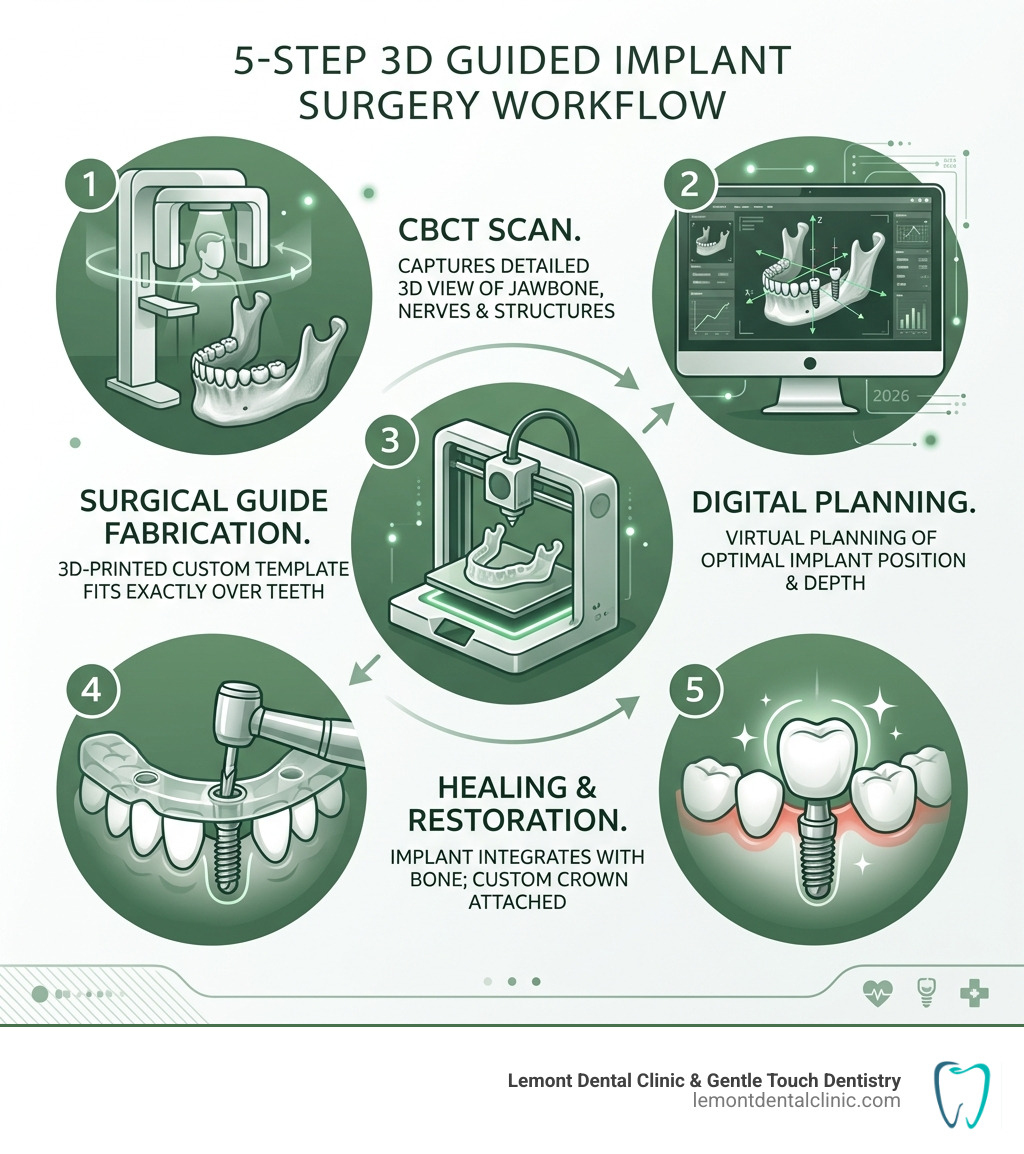
Here’s a quick overview of what it involves:
CBCT scan — a 3D X-ray captures your jawbone, nerves, and sinuses in full detail
Digital planning — software maps the exact position, angle, and depth for each implant
Surgical guide — a custom 3D-printed template fits over your teeth to direct placement
Guided placement — the implant goes in along the pre-planned path, with no guesswork
Faster healing — the minimally invasive approach means less trauma and quicker recovery
Most people picture dental implant surgery as an involved, nerve-wracking procedure. And honestly, without modern technology, that concern made sense.
Traditional implant placement relied almost entirely on a dentist’s experience and judgment — what’s often called “freehand” surgery. That approach works, but it carries more variability. Studies show freehand implant surgery has a failure rate nearly three times higher than guided surgery — 6.42% compared to just 2.25% with 3D guidance.
The difference comes down to one thing: precision.
When your dentist can see a complete 3D map of your mouth before making a single incision — including exactly where your nerves run, how dense your bone is, and how the final tooth will look — the entire procedure becomes more predictable, safer, and more comfortable for you.
At Lemont Dental Clinic & Gentle Touch Dentistry, this technology means we can plan your implant treatment with the kind of accuracy that simply wasn’t possible a decade ago.
Understanding 3D Guided Implant Surgery
When we talk about 3D guided implant surgery, we are describing a “top-down” approach to dentistry. In the past, implants were often placed where the bone looked strongest, and then we would try to make a tooth fit on top of it. Today, we start with the end in mind. This is called restorative-driven planning.
Using advanced Surgical Guides & Implant Planning Software, we create a virtual blueprint of your mouth. This isn’t just a simple picture; it’s a comprehensive digital environment where we can “test drive” the surgery before you even sit in the chair. By mapping out the dental roots, bone density, and vital structures, we ensure that the Dental Implants Life-Changing Technology we provide is perfectly integrated into your unique anatomy.
How 3D guided implant surgery works
The process begins with two critical pieces of data: DICOM and STL files.
DICOM Data: This comes from a Cone Beam Computed Tomography (CBCT) scan, which shows us the internal “hard” structures like bone and nerves.
Intraoral Scans (STL): We use a digital wand to capture a 3D surface map of your teeth and gums.
By merging these files, we create a virtual tooth mock-up. We can see exactly where the new tooth needs to sit for a perfect bite and beautiful smile, and then we work backward to determine the exact millimetric position for the implant post.
The role of 3D-printed surgical guides
Once the plan is perfected in the software, we don’t just memorize it—we print it. A custom 3D Printed Implant Guided Surgery guide is fabricated specifically for your mouth.
These guides often feature titanium sleeves. These sleeves act like a high-tech “stencil” for the dentist’s tools. They lock in the drill trajectory and depth control, ensuring the implant cannot go too deep or tilt at the wrong angle. It removes the “human error” of eyeballing the placement, making the physical surgery the easiest part of the entire process.
Guided vs. Traditional Freehand Surgery: The Precision Gap
In traditional “freehand” surgery, the dentist makes an incision, flaps back the gum tissue to see the bone, and uses their clinical judgment to place the implant. While experienced doctors are very good at this, the margin for error is simply higher.
Feature
3D Guided Surgery
Traditional Freehand
Accuracy
Within 0.5mm to 2mm
Relies on visual judgment
Failure Rate
~2.25%
~6.42%
Invasiveness
Minimally invasive (often flapless)
More invasive (requires incisions/sutures)
Recovery
Faster (minimal swelling)
Standard (more trauma to tissue)
Safety
High (nerves/sinuses mapped)
Moderate (anatomical risks)
The choice between Dental Implants vs Bridge often comes down to longevity, and guided surgery ensures that your implant has the best possible start.
Accuracy and success rates in 2026
As of April 2026, the technology has reached sub-millimeter precision. Using software like 3Shape Implant Studio: Digital Implant Workflow for Predictable Results, we can minimize “angular deviation”—the slight tilting that can cause an implant to fail years down the road. This precision ensures long-term stability and better distribution of biting forces, which is why guided surgery is now considered the gold standard for modern practices in the Lemont and Palos Hills areas.
Procedure time and efficiency
Efficiency isn’t just good for the dentist; it’s great for the patient. Because the “thinking” is done during the planning phase, the actual surgery is incredibly fast. Guided surgery appointments are often 30-50% shorter than traditional methods. In many cases, we can provide Dental Implants in a Day Near Me because the streamlined drilling protocols allow us to work with such confidence and speed.
The Technology Behind the 3D Map: CBCT and Digital Planning
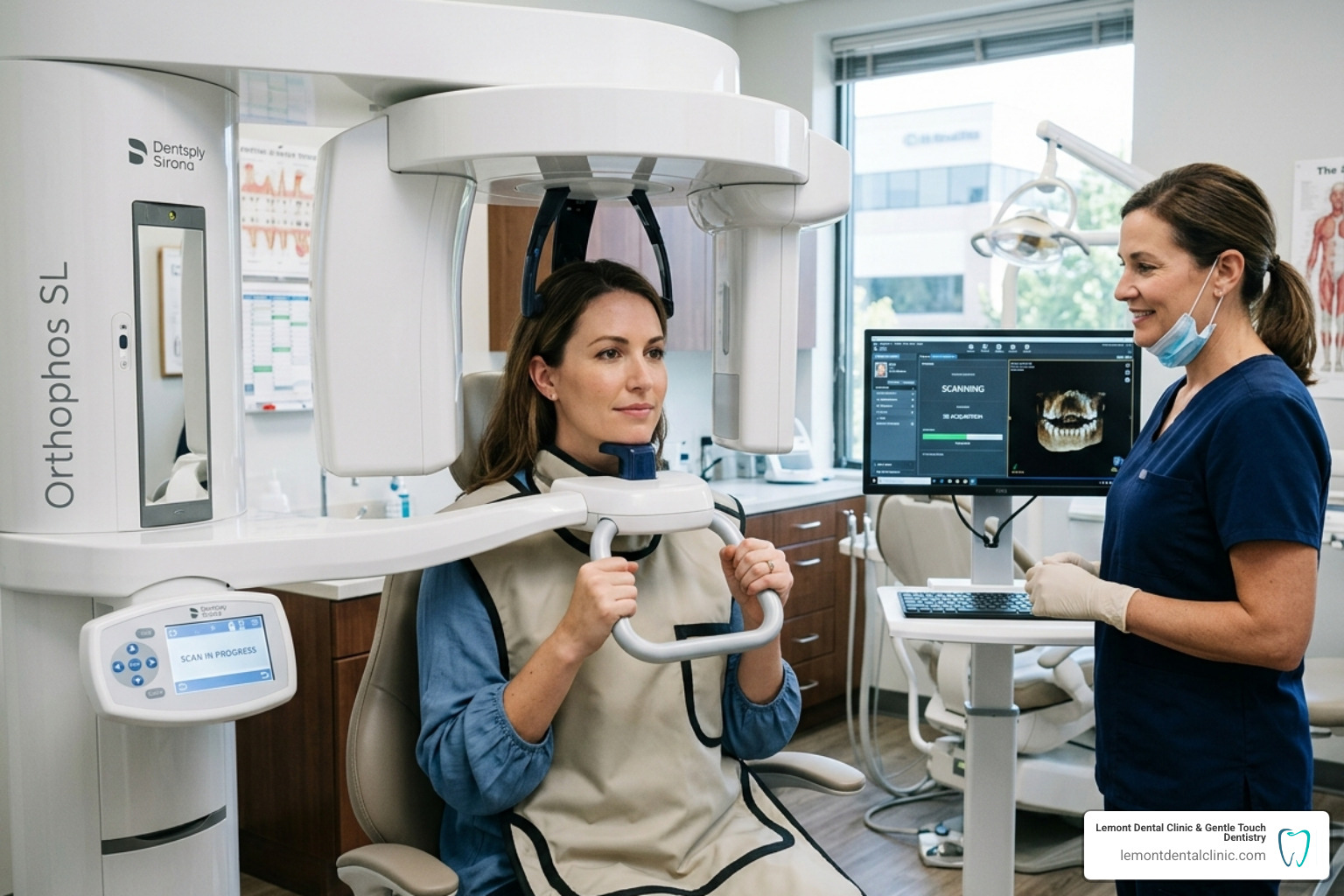
The “magic” starts with the CBCT machine. Unlike a traditional flat X-ray, Cone Beam Computed Tomography rotates around your head, capturing hundreds of images to create a 3D visualization of your skull.
This anatomical mapping is part of What’s New in Dental Implantology? that has truly revolutionized patient safety. We aren’t just looking at where the bone is; we are looking at the quality and density of that bone to ensure the implant will “take” properly.
Avoiding vital structures with software
The lower jaw contains the inferior alveolar nerve, and the upper jaw contains the maxillary sinuses. Hitting either of these during surgery can lead to permanent numbness or chronic infections.
With 3D CBCT Scan for Fully Guided Implant Placement, we use nerve tracing tools to mark these structures in bright colors on our screen. We then set “safety zones”—digital barriers that the software won’t let us cross. This level of protection is impossible with 2D imaging.
AI and the future of implant planning
The future of 2026 is already here with AI-powered enhancements. Modern versions of Implant Studio now feature automated scan alignment and AI-powered guide design. The software can suggest the best implant size based on thousands of successful cases it has analyzed. While our doctors always have the final say, this “robotic assistance” ensures that every plan is optimized for personalized medicine.
Key Benefits: Safety, Comfort, and Faster Recovery
One of the biggest surprises for our patients in Lemont and Palos Hills is how little it hurts. Because we know exactly where the implant is going, we can often use “flapless” surgery.
Instead of cutting a long line in the gums and peeling them back, we create a tiny, precise access hole. This leads to significantly reduced trauma and minimal swelling. Many of our patients looking for Same Day Dental Implants Near Me are back to work the very next day.
Minimally invasive techniques
By using these small access holes, we often eliminate the need for sutures (stitches) entirely. Less cutting means less bleeding and a much lower risk of post-operative infection. This environment also promotes faster osseointegration—the process where your bone grows into the Dental Implants to lock them in place.
Aesthetic and functional outcomes
Because we use prosthetic-driven placement, the final tooth doesn’t just feel good—it looks natural. We ensure the optimal angulation so that the crown emerges from the gum line exactly like a real tooth would. For those searching for the Best Teeth Implants Near Me, 3D guidance is the secret to that “seamless” look.
Who is a Candidate for 3D Guided Procedures?
Almost anyone who needs a tooth replaced can benefit from this technology, but it is a game-changer for complex cases.
If you have been told in the past that you aren’t a candidate for implants due to bone deficiency, 3D mapping might change that. By finding the exact pockets of strongest bone, we can often avoid the need for extensive bone grafting. This is especially useful for Best All-on-4 Dental Implants Near Me protocols. If you’re wondering, Are Dental Implants Right for You?, a 3D scan is the only way to know for sure.
Solving complex dental cases
We frequently use 3D guidance for:
Limited Bone Volume: Placing implants at precise angles to utilize existing bone.
Nerve Proximity: Safely navigating tight spaces in the back of the mouth.
Full-Mouth Reconstruction: Ensuring 4 to 6 implants are perfectly distributed to support Implant Dentures.
Revision Surgery: Replacing failed implants from other clinics by identifying why the first one failed.
Long-term success of 3D guided implant surgery
Statistics show that guided implants have a 5-year survival rate of approximately 95.6%, even in complex cases. By placing the implant in the “sweet spot” of the bone, we promote better bone preservation and overall periodontal health. When you look for the Best Dental Implants in My Area, you are really looking for a doctor who uses the best tools to ensure your investment lasts a lifetime.
Frequently Asked Questions about 3D Guided Implant Surgery
Is 3D guided surgery more expensive than traditional methods?
There is typically a premium for the technology, usually ranging from $500 to $1500 per implant. This covers the cost of the CBCT scan, the specialized planning software time, and the fabrication of the 3D-printed guide. However, most patients find this to be a wise investment. By reducing the risk of failure (which costs thousands to fix) and potentially avoiding bone grafts, the Dental Implants Cost Estimate for guided surgery often provides better long-term value.
How long does the recovery take compared to freehand surgery?
Because the procedure is so much less invasive, recovery is remarkably fast. Most patients report only minor “soreness” rather than “pain.” While freehand surgery might leave you swollen for a week, guided surgery patients often return to their normal routine—including work—the next day. During your Dental Consultation and Implants visit, we’ll give you a personalized recovery timeline.
Does the 3D scan involve high radiation?
Modern CBCT machines are designed for safety. They use a “focused beam” that only targets the area needed, resulting in significantly lower radiation than a traditional medical CT scan. The digital efficiency of the process means we get all the data we need in one 10-to-20-second scan.
Conclusion
At Lemont Dental Clinic & Gentle Touch Dentistry, we believe that precision is the foundation of a great smile. By using 3D guided implant surgery, we take the guesswork out of your treatment, providing a safer, faster, and more predictable experience. Whether you are in Lemont, Palos Hills, or surrounding areas like Lockport or Homer Glen, our goal is to combine the latest technology with a gentle touch.
If you’re ready to see the 3D map of your own smile and learn more about the Teeth Implants Price for your specific needs, we are here to help. Modern dentistry has changed—and we’ve made sure it changed for the better for our patients.