Dentures for missing teeth are removable oral appliances that replace one, several, or all of your missing teeth, helping restore your ability to eat, speak, and smile with confidence. Modern dentures are crafted from materials like acrylic, resin, porcelain, and metal to closely resemble natural teeth and gums.
Quick Overview of Denture Solutions:
Denture Type
Best For
Removability
Stability
Complete (Full) Dentures
All teeth missing in upper or lower jaw
Removable
Relies on gums/palate for support
Partial Dentures
Several missing teeth with healthy teeth remaining
Removable
Metal clasps attach to natural teeth
Implant-Retained Dentures
Those seeking more stability
Removable (snap-on)
Attached to dental implants
Implant-Supported Dentures
Those wanting permanent solution
Fixed (non-removable)
Secured to dental implants
Missing teeth affect more than just your smile. They can lead to difficulty chewing and speaking, cause nearby teeth to shift out of position, contribute to jawbone deterioration, and change your facial appearance. According to research, patient satisfaction is high for people who choose dentures, especially when they replace missing anterior (front) teeth.
The average cost of traditional removable dentures varies significantly by location—ranging from $1,695 in Alabama to $2,867 in Hawaii—and the process generally takes about two months from initial consultation to final fitting. With proper care and maintenance, dentures can last as long as 5-10 years.
I’m Dr. Piotr Dederowski, and at Lemont Dental Clinic & Gentle Touch Dentistry, I’ve helped countless patients steer their journey toward restoring their smiles with dentures for missing teeth that fit comfortably and look natural. Our approach combines modern dental technology with compassionate care to ensure you receive a solution custom to your specific needs and budget.
Why Consider Dentures? Signs and Benefits of Replacing Missing Teeth
Losing teeth impacts your life in many ways, affecting how you eat, speak, and feel about yourself. At Lemont Dental Clinic & Gentle Touch Dentistry, we understand these concerns and can guide you on whether dentures for missing teeth are the right solution for you.
One of the most immediate benefits is a restored smile, which can significantly boost your confidence. Beyond aesthetics, dentures remove many diet restrictions, allowing you to enjoy more foods and improve your nutrition. They also help you speak more clearly.
Dentures also play a crucial role in maintaining your facial structure. When teeth are missing, the jawbone can shrink, causing facial muscles to sag. Dentures provide support to prevent this sunken appearance and also stop remaining teeth from shifting into gaps.
Dentures for missing teeth allow you to live life to the fullest, free from the physical and emotional burdens of tooth loss. As the Cleveland Clinic notes, dentures help restore your oral health needs, supporting both your upper and lower jawbone ridge for support.
The Consequences of Unfilled Gaps
Ignoring missing teeth can cause significant oral health issues, primarily jawbone deterioration. Without stimulation from tooth roots, the jawbone shrinks. This affects the stability of remaining teeth, can change your face shape, and may make fitting dentures more difficult later.
Unfilled gaps can cause your remaining teeth to shift out of their natural positions, leading to bite problems. This misalignment can put increased strain on your remaining healthy teeth, making them more susceptible to wear, damage, and even further loss. When teeth shift, food can also become packed into these new gaps, increasing the risk of tooth decay and gum disease. Such issues can also contribute to bad breath and swollen gums.
Beyond oral health, missing teeth can lead to nutritional problems if you’re unable to properly chew a balanced diet. The discomfort and difficulty with eating can force you to choose softer, less nutritious foods. Finally, the aesthetic impact of missing teeth can significantly reduce your self-confidence, affecting your social interactions and overall quality of life.
Key Indicators You Might Need Dentures
How do you know if dentures for missing teeth are the right path for you? Here are some key indicators that suggest it’s time to explore your options:
Multiple Missing Teeth: If you’ve lost several teeth, dentures are an effective way to restore function and appearance.
Chronic Toothaches: Persistent tooth pain from extensive decay may indicate teeth are beyond repair and need extraction.
Severely Damaged Teeth: Teeth are too fractured or decayed for crowns or bridges to be viable options.
Loose Teeth: Advanced gum disease can cause multiple teeth to become loose, which may require dentures after gum treatment.
Trouble Eating Hard or Chewy Foods: You avoid certain foods because chewing is painful or difficult. Dentures can improve your ability to eat comfortably.
Impact on Appearance and Speech: If missing teeth make you self-conscious about your smile or cause difficulties with clear pronunciation, dentures can offer a transformative solution.
Tooth Loss from Injury or Disease: Accidents, trauma, or conditions like gum disease and extensive decay are common reasons for tooth loss that dentures can effectively address.
If you recognize any of these signs, we encourage you to schedule a consultation with us at Lemont Dental Clinic & Gentle Touch Dentistry. We’ll assess your oral health and discuss the best tooth replacement options custom to your needs.
A Guide to the Different Types of Dentures for Missing Teeth
When considering dentures for missing teeth, you’ll find a wide range of options. At Lemont Dental Clinic & Gentle Touch Dentistry, we offer comprehensive solutions, from traditional removable dentures to advanced implant-assisted options. Understanding the differences is the first step in choosing the right solution.
For more detailed information on the various types and their associated costs, you can explore our page on Types of Dentures and Cost.
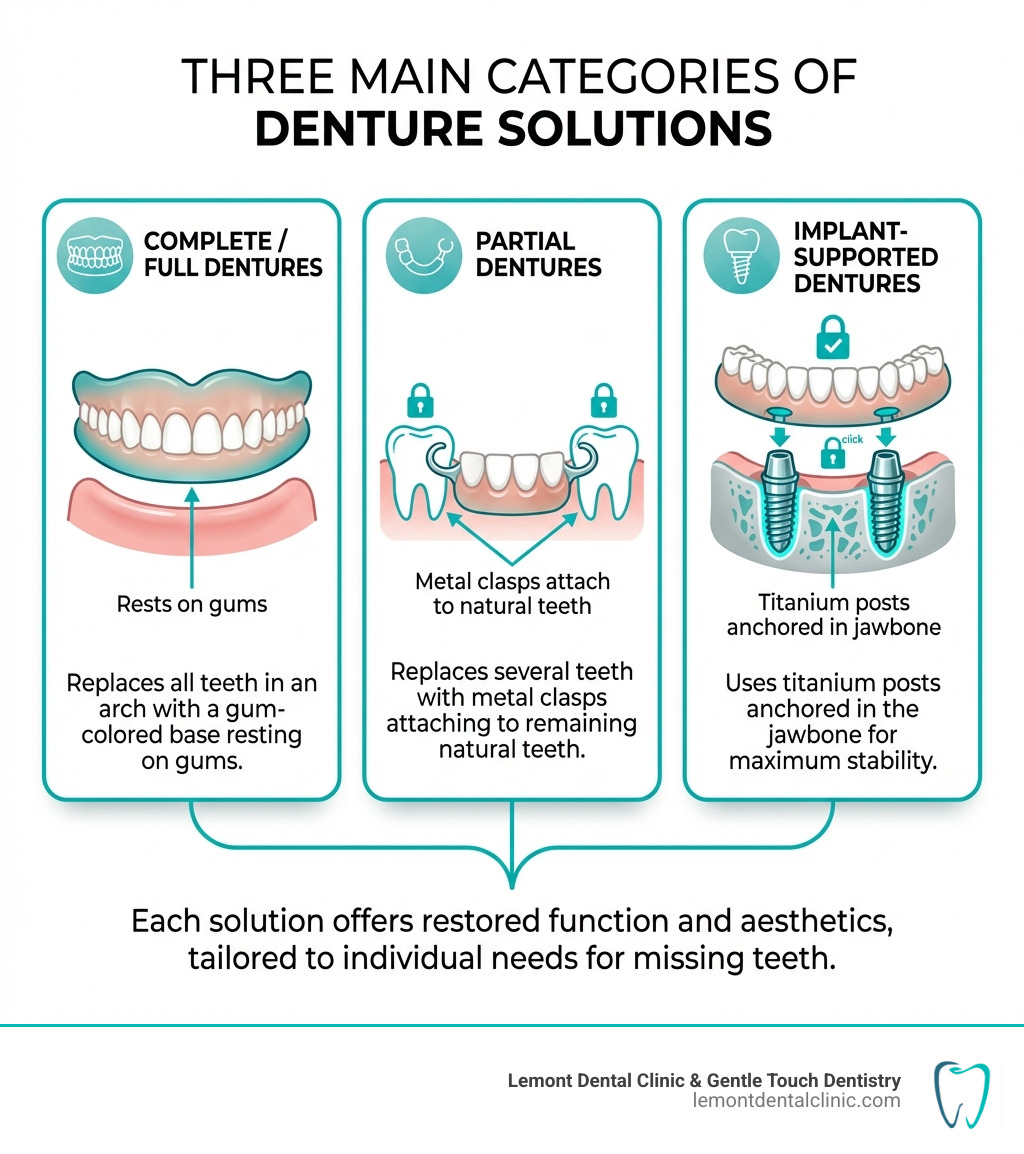
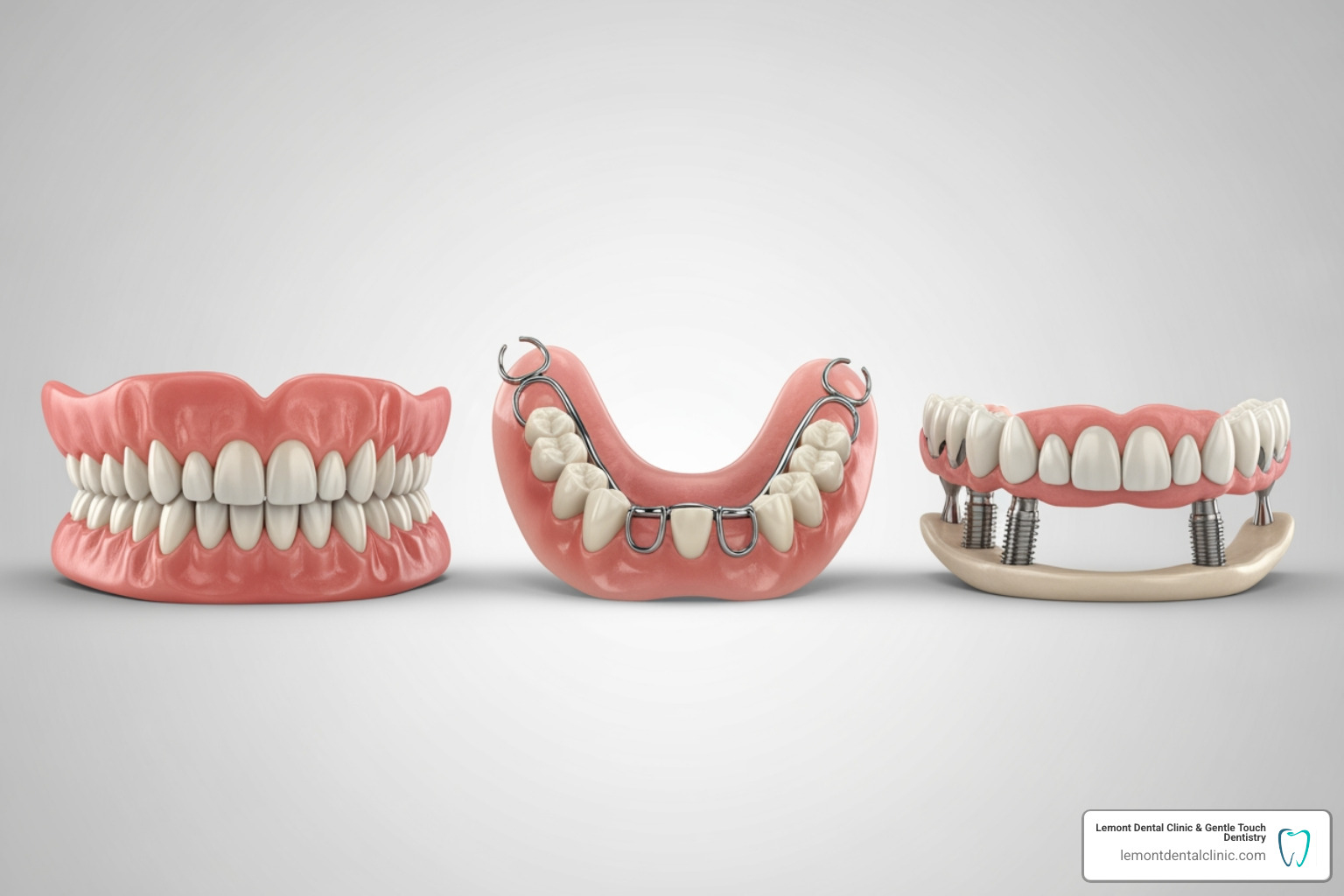
Here’s a comparison of the main categories of dentures for missing teeth:
Complete (Full) Dentures: Replacing an Entire Arch
Complete dentures are for individuals who have lost all teeth in an upper or lower jaw. They consist of artificial teeth in a gum-colored acrylic resin base that rests on the gums. The upper denture covers the palate for suction, which can be aided by adhesive.
There are two primary types of complete dentures:
Conventional Dentures: These are made and placed after the gum tissues have fully healed from any extractions, which takes about 8 to 12 weeks. This allows for a very precise and stable fit.
Immediate Dentures: Prepared in advance, these are inserted immediately after tooth extraction, so you don’t have to go without teeth. They act as a bandage over the extraction sites. As your mouth heals and changes shape, immediate dentures will need adjustments (relines) to maintain their fit. They are often a temporary solution until conventional dentures can be made.
Who is a Good Candidate for Partial Dentures for Missing Teeth?
Partial dentures are an excellent option if you are missing several, but not all, of your teeth in one or both jaws and still have healthy natural teeth remaining. These removable appliances fill the gaps, restoring your smile, chewing ability, and speech.
You might be a good candidate for partial dentures if:
You have three or more missing teeth, especially in a row: Partial dentures are effective for bridging these gaps.
You have healthy natural teeth to support the denture: Partial dentures rely on special clasps that hook around your remaining natural teeth for stability, in addition to resting on your gums and bone.
You are not a good candidate for dental implants or prefer not to undergo surgery: Partial dentures offer a non-surgical alternative to replace missing teeth.
You want to prevent your remaining teeth from shifting: The gaps left by missing teeth can cause adjacent teeth to drift out of position, leading to bite problems and other issues. Partial dentures hold these teeth in place.
Research shows that patient satisfaction is high for people who choose partial dentures, particularly if they replace missing anterior (front) teeth, significantly improving appearance and confidence. Partial dentures can be made from a combination of metal and plastic, with the metal framework providing strength and a lighter feel, while plastic (acrylic or resin) versions are generally less expensive.
Implant-Assisted Dentures: The Pinnacle of Stability
For superior stability and a natural feel, implant-assisted dentures for missing teeth are a significant advancement. They combine dentures with the secure foundation of dental implants—small titanium posts surgically placed into the jawbone to act as artificial tooth roots.
We offer various implant-assisted options, including Implant Dentures and Snap-On Dentures, which provide improved comfort and functionality.
There are two main types of implant-assisted dentures:
Implant-Retained Dentures (Snap-On Dentures): These removable dentures “snap on” to a few dental implants. This provides much more stability than traditional dentures, eliminating the need for adhesives and reducing movement while eating and speaking. You can still remove them for daily cleaning.
Implant-Supported Dentures (Fixed or Hybrid Dentures): These are non-removable dentures permanently secured to several dental implants. Only a dentist can remove them. They offer the highest stability and chewing power, closely mimicking natural teeth. This option is for those who prefer a fixed solution and are committed to thorough daily cleaning.
The integration of implants with your jawbone (osseointegration) provides a strong, lasting foundation, helping to preserve jawbone density and prevent the bone loss that often occurs with traditional dentures. While the initial cost is higher, the long-term benefits in terms of comfort, function, and bone health make them a worthwhile investment for many of our patients in Lemont, Palos Hills, and surrounding Illinois communities.
The Denture Journey: From Consultation to Final Fit
The journey to get dentures for missing teeth might seem daunting, but at Lemont Dental Clinic & Gentle Touch Dentistry, we ensure a smooth and comfortable process. Our goal is a functional and aesthetic result that restores your smile. The entire process generally takes about two months.
Here’s a step-by-step look at what you can expect:
Initial Consultation and Examination: Your journey starts with a comprehensive exam to assess your oral health, discuss your goals, and determine the best denture type for you. We will also discuss any needed preliminary procedures, like extractions.
Impressions and Models: We take precise impressions of your mouth using traditional molds or advanced digital scans. These are used to create detailed models of your jaws for a perfect fit.
Bite Registration: We record how your jaws and teeth come together. This step is crucial for ensuring your new dentures have a natural, balanced fit for comfortable chewing and speaking.
Wax Try-In: In this exciting step, you’ll preview a wax model of your dentures. You can see the shape, size, and arrangement of the teeth and request adjustments to ensure they look and feel right before final fabrication.
Final Fabrication: After your approval of the wax try-in, your dentures are crafted in a dental lab according to the exact specifications.
Final Delivery and Adjustments: We place your finished dentures, check the fit, and make any minor adjustments. It’s common to need a few follow-up appointments as your mouth adapts. Our team provides ongoing support to ensure your dentures remain comfortable and functional.
Adjusting to Life with Dentures
It’s normal to experience an adjustment period with new dentures. They may feel awkward initially, and your mouth muscles will need time to adapt. Increased saliva flow and minor soreness are also common but usually diminish within a few weeks.
Eating with new dentures requires practice. Start with soft, small pieces of food, chewing slowly on both sides. Gradually introduce other foods, but be cautious with anything very hot, hard, or sticky. As MedlinePlus advises, be careful with hot items, as dentures can dull temperature sensation.
Speaking may also feel different initially. Practicing by reading aloud can help you adapt. If your dentures slip, gently bite down and swallow to reposition them. Contact us for an adjustment if problems persist.
Potential Complications and When to See a Dentist
While dentures for missing teeth are designed for comfort and function, potential issues can arise. It’s important to be aware of these and know when to seek professional help from us at Lemont Dental Clinic & Gentle Touch Dentistry.
Common issues include:
Loose Fit: Over time, your jaw and gums change, which can loosen your dentures. This can cause slipping, difficulty with eating and speaking, and irritation. A denture reline often resolves this. For more information, visit our page on Fixing Loose Dentures.
Mouth Sores and Gum Irritation: While minor irritation is normal at first, persistent sores or bleeding gums can indicate an ill-fitting denture or an infection.
Difficulty Eating and Speaking: If you still struggle with chewing or speech after several weeks, your dentures may need an adjustment.
Bad Breath: This can be caused by bacteria on poorly cleaned dentures or by food trapped under ill-fitting ones.
Worn or Damaged Dentures: Dentures can wear or break over time. Never attempt to repair them yourself, as this can cause permanent damage.
It’s crucial to see your dentist if any of these problems persist, if your dentures cause significant pain, or if you notice any changes in your oral health. Regular dental check-ups are vital to ensure your dentures continue to fit well and to monitor your overall oral health.
Financial Planning for Dentures for Missing Teeth
Understanding the costs of dentures for missing teeth is a crucial step. At Lemont Dental Clinic & Gentle Touch Dentistry, we believe in transparent pricing and helping you explore financial options. Costs vary based on denture type, materials, and any additional procedures.
For instance, the average cost of traditional, removable dentures (both upper and lower plates) in Illinois is around $1,927. This is a good benchmark for our patients in Lemont, Palos Hills, and other Illinois locations like Chicago Ridge, Worth, Palos Park, Hickory Hills, Oak Lawn, Orland Park, Palos Heights, Bolingbrook, Romeoville, Palisades, and Lockport Heights. Nationally, partial metal dentures average $2,229, while partial resin dentures average $1,738, indicating that material choice plays a role in the final price.
Breaking Down the Costs
Beyond the denture itself, there are often additional procedures that contribute to the overall cost of getting dentures for missing teeth. These might include:
Dental Exam: The average cost for a dental exam is around $203, with a range of $50 to $350.
X-rays: Various types of X-rays might be needed:
Panoramic X-ray: Average $200
Full-mouth X-ray: Average $266
Cone-beam CT X-ray: Average $466 (often used for implant planning)
Bitewing, Cephalometric, Occlusal, and Periapical X-rays: Range from $55 to $141 on average.
Tooth Extractions: If you have remaining teeth that need to be removed before dentures can be fitted:
Simple extraction: Average $177
Surgical extraction: Average $363
General Anesthesia: If needed for extractions or other procedures, the average cost is around $639.
Dental Scaling and Planing (per quadrant): Average $242, necessary for gum health if existing issues are present.
Denture Sealant (per tooth): Average $42.
Denture Adhesives: While not a one-time cost, denture adhesives are an ongoing expense for many removable denture wearers. The FDA provides guidance on the Use of denture adhesives to ensure proper application and safety.
These additional costs highlight the importance of a comprehensive treatment plan that outlines all expected expenses.
Navigating Insurance and Payment Options
Understanding how insurance covers dentures for missing teeth can be complex. Here’s what you need to know:
Private Dental Insurance: Most plans cover a portion of denture costs, often 50% for major procedures, but usually have a low yearly maximum. You are responsible for costs exceeding this maximum. Contact your provider to understand your specific coverage.
Medicare: Basic Medicare generally does not cover dentistry, including dentures. However, a Medicare Advantage plan (Part C) may offer dental benefits that cover dentures fully or partially. We recommend reviewing your specific Medicare Advantage plan details.
Medicaid: Coverage varies by state. In Illinois, Medicaid may offer some coverage, but with limitations, like one set every five or six years. We can help you understand potential benefits.
At Lemont Dental Clinic & Gentle Touch Dentistry, we are committed to making quality dental care accessible. We offer various payment options and can help you explore financing solutions to manage the cost of your dentures.
Long-Term Care, Longevity, and Alternatives
Proper care is key to the longevity of your new dentures for missing teeth and your overall oral health. While durable, dentures aren’t permanent, and it’s good to be aware of other replacement options.
With proper care, permanent dentures can last 5-10 years. Their lifespan depends on the type, fit, and your daily routine. Over time, as your mouth changes, dentures can become loose and may need to be relined, rebased, or remade to ensure a proper fit. For more advice on oral health, the National Institute on Aging offers excellent resources on Taking Care of Your Teeth and Mouth.
Daily Care and Maintenance for Your Dentures
Just like natural teeth, dentures for missing teeth require daily cleaning to keep them fresh, prevent stains, and maintain your oral health. Here’s our best advice for caring for your dentures:
Brush Daily: Remove and brush your dentures daily with a soft-bristled brush and a non-abrasive denture cleaner. Never use regular toothpaste, as it’s too abrasive. The Oral Health Foundation has more tips on Cleaning your dentures (Oral Health Foundation).
Rinse After Meals: After eating, rinse your dentures under cold water to remove any loose food particles.
Clean Your Mouth: Gently brush your gums, tongue, and any natural teeth daily with a soft toothbrush to stimulate circulation and remove plaque.
Soak Overnight: Remove dentures nightly and store them in water or a denture solution to keep them from warping. Never use hot water.
Handle with Care: Always clean your dentures over a sink filled with water or a folded towel. This way, if you accidentally drop them, they are less likely to break.
Regular Adjustments and Relines: As your mouth changes, your dentures may become loose. We can perform a denture reline to improve the fit. A reline reshapes the underside of your denture to match the current contours of your gums. For more details on this process, see our guide on What Happens During a Denture Reline.
Never DIY Repairs: If your dentures break, crack, chip, or a tooth comes loose, never attempt to repair them yourself with household glues or DIY kits. This can cause irreversible damage. Always contact us for professional repairs or adjustments.
Exploring Alternatives to Dentures
While dentures for missing teeth are an excellent and often preferred solution, it’s worth knowing about other options for tooth replacement, especially if your oral health and budget allow.
Dental Bridges: A bridge is a fixed solution that replaces one or more missing teeth. It consists of artificial teeth held in place by crowns on adjacent natural teeth. Unlike dentures, bridges are permanently cemented in place. They are a good option if you have strong teeth next to the gap and can last 10 years or more with proper care.
Dental Implants: Considered the most advanced solution, dental implants involve a titanium post surgically placed into the jawbone to act as an artificial tooth root. A crown, bridge, or denture is then attached. Implants offer superior stability, prevent bone loss, and feel like natural teeth. The American Association of Oral and Maxillofacial Surgeons provides more info on Dental Implant Surgery. While the upfront cost is higher, they can last a lifetime with proper care, making them a great long-term investment. They do require sufficient jawbone density.
At Lemont Dental Clinic & Gentle Touch Dentistry, we will thoroughly discuss all viable options with you, considering your oral health, lifestyle, and financial situation to help you make the best choice.
Conclusion: Take the Next Step Towards a Complete Smile
Losing teeth can impact every aspect of your life, from your ability to enjoy your favorite foods to your confidence in social situations. However, with modern dentures for missing teeth, restoring your smile and reclaiming your quality of life is more accessible and effective than ever before.
We’ve explored the many benefits of dentures, from improving your chewing and speaking to supporting your facial structure and boosting your self-confidence. We’ve also guided you through the various types available—from conventional full and partial dentures to the advanced stability offered by implant-retained and implant-supported options. Understanding the process, costs, and ongoing care is crucial, and our team is here to simplify it all.
At Lemont Dental Clinic & Gentle Touch Dentistry, we pride ourselves on offering high-quality, comprehensive general and restorative dental care right here in Lemont and Palos Hills, IL. Our experienced doctors use the latest technology to ensure your dentures are carefully crafted for a comfortable fit, natural appearance, and long-lasting durability. We focus on providing all-in-one care with competitive prices, because we believe everyone deserves a healthy, confident smile.
Don’t let missing teeth hold you back any longer. We invite you to take the next step towards a complete smile by scheduling a consultation with us. We’ll assess your unique needs, answer all your questions, and help you Find the right denture solution for you. Let us help you refind the joy of eating, speaking, and smiling without hesitation.