Why Dental Implant Laboratory Quality Is the Hidden Factor Behind Implant Success
Dental implant laboratory quality is one of the most important — and most overlooked — factors in whether your implant lasts a lifetime or causes problems down the road.
Most patients assume that a sterile-packaged implant is a clean, safe implant. But multiple studies have found significant surface contamination on implants straight from the manufacturer — including metal particles, organic residues, and chemical compounds that can interfere with healing.
Here’s what defines a high-quality dental implant laboratory:
Clean implant surfaces — no foreign metal particles, no fluorocarbon compounds, and minimal organic residues
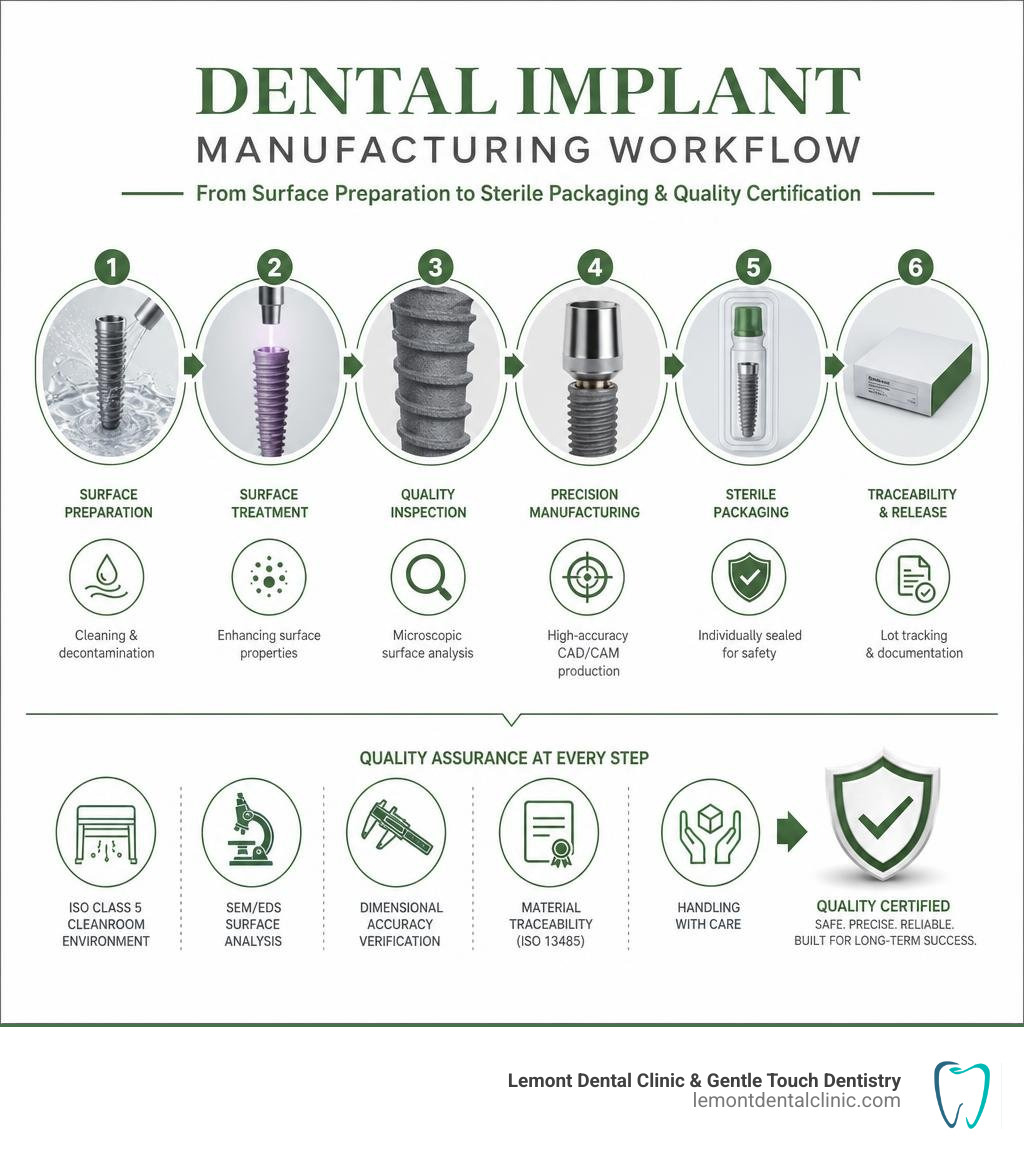
Verified testing protocols — SEM/EDS analysis conducted in ISO Class 5 cleanroom conditions
Precision fit — CAD/CAM manufacturing achieving marginal accuracy within 20–50 microns
Certified materials — ISO 13485-compliant, with full material traceability
Proven clinical outcomes — peer-reviewed survival data showing at least 95% implant success over two years
Independent quality certification — such as the CleanImplant Trusted Quality Mark
This guide walks you through every criterion that separates a truly high-quality implant laboratory from one that simply looks the part. Whether you’re a dental professional evaluating lab partners or a patient who wants to understand what goes into a safe, long-lasting implant, you’ll find a practical, evidence-based checklist here.
The stakes are real. Surface contaminants on implants have been linked to foreign body reactions, early bone loss, and peri-implantitis — complications that are painful, costly, and often preventable when the right quality standards are in place.
Why Dental Implant Laboratory Quality Matters for Patient Safety
When we think about dental implants, we often picture the clinical procedure: a skilled dentist precisely placing a titanium post into the jawbone. However, the biological magic of osseointegration—the process where your bone fuses directly to the implant surface—depends entirely on the microscopic characteristics of that implant.
At Lemont Dental Clinic & Gentle Touch Dentistry, serving our neighbors across Lemont, Palos Hills, and the surrounding Chicagoland communities, we know that patient safety begins long before you sit in the dental chair. It starts in the manufacturing facility and the dental laboratory. High-quality production ensures that the micro-surface of the implant is perfectly primed to bond with your bone, unlocking the true implant health benefits of restorative care.
Common Surface Contaminants and Manufacturing Defects
During the fabrication process, dental implants undergo aggressive subtractive and additive treatments to create a rough microtexture that encourages bone growth. This often involves sandblasting the titanium with materials like aluminum oxide or silicon dioxide, followed by acid etching.
If a laboratory lacks rigorous quality control, remnants of these blasting materials can remain deeply embedded in the titanium. Other common manufacturing defects include:
Organic residues: Tiny particles of plastics from packaging, synthetic surfactants, or lubricating oils from milling machines.
Foreign metal particles: Microscopic flakes of stainless steel, bronze, or copper shaved off from worn manufacturing tools or sandblasting nozzles.
When these foreign materials are introduced into your jawbone, your immune system recognizes them as invaders. Instead of healthy bone cells (osteoblasts) building a tight bond with the titanium, the body initiates a foreign body reaction. Macrophages and giant cells surround the contaminated areas, releasing pro-inflammatory cytokines like TNF-α and IL-8. This localized inflammatory response prevents proper osseointegration and can lead to early-stage peri-implantitis—an inflammatory disease that destroys the bone surrounding the implant, ultimately leading to premature implant failure.
The Impact of Fluorocarbon Compounds and Thin-Film Impurities
Beyond visible particulate matter, modern surface analysis has revealed the danger of invisible, thin-film contaminants. These are often carbonaceous impurities, industrial detergents, or remnants of fluorocarbon compounds used during chemical processing or cleanroom packaging.
Fluorocarbon compounds and thin-film organic residues form a hydrophobic barrier over the implant surface. This barrier prevents blood from wetting the implant immediately upon placement—a crucial step for initiating the healing cascade. Furthermore, these chemical impurities can be toxic to local bone cells. When osteoblasts attempt to attach to a surface coated with cell-toxic residues, they fail to adhere, leading to fibrous encapsulation (where the body wraps the implant in soft tissue instead of bone) and early osseointegration failure.
Advanced Testing Protocols: SEM/EDS and ISO Cleanroom Standards
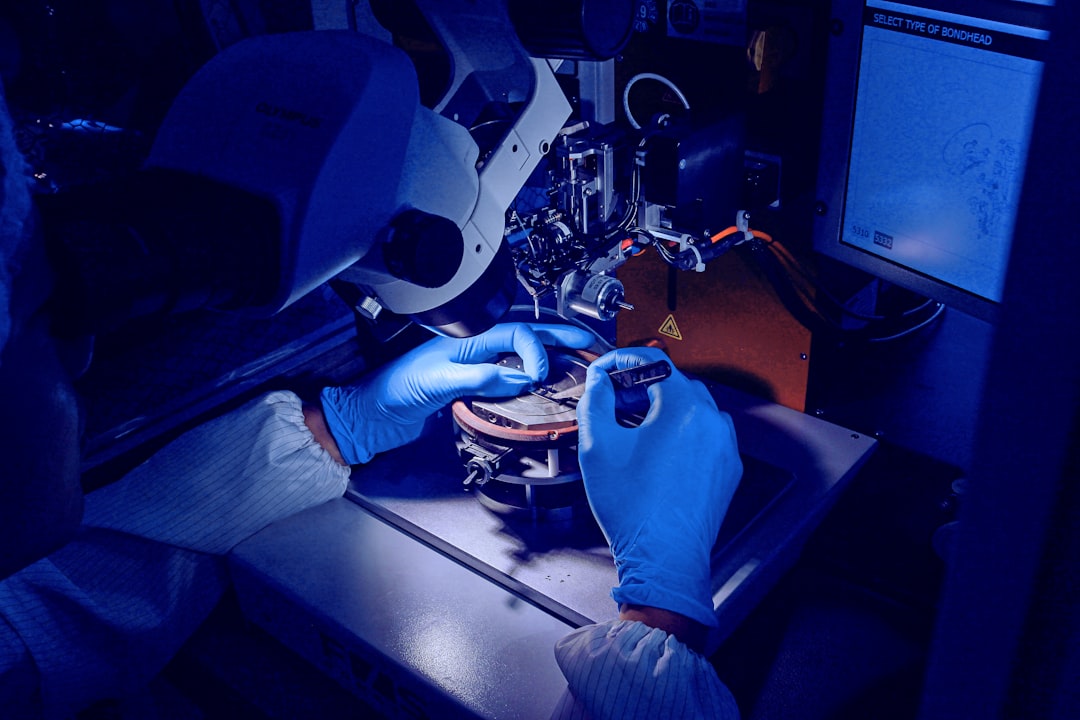
To ensure that the implants we place in our patients from Bolingbrook to Oak Lawn are of pristine quality, we must look at how top-tier dental laboratories verify surface purity. You cannot see an organic residue or a copper flake with the naked eye. Verifiable dental implant laboratory quality requires advanced scientific instruments and controlled environments.
Evaluating Dental Implant Laboratory Quality via Cleanroom Standards
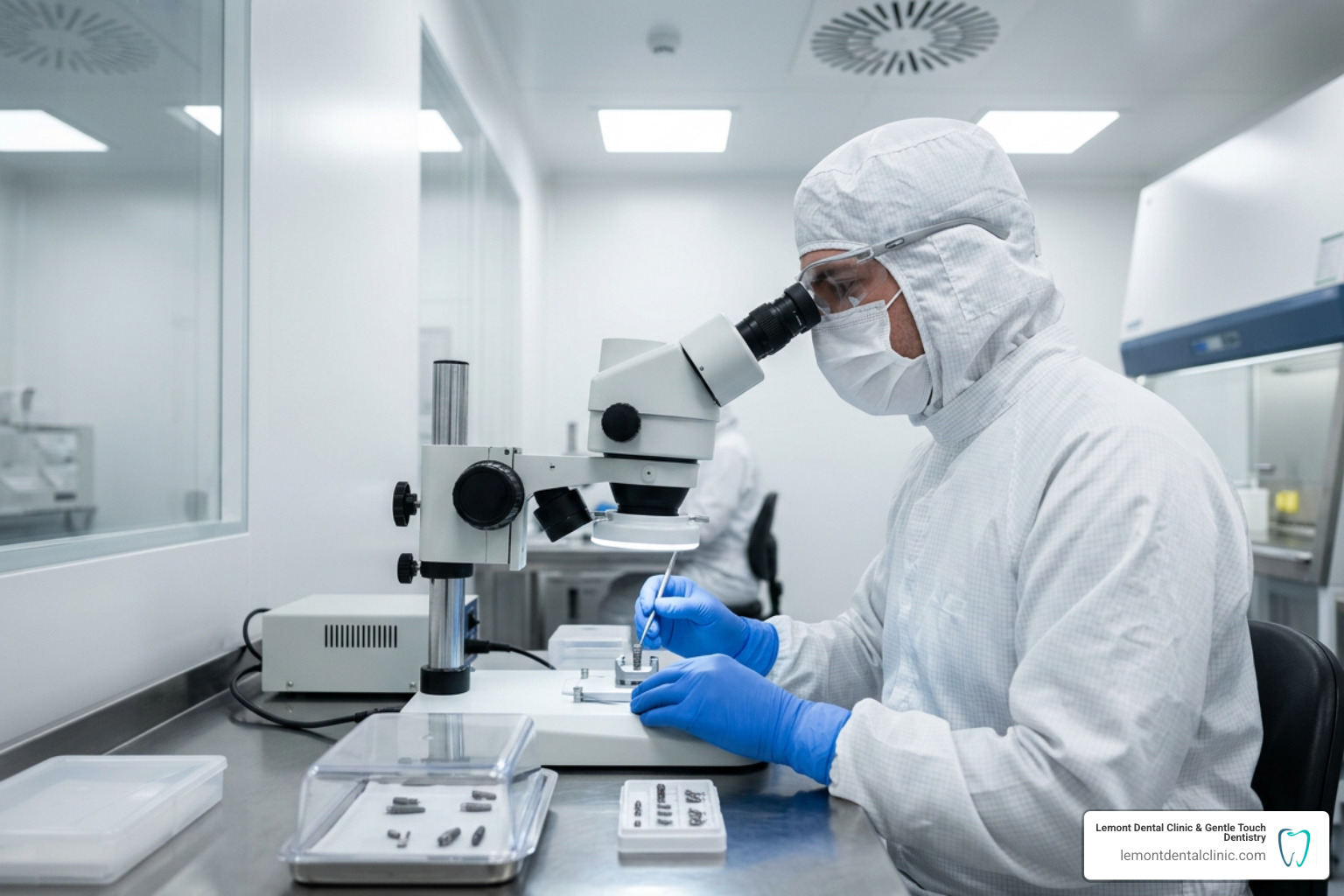
The packaging and handling of dental implants must take place in highly controlled environments to prevent airborne particles from settling on the sterile components. High-quality manufacturers utilize ISO Class 5 cleanrooms.
An ISO Class 5 cleanroom is designed to limit the number of airborne particles to no more than 3,520 particles per cubic meter for particles of 0.5 microns or larger. For comparison, ordinary room air contains millions of such particles. By keeping the packaging environment strictly regulated, laboratories ensure that when an implant is sealed in its sterile container, it remains free of dust, skin cells, and microscopic packaging debris. You can learn more about dental lab quality control systems to see how modern facilities maintain these rigorous standards throughout the production cycle.
What SEM/EDS Analysis Reveals About Real-World Manufacturing
The gold standard for analyzing implant surface purity is the combination of Scanning Electron Microscopy (SEM) and Energy-Dispersive X-ray Spectroscopy (EDS).
SEM (Scanning Electron Microscopy): This technology uses a focused beam of electrons to scan the surface of the implant, producing high-resolution, three-dimensional images at magnifications up to 500x and beyond. It allows technicians to visually identify surface anomalies, cracks, and embedded particles.
EDS (Energy-Dispersive X-ray Spectroscopy): While SEM shows where a particle is, EDS identifies what it is. By measuring the energy of X-rays emitted by the sample when hit by the electron beam, EDS provides a complete elemental analysis of the surface. It can instantly tell if a microscopic speck is harmless titanium oxide or a dangerous particle of copper, iron, or carbon.
When analyzing real-world manufacturing, SEM/EDS testing often reveals surprising discrepancies between different brands. While premium manufacturers show flawlessly clean titanium surfaces, lower-tier or poorly regulated implants sometimes present clusters of foreign material. For dental professionals, reviewing these scientific reports is vital. Following scientific guidelines on outsourcing quality control helps clinics verify that their laboratory partners adhere to strict, documented testing protocols before shipping restorations.
The CleanImplant Trusted Quality Mark and Scientific Benchmarks
Because there is currently no universal ISO standard that defines acceptable contamination limits for sterile-packaged dental implants, the industry relied on self-regulation for years. To solve this problem, the CleanImplant Foundation established an independent, peer-reviewed certification system to objectively evaluate implant cleanliness.
Specific Criteria for the CleanImplant Trusted Quality Mark
To receive the prestigious CleanImplant Trusted Quality Mark, implant systems must undergo a rigorous, multi-step testing process. The foundation utilizes a “mystery shopping” approach, purchasing implants directly from the market to ensure they are testing the exact same products patients receive.
Zero foreign metal particles: No particles of copper, bronze, stainless steel, or other non-biocompatible metals are allowed.
Strict organic particle limits: A maximum of 10 organic particles smaller than 50 µm are permitted within a 120° viewing angle, with absolutely no particle clusters larger than or equal to 50 µm.
Zero fluorocarbon or cell-toxic residues: The surface must be completely free of toxic chemical compounds.
Clinical survival rates: Manufacturers must provide peer-reviewed clinical data showing a survival rate of 95% or higher over a minimum of two years.
Re-evaluation cycle: To maintain the Quality Mark, implants must be re-evaluated every two years to ensure manufacturing quality has not slipped.
The Role of the Scientific Advisory Board in Setting Quality Benchmarks
The CleanImplant Scientific Advisory Board is composed of independent, world-renowned scientists, researchers, and clinicians. This board plays a pivotal role in updating quality benchmarks as analytical technology improves.
By keeping their consensus guidelines aligned with the latest findings in immunology and material science, the board ensures that the definition of “clean” is based on clinical safety rather than marketing claims. Their independent testing protects both dentists and patients from the hidden risks of sub-standard manufacturing.
Biomechanical Engineering and Passive Fit Standards
While the purity of the implant post determines how well it integrates with your bone, the engineering of the crown, bridge, or denture that sits on top of it determines how well the system functions under the pressure of chewing.
The Biomechanical Consequences of Non-Passive Fit
When multiple implants are placed to support a multi-unit bridge or a full-arch restoration, the prosthetic framework must achieve a “passive fit.” This means that when the bridge is screwed or cemented into place, it should sit perfectly on the implants without exerting any lateral or rotational tension.
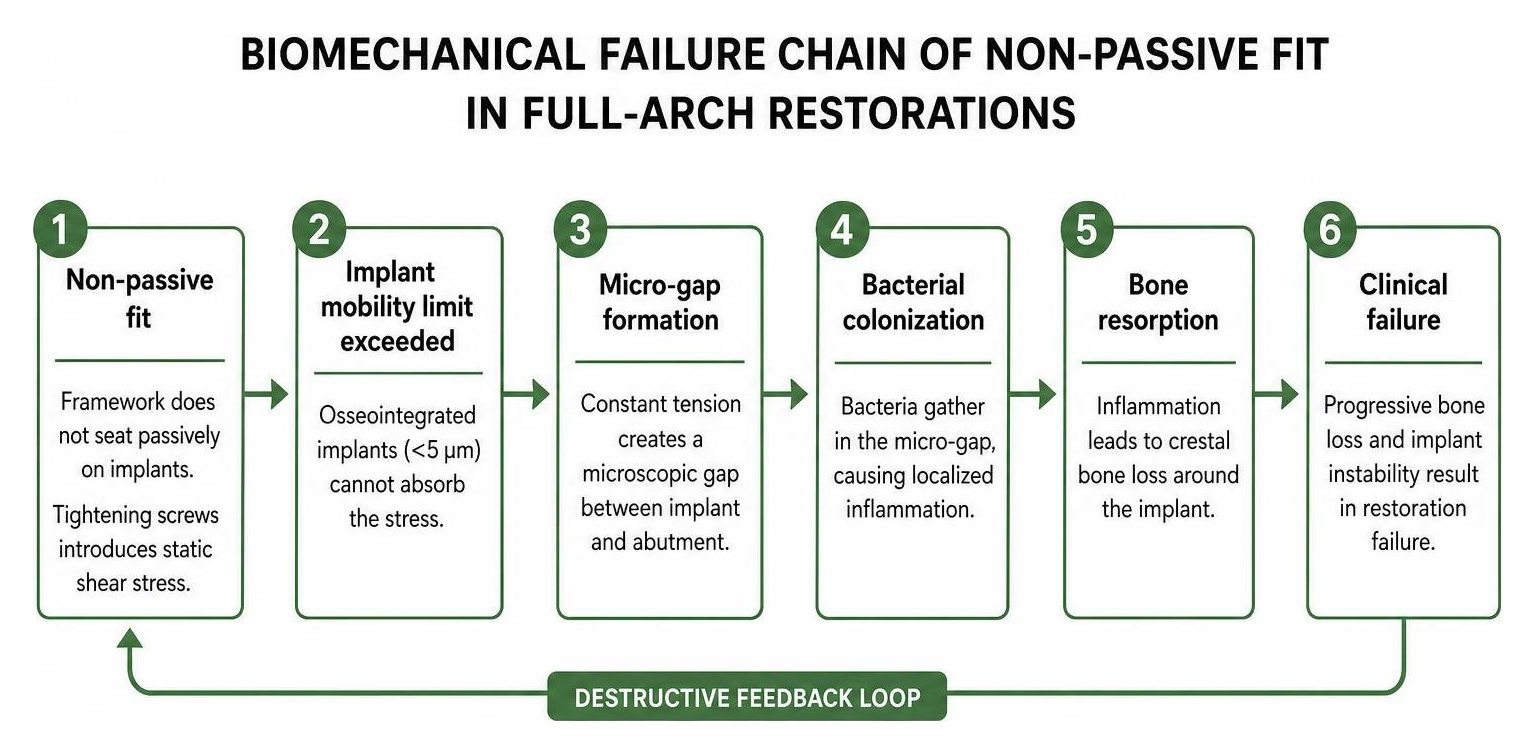
We can visualize this process using a simple sequence of physical forces:
If the framework does not fit passively, tightening the retaining screws introduces continuous static shear stress to the implants and the surrounding bone. Because osseointegrated implants have a natural mobility limit of under 5 microns (compared to natural teeth, which can cushion forces by moving 28 to 56 microns within their periodontal ligament), they cannot absorb this stress.
This leads to a destructive feedback loop:
Micro-gap formation: The constant tension creates a microscopic gap between the implant and the abutment.
Bacterial colonization: Bacteria gather in this micro-gap, causing localized inflammation.
Mechanical failure: The retaining screws repeatedly loosen or break under the force of chewing.
Bone loss: The combination of mechanical stress and bacterial inflammation causes the surrounding bone to recede, which is why understanding implant dentures and their engineering is so critical for long-term success.
Material Selection: Monolithic Zirconia vs. Layered Restorations
The choice of restorative materials plays a massive role in the durability of your new smile. In the past, laboratories often layered porcelain over a metal or zirconia framework to achieve a natural look. However, clinical data has shifted the industry toward monolithic materials.
Beautiful aesthetics, but the hand-layered cosmetic porcelain is prone to chipping under heavy biting forces.
Plastic-like / Acrylic Bridges
Up to 5%
10% – 20%
Lighter and cheaper initial cost, but prone to wear, fluid absorption, odor, and frequent structural breakage.
At our clinics in Lemont and Palos Hills, we prioritize monolithic zirconia for full-arch restorations. It offers unmatched structural integrity, virtually eliminating the chipping issues common with older, layered techniques.
Practical Steps for Selecting a High-Quality Laboratory Partner
For dental practitioners looking to elevate their clinical outcomes, selecting the right laboratory is a strategic decision. It requires a systematic approach to verifying quality and embracing modern technology.
How to Verify Dental Implant Laboratory Quality in Your Practice
When searching for a dental implant provider or evaluating partner laboratories, use this practical verification checklist:
[ ] Verify ISO 13485 Certification: Ensure the laboratory is certified for medical device quality management.
[ ] Request Material Traceability Reports: The lab should provide documentation showing the exact batch numbers and origins of all metals, zirconia, and ceramics used.
[ ] Confirm Original Component Use: Ask if the lab uses original manufacturer abutments and screws rather than generic, third-party copies which can compromise the precision of the fit.
[ ] Assess Technical Support Access: Ensure you have direct communication with the certified dental technicians (CDTs) designing your cases.
If you are a patient looking for high-quality care, finding the best dental implants near me means choosing a clinic like ours that only partners with laboratories meeting these precise benchmarks.
Integrating Digital Workflows and Verification Models
The transition from traditional, messy impressions to digital intraoral scanning has revolutionized dental implant laboratory quality.
Digital workflows offer significant advantages:
Reduced remake rates: Utilizing digital scans reduces laboratory remake rates by 10% to 15%.
Unmatched precision: Modern 5-axis subtractive milling and CAD/CAM software allow laboratories to achieve an edge fit within 20 to 50 microns.
Speed and efficiency: Labs integrating AI-driven design and digital workflows report improvements in production speed of 25% to 50% compared to traditional, hand-waxed methods.
For complex, full-arch cases, high-quality laboratories will fabricate a physical “verification model” or use a temporary PMMA bridge first. This step allows us to verify the passive fit in the patient’s mouth before milling the final monolithic zirconia prosthesis, ensuring a perfect result every time. For patients exploring fixed options, this level of precision is what makes implant-supported dentures feel and function just like natural teeth.
Frequently Asked Questions about Dental Implant Laboratory Quality
What are the most common contaminants found on sterile-packaged implants?
The most common contaminants are organic residues (such as plastic microscopic particles from packaging or cleaning agents), blasting material remnants (like aluminum oxide used to roughen the surface), and foreign metal particles (such as iron, copper, or stainless steel from manufacturing tools).
How does a non-passive fit affect the long-term success of full-arch restorations?
A non-passive fit introduces constant, static shear stress to the implants and jawbone. This tension can cause the retaining screws to loosen or break, create microscopic gaps that harbor bacteria, and lead to localized bone loss around the implant, ultimately causing the restoration to fail.
What certifications should I look for when choosing a dental implant laboratory?
You should look for laboratories that hold ISO 13485 certification for medical devices, comply with FDA regulations, provide full material traceability reports, and use implant components that have been independently certified by organizations like the CleanImplant Foundation.
Conclusion
At Lemont Dental Clinic & Gentle Touch Dentistry, we believe that exceptional dentistry is a blend of clinical skill, advanced technology, and uncompromising material quality. By understanding the critical role of dental implant laboratory quality, we ensure that every implant we place for our patients in Lemont, Palos Hills, and the surrounding Chicagoland area is safe, clean, and engineered to last.
If you are ready to restore your smile with the peace of mind that comes from state-of-the-art restorative care, we invite you to schedule a consultation for dental implants with our experienced team today. Let us help you achieve a healthy, beautiful smile built on a foundation of verified quality.