Why Proper Denture Care Matters for Your Smile and Health
Denture care tips are something every one of the estimated 41 million Americans living with dentures needs to know — because how you treat your dentures directly affects your comfort, your oral health, and your confidence every single day.
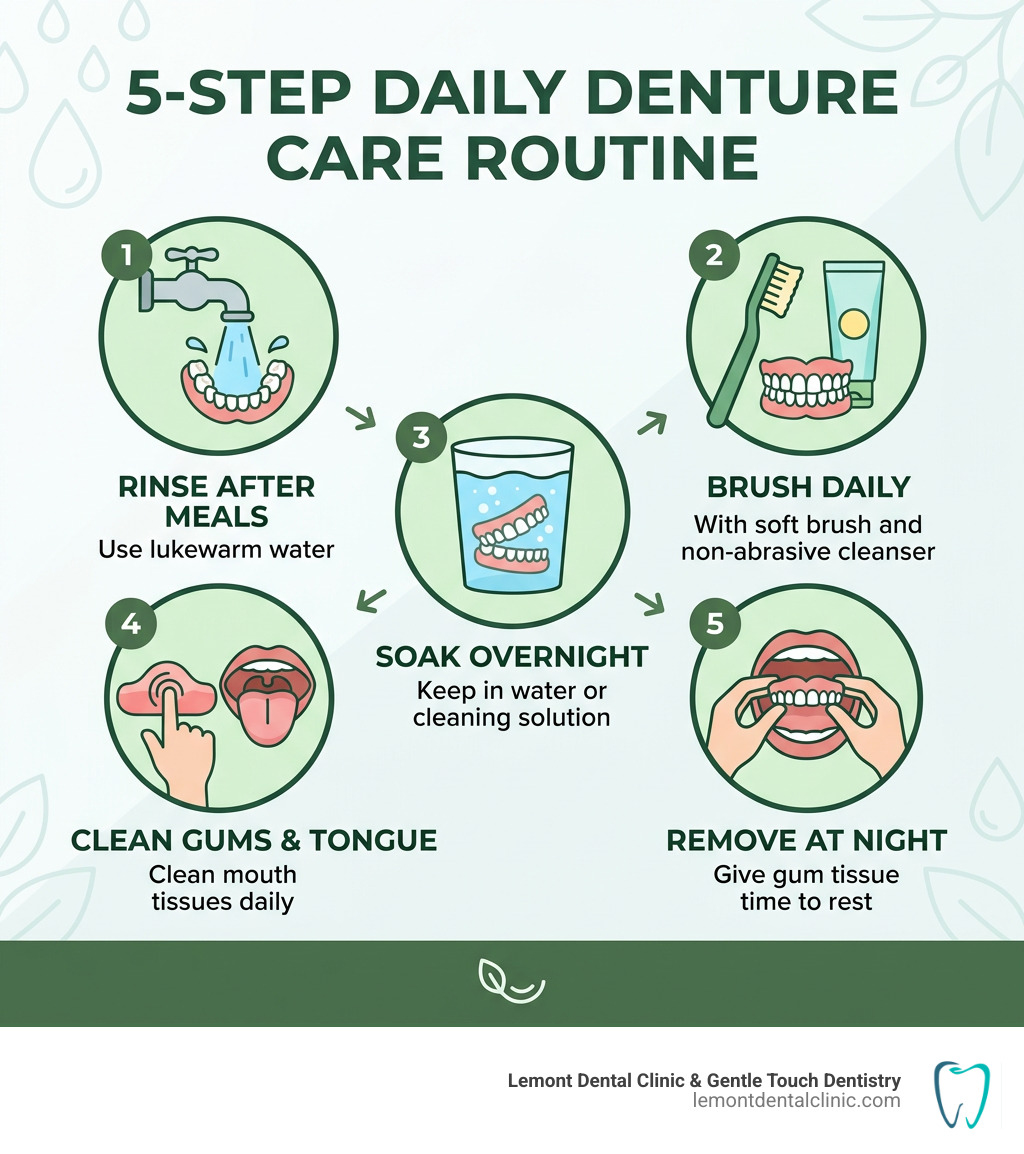
Here’s a quick overview of the most important denture care habits:
Rinse dentures after every meal with lukewarm water to remove food particles
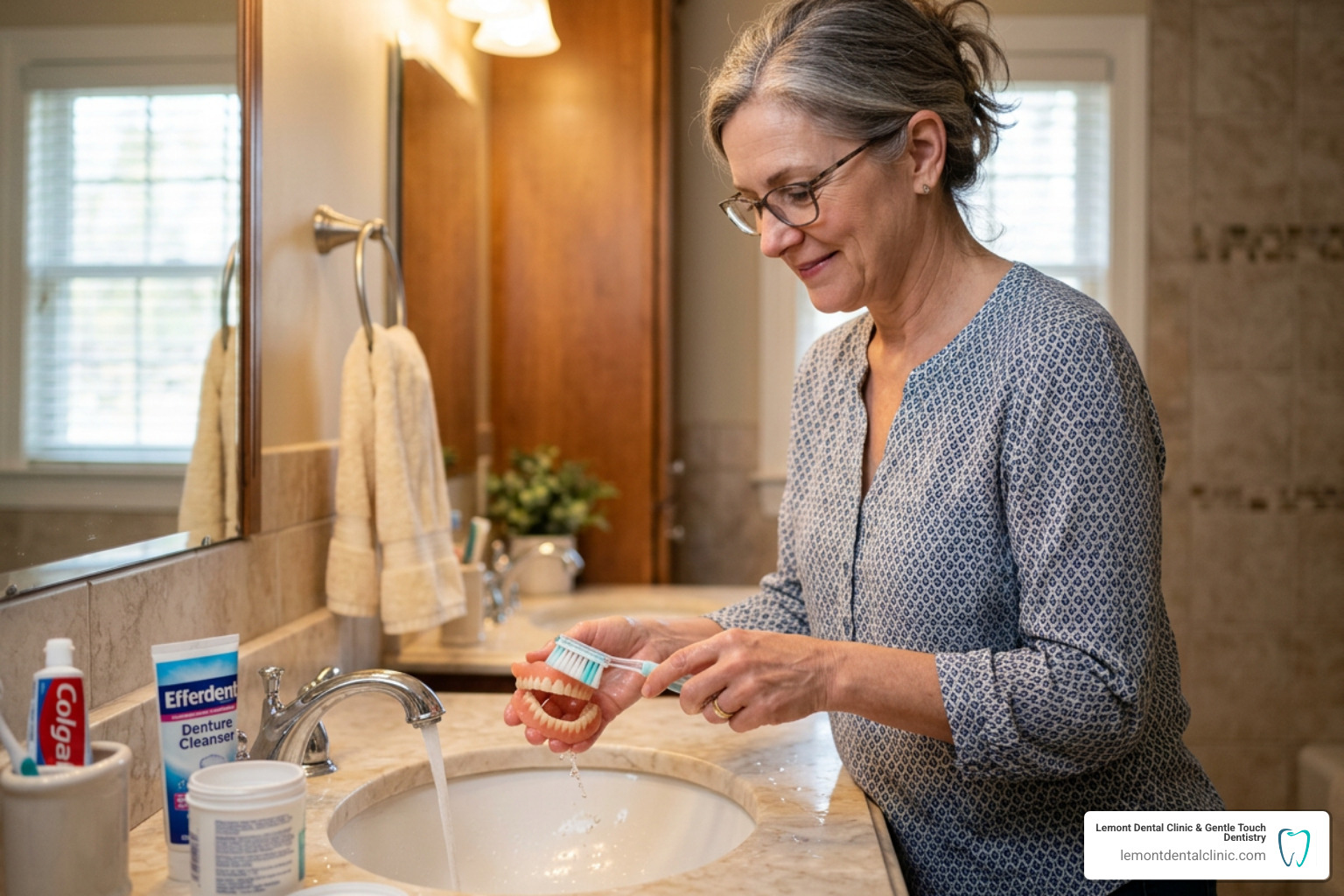
Brush dentures daily using a soft-bristled denture brush and a non-abrasive cleanser
Soak dentures overnight in water or a denture-cleaning solution to prevent warping
Clean your gums, tongue, and palate every day, even when dentures are out
Remove dentures at night to give your gum tissue time to rest and recover
Visit your dentist regularly for fit checks, adjustments, and professional cleaning
Dentures aren’t like natural teeth — they don’t decay. But that doesn’t mean they take care of themselves. Plaque, bacteria, and calcium deposits still build up on denture surfaces. In fact, denture stomatitis, a fungal infection of the gum tissue under dentures, affects up to 65% of denture wearers. That’s a striking number, and it’s largely preventable with the right daily habits.
Poor denture care can lead to sore gums, bad breath, loose fit, and even serious infections. On the other hand, a consistent care routine keeps your dentures looking great, feeling comfortable, and lasting as long as possible.
This guide walks you through everything you need to know — from daily cleaning to handling common problems to knowing when it’s time to see a professional.
When we talk about the longevity of your dentures, we aren’t just talking about the plastic and porcelain staying intact. We are talking about the health of the mouth that supports them. At Lemont Dental Clinic & Gentle Touch Dentistry, we often see patients who believe that once their natural teeth are gone, their oral hygiene duties are over. This couldn’t be further from the truth!
Proper maintenance is the only way to avoid denture stomatitis, a condition where the tissues under your appliance become red, swollen, and sometimes painful. This is often caused by a buildup of Candida albicans, the same fungus responsible for thrush. Without regular cleaning, plaque builds up on your dentures just as it does on natural teeth. This plaque hardens into tartar (calculus), which can only be removed by a professional.
Following evidence-based guidelines for denture maintenance is essential. These guidelines emphasize that daily mechanical cleaning — the physical act of brushing — is the most effective way to disrupt the biofilm that forms on your dentures. By keeping the surface smooth and clean, you prevent the microscopic “nooks and crannies” where bacteria like to hide.
Daily Denture Care Tips for a Clean Smile
Your daily routine should be as automatic as your morning coffee. To keep your smile bright, you need the right tools. We recommend a soft-bristled brush specifically designed for dentures. These brushes usually have two heads: one for the flat surfaces and a smaller, tapered one for the deep grooves that fit over your gums.
Using a non-abrasive cleanser is non-negotiable. Many people reach for their old favorite toothpaste, but most standard toothpastes contain abrasive particles designed to scrub tough enamel. On the acrylic material used in various types of fake teeth, these abrasives leave behind tiny scratches. These scratches are like “luxury hotels” for bacteria, making your dentures much harder to keep clean over time.
Rinsing after every meal is a simple but powerful habit. It only takes thirty seconds under lukewarm water to flush away food particles that could otherwise lead to staining or irritation. Never use boiling water! Extreme heat can warp the plastic, ruining the precise fit we worked so hard to achieve for you.
Mastering the Daily Cleaning Routine
Consistency is the secret sauce to a comfortable denture experience. Think of your dentures like a pair of high-quality shoes; if you don’t take care of them, they’ll eventually start to pinch and wear out prematurely.
The Importance of the Overnight Soak
Why do we insist on soaking your dentures overnight? It’s all about moisture retention. Most dentures are made of acrylic, which needs to stay hydrated to maintain its shape. If a denture dries out, it can become brittle and warp. A warped denture won’t sit correctly on your bony ridge, leading to those dreaded sore spots.
But there is a more serious reason to take them out. Research on pneumonia risks has shown that wearing dentures while you sleep can actually double the risk of pneumonia in the elderly. This is because bacteria from the dentures can be inhaled into the lungs during the night. Taking them out gives your gums a much-needed rest and significantly lowers your risk of respiratory infections.
Recommended Cleaning Tools
To make your routine easier, keep these items in your “denture kit”:
Denture Brush: Specifically shaped for the contours of your appliance.
Denture Cleanser Tablets: These help chemically break down stains and bacteria.
Soft Cloth or Gauze: Use this to gently wipe your gums, tongue, and the roof of your mouth every morning.
A Plastic Container: A dedicated soaking bath with a lid to keep dust out.
A Folded Towel: Always place this in the sink while handling your dentures. If you drop them, the towel provides a soft landing and prevents the acrylic from shattering.
Advanced Denture Care Tips for Adhesives and Comfort
Many of our patients in Lemont and Palos Hills ask about adhesives. While a well-fitting denture shouldn’t require adhesive to stay in place, many people use it for an extra sense of security during social events or when eating particularly challenging foods.
If you choose to use an adhesive, we highly recommend zinc-free products. While zinc is a necessary mineral, excessive intake from overusing denture adhesives has been linked to neurological issues. To use adhesive safely, follow these steps:
Start with clean, dry dentures.
Apply three or four pea-sized dollops to the areas that contact your gums.
Don’t apply it too close to the edges; you don’t want it oozing out.
Press the denture firmly into place and hold for a few seconds.
If you find yourself needing more and more adhesive just to keep your teeth in, it’s a sign that the fit has changed. You might need help fixing loose dentures through a professional reline. Adhesives should improve your masticatory performance and bite force, but they aren’t a permanent “fix” for a denture that no longer fits your jaw.
Managing Comfort and Common Issues
Even with the best denture care tips, you might occasionally experience discomfort. Your mouth is a living environment that is constantly changing, while your dentures are static.
Dealing with Denture Sores
If you develop a sore spot, don’t try to “tough it out.” Small sores can quickly turn into painful ulcers.
Saltwater Rinses: Dissolve half a teaspoon of salt in a cup of warm water and swish several times a day. This helps reduce inflammation and keeps the area clean.
Aloe Vera: Applying pure aloe vera gel to the affected gum tissue can provide soothing relief.
Give it a Rest: If a sore develops, leave the dentures out as much as possible to allow the tissue to heal.
Eating Comfortably
Learning to eat with dentures is a skill. It takes practice to retrain your muscles. We suggest starting with a “soft food” phase before moving on to tougher textures.
Soft Foods (Safe)
Foods to Avoid/Limit
Scrambled eggs
Crusty bread and bagels
Cooked pasta
Whole nuts and seeds
Steamed vegetables
Sticky candy (toffee/caramel)
Yogurt and smoothies
Tough, fibrous meats (steak)
Flaky fish
Raw carrots or apples (unless cut small)
Pro Tip: Bilateral Chewing. To keep your dentures stable, try to chew on both sides of your mouth at the same time. This prevents the denture from tipping or lifting on one side, which is the most common cause of instability while eating.
Professional Maintenance and Long-Term Health
Your dentures are an investment in your quality of life, and like any investment, they require professional oversight. Even if you have no natural teeth left, we still need to see you at least once or twice a year at our Lemont or Palos Hills locations.
Why Annual Checkups Matter
During a professional checkup, we do more than just look at your teeth. We perform an oral cancer screening and check the health of your soft tissues. We also evaluate the fit of your dentures. Over time, the “bony ridge” of your jaw naturally shrinks (a process called resorption). As the bone changes shape, the denture that once fit perfectly will begin to wobble.
When this happens, we can often perform a reline. If you’re curious about the process, you can learn more about what happens during a denture reline. Essentially, we add a new layer of material to the inside of your denture to match the current shape of your gums.
Denture Lifespan
Most dentures have a lifespan of 5 to 10 years. After a decade, the materials begin to degrade, and the wear on the “teeth” can affect your bite and facial appearance. If your dentures are looking dull, yellowed, or if you find yourself using adhesive constantly, it might be time to discuss different types of dentures that could better serve your current needs.
Frequently Asked Questions about Denture Care
Can I use regular toothpaste on my dentures?
We strongly advise against it. As mentioned earlier, regular toothpaste is far too abrasive. It creates microscopic scratches that harbor bacteria and plaque, leading to bad breath and potential infections. These scratches also make the dentures look “dull” over time. Instead, use a specialized denture paste or even a mild, unscented dish soap or hand soap. Just make sure to rinse them thoroughly afterward!
Should I wear my dentures while sleeping?
In almost every case, the answer is no. Your gum tissue needs to “breathe” and receive blood flow that is otherwise restricted by the constant pressure of the dentures. Sleeping without them allows for tissue recovery and prevents accelerated bone resorption. Plus, as we noted, it significantly reduces your risk of respiratory issues like pneumonia.
What should I do if my dentures break or chip?
First, do not use DIY glue or superglue! Most household glues are toxic and can cause severe chemical burns in your mouth. Furthermore, they are not waterproof and will fail quickly. If your denture breaks, keep all the pieces and call us immediately. We can often perform professional repairs in our office or send them to a specialized lab to ensure the structural integrity is restored without causing oral irritation.
Conclusion
At Lemont Dental Clinic & Gentle Touch Dentistry, we believe that everyone deserves a smile they can be proud of. Whether you live in Lemont, Palos Hills, or surrounding areas like Hickory Hills or Oak Lawn, we are here to provide the personalized, high-quality care you need to keep your dentures in peak condition.
By following these denture care tips, you aren’t just maintaining a dental appliance — you’re protecting your health and your ability to eat, speak, and smile with total confidence. While your dentures are “fake” teeth, the health of your mouth is very real.
If your dentures feel loose, look dull, or are causing you discomfort, don’t wait for the problem to get worse. We invite you to schedule an appointment for dentures near me at one of our convenient Illinois locations. Let us help you keep your smile looking as bright and natural as the day you first put it on!