When a Missing Tooth Leaves You Wondering What Comes Next
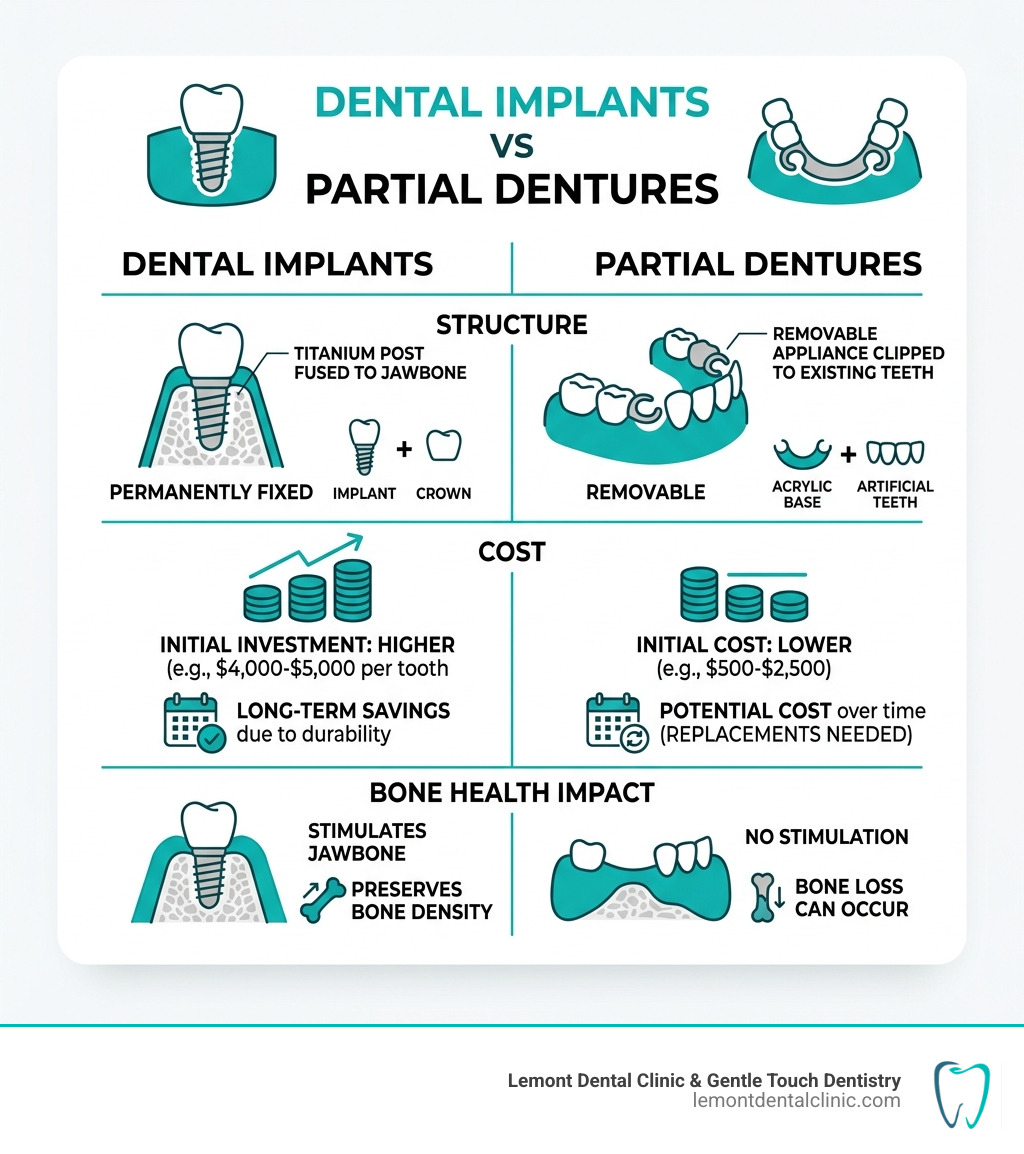
Dental implants vs partial dentures are the two most common ways to replace missing teeth — and choosing between them comes down to your budget, bone health, and long-term goals.
Here’s a quick side-by-side to help you decide:
Factor
Dental Implants
Partial Dentures
How it works
Titanium post fused into jawbone
Removable appliance clipped to existing teeth
Longevity
25+ years with proper care
5-10 years before replacement
Cost
~$4,000-$5,000 per tooth
~$500-$2,500 for a set
Surgery required
Yes
No
Bone preservation
Yes — stimulates jawbone
No — bone loss can occur over time
Natural feel
Very high
Moderate
Treatment time
Several months
Weeks
Losing a tooth affects more than your appearance. It changes how you chew, how you speak, and how confident you feel in everyday moments. It can also quietly damage your jaw and neighboring teeth if left untreated.
The good news? Modern dentistry offers real solutions — but the right one depends on your specific situation.
This guide walks you through both options clearly and honestly, so you can have a confident conversation with your dentist.
Understanding Dental Implants vs Partial Dentures
When we talk about dental implants vs partial dentures, we are looking at two very different philosophies of restorative dentistry. One is a permanent, structural replacement that mimics nature, while the other is a removable, functional appliance that rests on the surface of your gums.
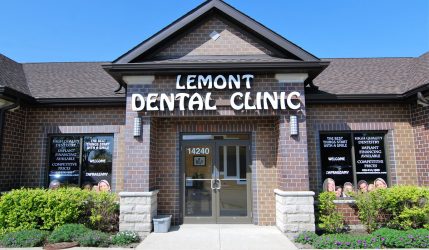
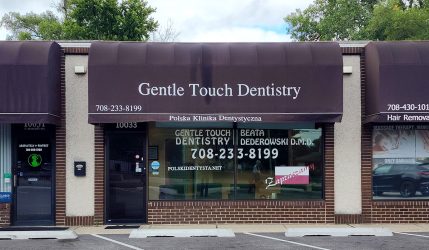
At Lemont Dental Clinic & Gentle Touch Dentistry, we see patients from Lemont to Palos Hills who are often overwhelmed by these choices. The fundamental difference lies in how they interact with your anatomy. Dentures vs. Implants: Uses, Benefits, and Side Effects highlights that while both restore your smile’s appearance, the surgical nature of implants offers a level of stability that traditional “false teeth” simply cannot match. To get a better handle on the basics, you might want to check out our guide on Fake Teeth 101: Understanding the Different Types Available.
How Dental Implants Work
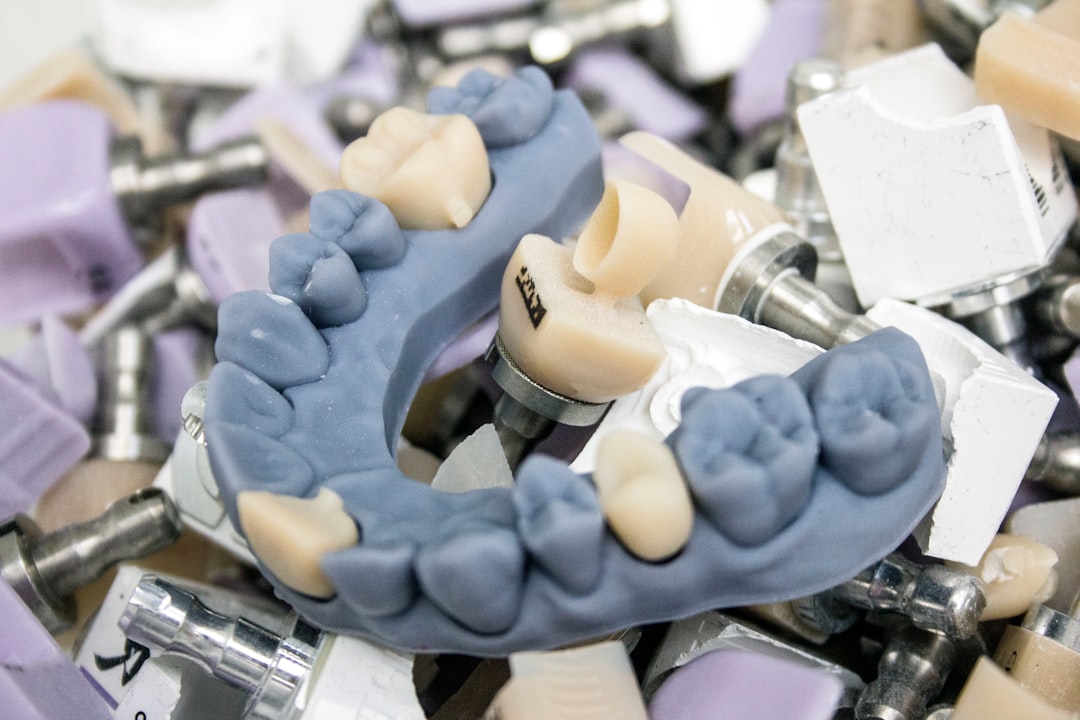
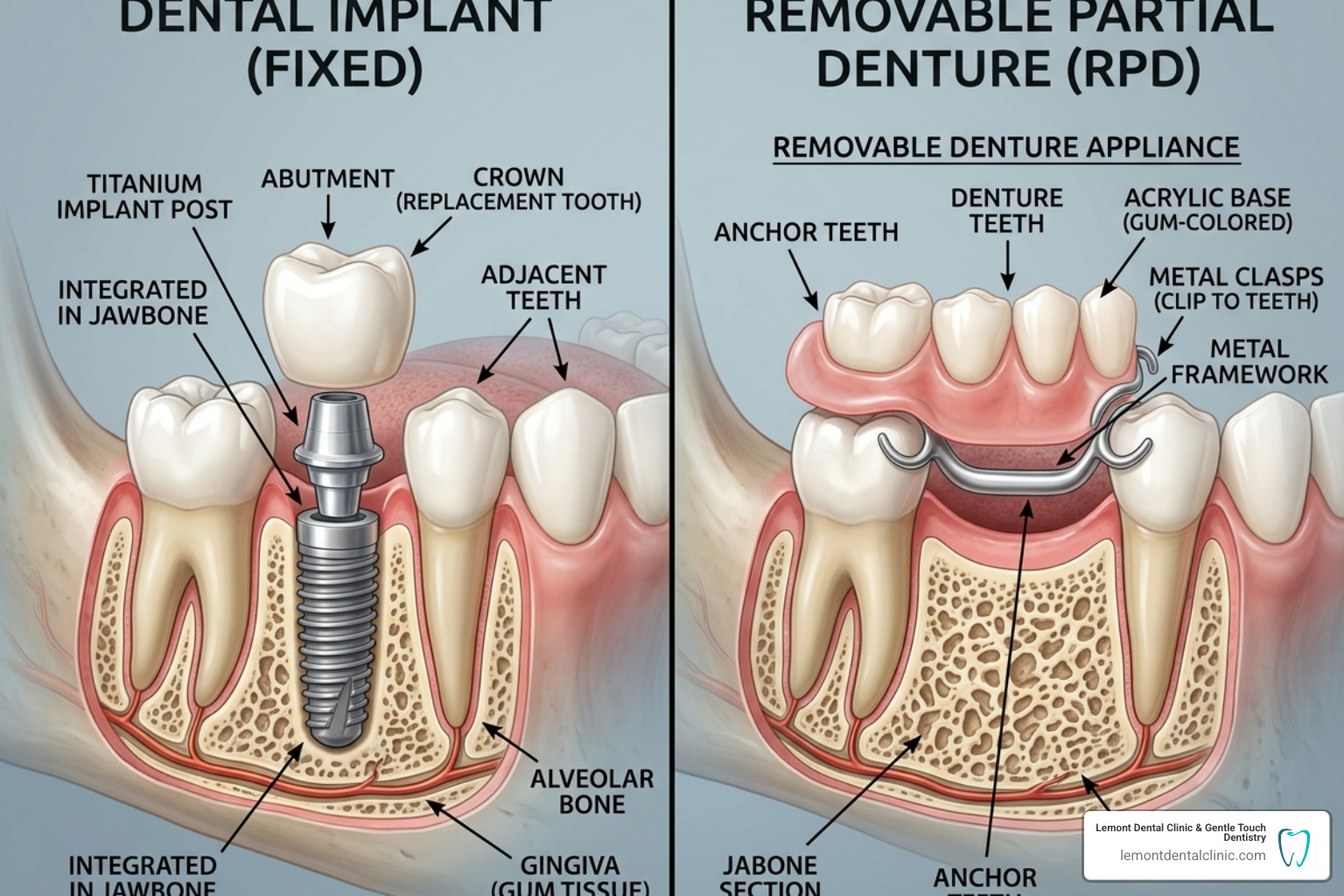
Think of a dental implant as a high-tech “artificial root.” We surgically place a small titanium post directly into your jawbone. Over a period of three to six months, a biological miracle called osseointegration occurs—your bone literally grows around and fuses with the titanium.
Once this bond is solid, we add an abutment (a connector piece) and a custom-made porcelain crown. This setup doesn’t just fill a gap; it stimulates the jawbone, preventing the “sunken” look that often follows tooth loss. You can learn more about the specifics of this process on our Dental Implants service page.
How Partial Dentures Work
Partial dentures are removable prosthetics designed for patients who still have some healthy natural teeth remaining. These appliances consist of replacement teeth attached to a pink, gum-colored acrylic base, often reinforced with a metal framework.
They stay in place using metal clasps or precision attachments that “clip” onto your natural teeth. Unlike implants, they sit on top of the gum tissue. They are a fantastic, non-invasive way to restore chewing function quickly. For a deeper dive into the varieties we offer, see What Are Different Types of Dentures?.
Pros and Cons: Weighing Your Options
Choosing between dental implants vs partial dentures is rarely a “one-size-fits-all” answer. It requires balancing your immediate needs with your long-term health.
According to Dentures vs Implants: What’s the Best Option for Your Teeth?, implants boast a success rate of over 97% in healthy patients. However, they do require surgery and a significant time commitment. On the flip side, partial dentures are faster and more affordable upfront but may require more frequent adjustments as your mouth changes over time.
Advantages of Dental Implants vs Partial Dentures
The biggest “pro” for implants is their lifespan. While a partial denture typically lasts 5 to 10 years, a dental implant can last 25 years or even a lifetime with proper care.
Other key benefits include:
Bone Preservation: Implants are the only option that stops jawbone resorption.
No “Slip” Factor: You can eat steak, corn on the cob, and apples without worrying about your teeth moving.
Natural Aesthetics: They look and feel exactly like your natural teeth.
Tooth Protection: Unlike bridges or partials, implants don’t rely on neighboring teeth for support, keeping your remaining natural teeth healthier.
Don’t count partial dentures out! They are a tried-and-true solution for many of our neighbors in Palos Park and Hickory Hills.
Affordability: They are significantly less expensive than multiple implants.
Non-Surgical: If the thought of dental surgery makes you nervous, partials are the way to go.
Speed: You can usually have your final prosthetic in a matter of weeks, rather than months.
Adjustability: If you lose more teeth in the future, we can often add new teeth to your existing partial.
If you’re looking for a quick and budget-friendly fix, searching for Dentures Near Me is a great first step toward a functional smile.
Cost and Longevity: A Long-Term Investment Analysis
We understand that for many families in the Chicago Ridge and Worth areas, the decision often comes down to the bottom line. It’s important to look at the “cost per year” rather than just the initial sticker price.
A single implant and restoration can range from $4,000 to $5,000. In contrast, a partial denture might cost between $500 and $2,500. However, dentures often need to be relined, repaired, or replaced every few years. Implants are a “set it and forget it” (with good hygiene!) investment. For a detailed breakdown, check our Dental Implants Cost Estimate and our page on Types of Dentures and Cost.
Comparing the Price of Dental Implants vs Partial Dentures
When comparing dental implants vs partial dentures, consider your insurance. Many plans cover a portion of dentures because they are considered “medically necessary” for eating. Implants were once considered cosmetic, but more insurance providers are starting to cover the surgical or crown portion of the procedure.
At Lemont Dental Clinic & Gentle Touch Dentistry, we work hard to provide Affordable Dental Implants Cost Near Me through flexible financing options, ensuring quality care is accessible to our community.
The Procedure and Recovery Timeline
The journey to a new smile looks very different depending on which path you choose.
The Implant Timeline:
Consultation: We use 3D imaging to check your bone density.
Surgery: The titanium post is placed. This is a minor surgical procedure.
Osseointegration: You wait 3-6 months for the bone to heal and fuse. You may wear a temporary “flipper” during this time.
Abutment & Crown: Once healed, we attach the final, beautiful tooth.
The Partial Denture Timeline:
Impressions: We take precise molds of your mouth.
Bite Study: We ensure the new teeth will meet your existing ones correctly.
Fitting: A trial version is made for adjustments.
Delivery: You receive your final partial, usually within 2-4 weeks.
Frequently Asked Questions about Tooth Replacement
Who is a good candidate for dental implants?
Generally, anyone healthy enough to undergo a routine dental extraction is a candidate for an implant. The most important factor is having enough jawbone density to support the post. Non-smokers and those without uncontrolled diabetes tend to have the highest success rates.
When might a dentist recommend partial dentures over implants?
We might suggest a partial if you have significant bone loss and aren’t interested in a bone graft. Additionally, if you need to replace many teeth on a tight budget, or if you have health conditions that make surgery risky, a partial is an excellent alternative.
What are the alternatives to these options?
If you only have one missing tooth and the teeth on either side are healthy, a dental bridge might be a middle-ground option. We discuss this in-depth in our Dental Implants vs. Bridge comparison.
Another popular “hybrid” solution is Snap-On Dentures. These use a few implants to “anchor” a denture in place, giving you the stability of implants with the cost-effectiveness of dentures.
Conclusion
Whether you choose dental implants vs partial dentures, the most important thing is that you don’t leave the gap empty. Missing teeth can lead to bone loss, shifting teeth, and a decline in your overall quality of life.
At Lemont Dental Clinic & Gentle Touch Dentistry, we pride ourselves on providing comprehensive, high-quality care to our patients in Lemont, Palos Hills, and the surrounding Illinois suburbs. We don’t just look at your teeth; we look at your lifestyle, your budget, and your long-term health goals.
Ready to find the perfect fit for your smile? Restore your smile today by scheduling a professional consultation with our experienced team. We’re here to help you fill the gaps without breaking the bank!