Why Addressing a Missing Tooth for Years Still Matters
If you’ve been living with a missing tooth for years, you’re likely wondering if it’s too late to do something about it. The short answer: No, it’s not too late.
Quick Answer:
Yes, you can still get a dental implant after having a missing tooth for years.
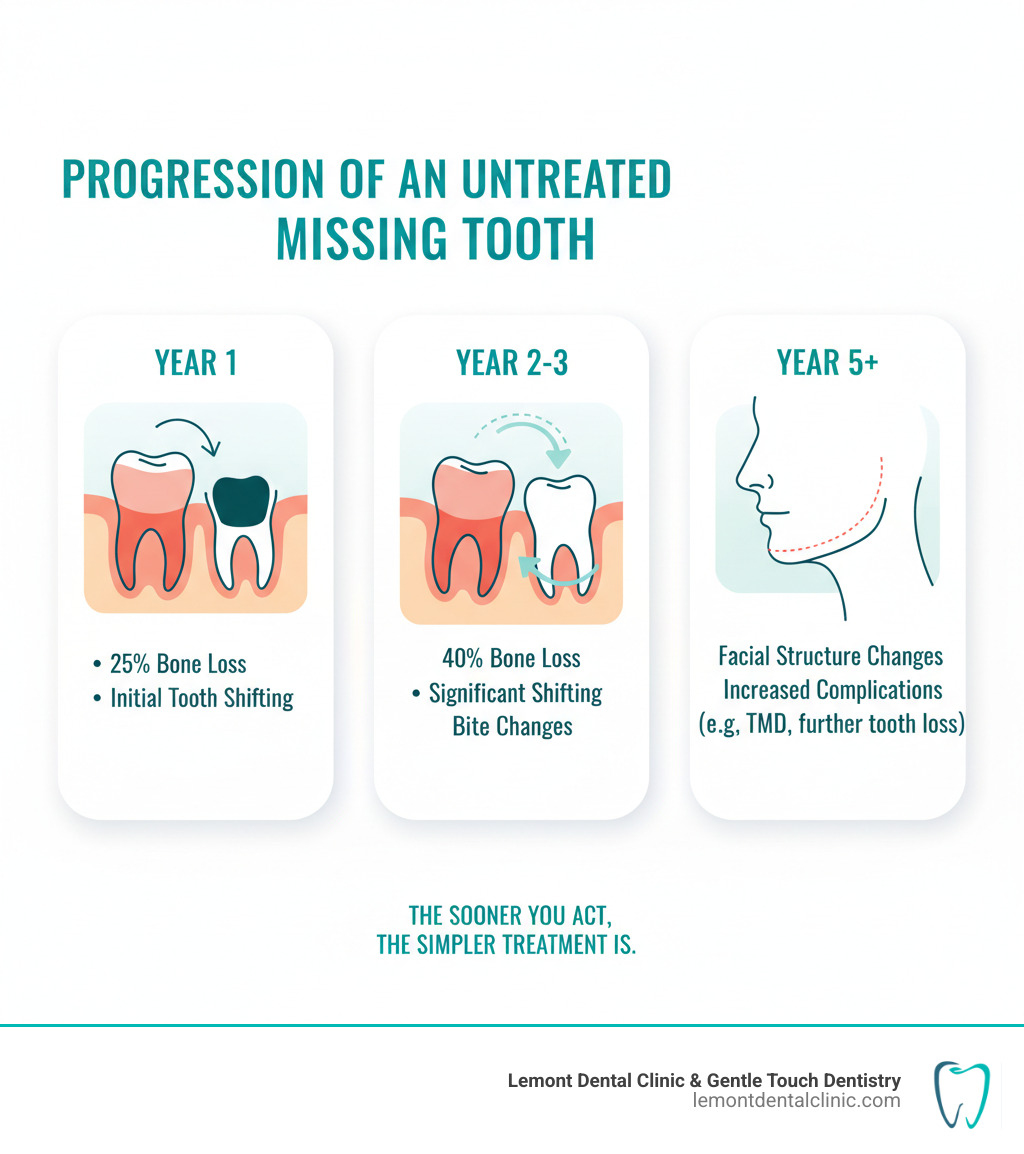
Bone loss is common (up to 25% in the first year, 40% within a few years).
Bone grafting can rebuild the jawbone if necessary.
Treatment takes longer when bone loss has occurred (several additional months).
The sooner you act, the less complicated and costly treatment becomes.
Many people delay replacing a missing tooth, but what seems like a small gap can trigger a cascade of problems. Without the stimulation from chewing, your jawbone deteriorates, remaining teeth shift, and your bite becomes misaligned. Over time, replacement becomes more complex.
The good news is that modern dentistry has solutions. Dental implants are a proven way to restore function and appearance, even when significant bone loss has occurred.
I’m Piotr Dederowski of Lemont Dental Clinic & Gentle Touch Dentistry. I’ve helped many patients who’ve had a missing tooth for years reclaim their smiles through personalized treatment plans. What matters most is taking the first step to understand your options.
The Domino Effect: What Happens When You Have a Missing Tooth for Years?
Losing a tooth starts a chain reaction that affects your entire mouth. If you’ve had a missing tooth for years, you may have noticed some of these changes, but the most serious problems happen beneath the surface.
The “Invisible” Problem: Jawbone Deterioration
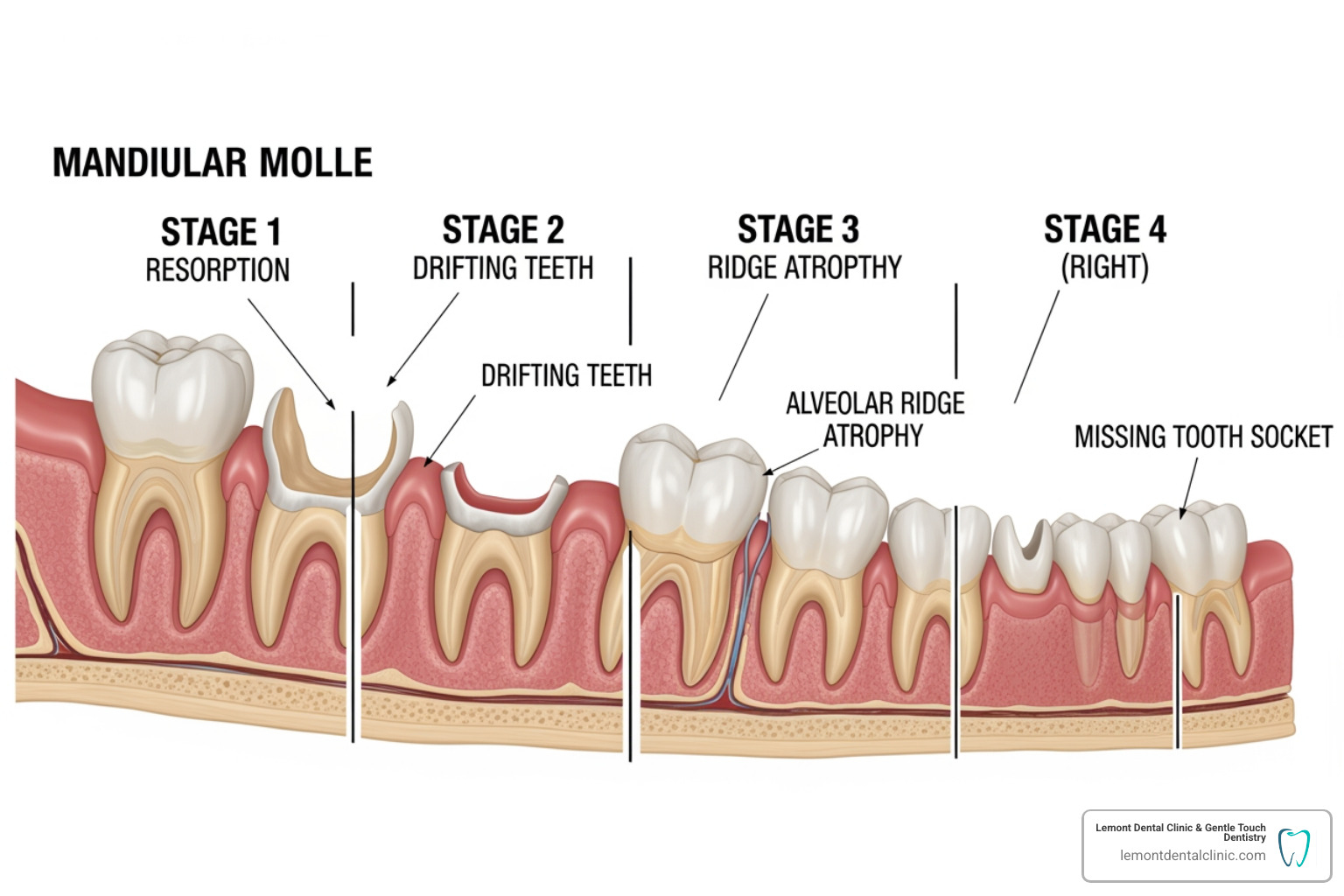
The biggest issue is jawbone resorption. Your tooth roots stimulate the jawbone, signaling your body to keep it strong. Without that stimulation, your body reabsorbs the bone. You can lose up to 25% of bone mass in the first year and roughly 40% within a few years. This deterioration happens silently, weakening the foundation for neighboring teeth and making future tooth replacement more complicated. For more information on what happens after an extraction, visit our page on Tooth Extraction.
How a Missing Tooth Affects Your Other Teeth
As the jawbone weakens, your remaining teeth begin shifting into the empty space. Without a neighbor to hold them in place, they drift and tilt. This creates new gaps that become food traps, increasing your risk of decay and gum disease. This shifting also leads to bite misalignment (malocclusion), causing uneven pressure that can wear down, chip, or crack your other teeth. To learn more about protecting your remaining teeth, explore options like Crowns and Bridges.
For a comprehensive look at these consequences, explore this overview from the National Institute of Dental and Craniofacial Research: Tooth Loss.
Other long-term consequences include:
Facial Structure Changes: Bone loss can create a sunken appearance around the mouth, making you look older.
Chewing and Speech Difficulties: A compromised bite can make eating difficult and may cause a lisp or slur.
TMJ Disorders: An unbalanced bite can strain your jaw joint, leading to pain and headaches.
Psychological Impact: A gap in your smile can harm your confidence in social and professional settings.
It’s Not Too Late: Getting Dental Implants After Bone Loss
If you’ve had a missing tooth for years, you might assume it’s too late for a dental implant. The great news is: it’s absolutely not too late. Modern dentistry has proven solutions for patients who have experienced significant bone loss.
Can I get an implant if I’ve had a missing tooth for years?
Yes, you can. The length of time a tooth has been missing doesn’t automatically disqualify you. What matters is the current condition of your jawbone and overall oral health. At Lemont Dental Clinic & Gentle Touch Dentistry, we start with a comprehensive dental consultation and advanced 3D imaging (CBCT scan). This gives us a precise, three-dimensional picture of your jaw, allowing us to assess bone density and plan your treatment accurately.
If you have active gum disease or other health concerns, we’ll address those first to create the optimal conditions for implant success. The health benefits of replacing a long-missing tooth are significant, as detailed in our guide on More info about Dental Implants Health Benefits.
What is Bone Grafting and When is it Necessary?
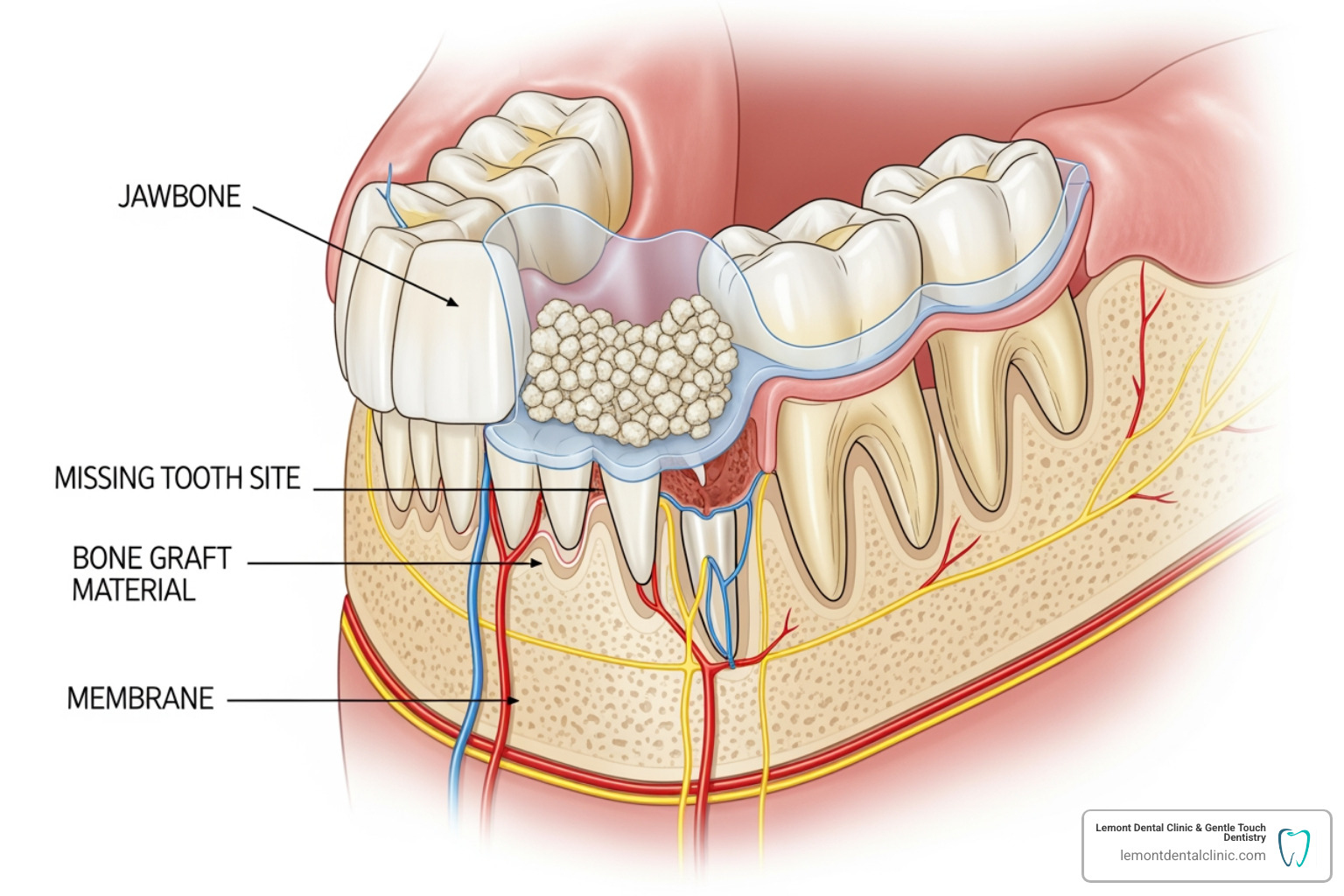
If the 3D scan shows you’ve lost too much bone to support an implant, bone grafting is the solution. This procedure rebuilds your jaw’s foundation. We place bone graft material into the deteriorated area, which acts as a scaffold for your body to grow new, natural bone. This process typically takes several months.
Bone grafting is necessary whenever there isn’t enough bone to securely anchor a Dental Implant. It turns a potential “no” into a confident “yes,” creating the strong foundation needed for long-term success.
Comparing Your Options: Why Implants Excel for Long-Term Health
When you have a missing tooth for years, you have several restoration options. While they all fill the gap, they have very different effects on your long-term oral health, especially your jawbone. The table below shows a clear comparison.
Poor. Does not stimulate bone, leading to continued bone loss.
Poor. Rests on gums, accelerating bone loss.
Longevity
Excellent. Often lasts a lifetime with proper care.
Good. Typically 5-15 years.
Fair. Typically 5-10 years.
Impact on Adjacent Teeth
None. Standalone, preserving natural teeth.
Negative. Requires grinding down healthy adjacent teeth.
Variable. Can put stress on supporting teeth.
Feel & Function
Most Natural. Mimics natural tooth root, stable.
Good. Fixed in place, good chewing ability.
Least Natural. Can slip, reduced chewing power.
Maintenance
Easy. Like natural teeth: brush and floss.
Moderate. Requires special cleaning under the bridge.
High. Daily removal and cleaning.
Dental Implants: The Gold Standard for Bone Health
Dental implants are the gold standard because they replace the entire tooth structure, including the root. A titanium post is placed in the jawbone and fuses with it through a process called osseointegration. This integrated post stimulates the jawbone just like a natural root, preventing future bone loss and preserving your facial structure. Patients report that implants look, feel, and function just like natural teeth. For those missing multiple teeth, More info about Implant Dentures offer the same bone-preserving benefits.
Bridges and Dentures: Understanding the Limitations
Bridges and dentures are effective at replacing the visible tooth, but they cannot stop underlying bone loss.
Dental Bridges require grinding down healthy adjacent teeth to support the bridge. The jawbone beneath the artificial tooth receives no stimulation and continues to deteriorate. For a detailed comparison, see More info about Dental Implants vs Bridge.
Dentures rest on the gums and can actually accelerate bone loss over time. This leads to a loose fit, requiring frequent adjustments and replacements. We offer various More info about Types of Dentures and Cost, but it’s crucial to understand this limitation.
Only dental implants address the root cause of bone loss, making them the superior choice for long-term health.
The Step-by-Step Guide to Getting an Implant After Years
If you’ve had a missing tooth for years, the process to get a dental implant is a journey with several key stages. At Lemont Dental Clinic & Gentle Touch Dentistry, we guide you through every step.
Initial Consultation & 3D Imaging: We start with a thorough assessment of your oral health and use a CBCT scan to get a precise 3D image of your jawbone. This reveals the extent of any bone loss and allows for accurate planning.
Bone Grafting (If Needed): If bone loss is significant, this procedure rebuilds the jaw’s foundation. It involves a healing period of 3 to 9 months as your body generates new bone.
Implant Placement: The small, titanium implant post is surgically placed into your healed jawbone.
Osseointegration: Over the next 3 to 6 months, the implant fuses with your jawbone, creating a solid, permanent anchor.
Abutment Placement: A small connector piece, the abutment, is attached to the implant to hold the new crown.
Final Crown Restoration: A custom-made crown, matched to your natural teeth, is secured to the abutment, completing your new tooth.
How long does the process take with a missing tooth for years?
The timeline varies. For a patient with healthy bone, the process from implant placement to final crown typically takes a few months. However, if you’ve had a missing tooth for years, bone grafting is likely necessary. This adds 3 to 9 months of healing time to the beginning of the process.
In total, a patient needing a bone graft can expect the entire journey to take from nine months to over a year. Factors like the extent of bone loss, your individual healing rate, and overall health influence the exact duration. While faster options exist, such as More info about Same Day Dental Implants Near Me, they are not suitable for cases with significant bone loss. Taking the time to build a proper foundation is crucial for a successful, long-lasting result.
Frequently Asked Questions about Replacing Long-Missing Teeth
It’s natural to have questions when considering an implant for a tooth that’s been missing for years. Here are some clear, honest answers to common concerns.
How much discomfort is involved with bone grafting and implant surgery?
Most patients are surprised by how manageable the process is. We use effective local anesthesia during the procedure, and sedation options are available for anxious patients. Post-operative soreness is normal and can typically be managed with over-the-counter pain relievers. Discomfort usually peaks in the first 48 hours and subsides within a few days.
Will a dental implant look and feel like a natural tooth?
Yes, absolutely. Your custom-made crown is carefully designed to match the color and shape of your natural teeth for a seamless blend. Because the implant is anchored in your jawbone, it feels secure and stable, restoring chewing function that is remarkably close to a natural tooth. You can eat, speak, and smile with confidence. It’s a key part of our commitment to More info about Cosmetic Dentistry Lemont IL.
How do I care for my new dental implant?
Caring for your implant is simple: treat it like your natural teeth. Good daily oral hygiene, including brushing twice a day and flossing daily, is essential. It’s also critical to maintain regular dental check-ups. These visits allow us to monitor the implant, gums, and surrounding bone to ensure everything remains healthy. With proper care, your implant can last a lifetime. For general information on oral health, you can consult resources like this Information on Tooth Loss from Cleveland Clinic.
Restore Your Smile and Health, No Matter How Long It’s Been
Living with a missing tooth for years leads to escalating problems, from bone loss and shifting teeth to a loss of confidence. The domino effect is real, but we want to reiterate a powerful message: it’s not too late.
Modern dentistry, with solutions like dental implants and bone grafting, offers a path to restoration. At Lemont Dental Clinic & Gentle Touch Dentistry, we have the technology and expertise to create a personalized plan for you. Acting now halts further damage, restores function, and reclaims your confident smile.
We are proud to serve the communities of Lemont and Palos Hills, IL, with high-quality, comprehensive dental care. Our team is dedicated to providing all-in-one treatment in a comfortable environment.
Don’t let the years of a missing tooth deter you. Taking the first step is the most important part of your journey.